A 1946 Tokyo Optical collapsible 50mm f/3.5 for the coupled Leotax Special, identified by State engraving, nickel finish and an old-style f/18 scale.
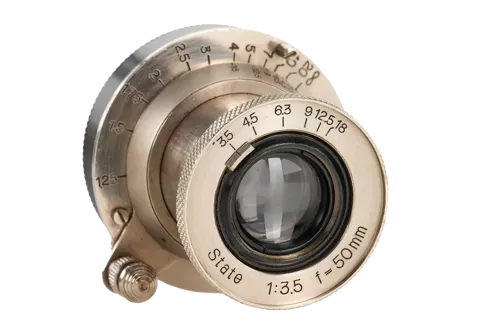
Tokyo Kogaku State 50mm f/3.5 (Collapsible)
LTM mount
No listings tracked for this lens right now.
The Tokyo Kogaku State 50mm f/3.5 (Collapsible) is a LTM-mount lens for Leica rangefinder cameras. Leica price index →
How it compares
Measured against the 108 other 50mm LTM-mount lenses in the catalogue.
Specification
About this lens
Tokyo Kogaku State 50mm f/3.5 (Collapsible)
The Tokyo Kogaku State 50mm f/3.5 is an early post-war collapsible standard lens associated with the Leotax Special of 1946. It was made by Tokyo Optical, later known for the Topcor name, and belongs to the first documented sequence of Tokyo Optical normal lenses supplied for Leotax rangefinder cameras. The State is a native Leica-standard screw-mount photographic lens, not an enlarging lens that merely shares a 39mm thread.
Its compact metal barrel follows the familiar collapsible arrangement used on contemporary Leica-type cameras. The optical tube is extended and locked for photography, then released and withdrawn for storage. Documented State examples have nickel-finished barrels, a focal-length engraving in millimetres and the older aperture sequence ending at f/18. Aperture control is by a small front ring or tab, while focusing is performed by the lens helicoid. Its use as a standard lens on the coupled Leotax Special places it within the rangefinder-coupled LTM system.
The optical construction is not stated as settled fact here. Specialist sources disagree over whether the State is a three-element lens or a four-element, three-group Elmar-type design. Its close external resemblance to a Leitz Elmar does not by itself establish the formula. Reliable figures for minimum focus, diaphragm blade count and filter fitting of this exact State generation are likewise too limited to present as universal specifications.
On Leica-standard screw-mount bodies, the lens provides the normal 50mm field of view for which contemporary Leotax finders were designed. It can also be mounted on Leica M cameras with a suitable LTM-to-M adapter. Because the barrel collapses behind the mount, clearance must be checked before retracting it on any adapted digital body.
Optical qualities
Rendering
Dependable performance testing for the exact State 50mm f/3.5 is limited. Available historical and collector sources establish its physical identity and its place in the Leotax system, but they do not provide controlled evidence from which specific claims about sharpness, contrast, bokeh or aberration correction can be made. Descriptions of generic Elmar rendering should not be transferred to this lens while its optical formula remains disputed.
The absence of a C prefix is also not sufficient on its own to define the coating status of every surviving State lens. Later C.Simlar documentation explicitly explains C as coated, but accessible sources do not establish a single coating specification for the complete State production. Condition, internal haze, cleaning marks and mechanical alignment can have a substantial effect on any individual lens of this age.
Digital use
Mirrorless adaptation makes accurate focusing possible through magnification, but it does not resolve the historical specification gaps. The retractable tube is the main practical concern. It should remain extended unless safe internal clearance has been confirmed for the particular camera and adapter combination.
History
Development and Launch
The State appeared in the immediate post-war rebuilding period of the Japanese camera industry. Leotax collector research associates it with the 1946 Leotax Special, a Leica-style 35mm camera derived from the earlier Special A. Tokyo Optical supplied the 50mm f/3.5 lens while Showa Kogaku produced the camera. A period advertisement discussed in specialist research also connects the State name with early post-war Leotax production, although the exact dating of the illustrated camera is not entirely clear.
The lens is important as an early point in the relationship between Leotax and Tokyo Optical. That relationship continued through the Simlar, C.Simlar and later Topcor names. The State should therefore be treated as its own engraved early identity, not simply relabelled as a later Simlar.
Production Evolution
The documented sequence moves from State to early Simlar and coated C.Simlar collapsible 50mm f/3.5 lenses. All three early forms are recorded with the older aperture scale ending at f/18 and with 50mm focal-length engraving. Around the introduction of the Leotax D IV in 1951, the C prefix was dropped from the coated collapsible Simlar, the minimum aperture changed to f/16, the rational aperture scale was adopted and the focal length was engraved as 5cm.
Those later changes help identify the State as an earlier generation, but they do not prove that every lens in the sequence shared an unchanged optical formula. Until a factory diagram or documented disassembly resolves the disagreement, the State element and group count should remain unknown.
Special Editions/Variants
Nickel-finished State lenses with the Tokyo Optical Co. engraving are documented. No separate factory special edition has been reliably established. Finish variation, normal engraving differences or an association with a particular surviving camera should not be promoted to a separate profile without stronger production evidence.
Collector Notes
The State name, 50mm notation, f/18 endpoint and collapsible nickel barrel are the principal identification points. These features distinguish it from the later f/16, 5cm Simlar and from C.Simlar lenses carrying an explicit coating prefix. Collectors should also distinguish the original Leica-standard photographic mount from unrelated 39mm applications and inspect the rangefinder cam, extension lock and collapsing tube for correct operation.
The disputed optical formula is a reason for caution, not a reason to choose whichever specification appears most often online. The lens should be catalogued from its documented factory identity while leaving unresolved technical fields unknown.
Sources
Where to buy
Related lenses
Similar lenses you might be interested in
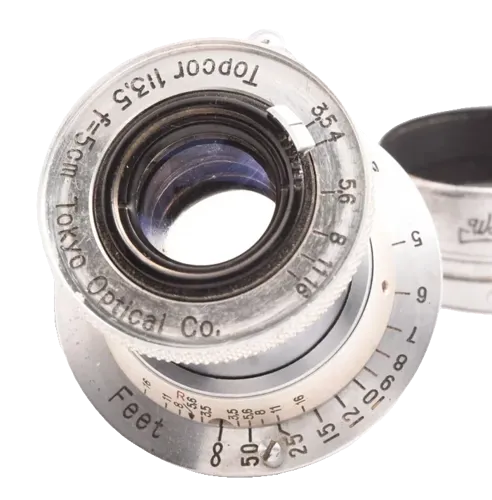
Topcor 50mm f/3.5 ELMAR
Topcor 50mm f/3.5 TESSAR
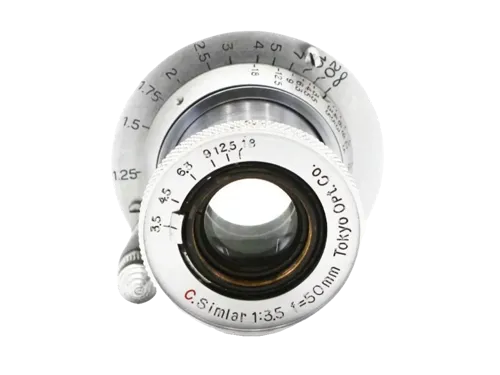
C Simlar 50mm f/3.5 (Collapsible)
Simlar 50mm f/3.5 (Collapsible)
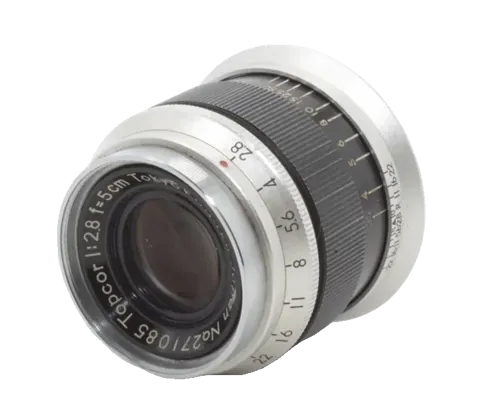
Topcor 50mm f/2.8
Comments