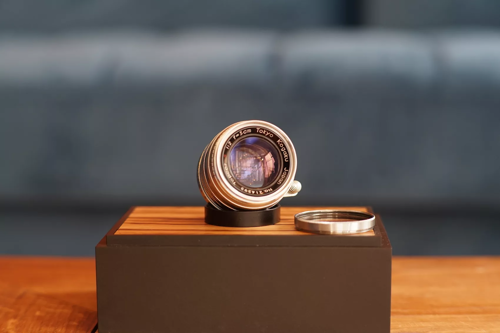
The Tokyo Kogaku Topcor 50mm f/3.5, a four-element LTM screw-mount Elmar-type standard lens for Leotax and other M39 bodies, prized by Topcor collectors.
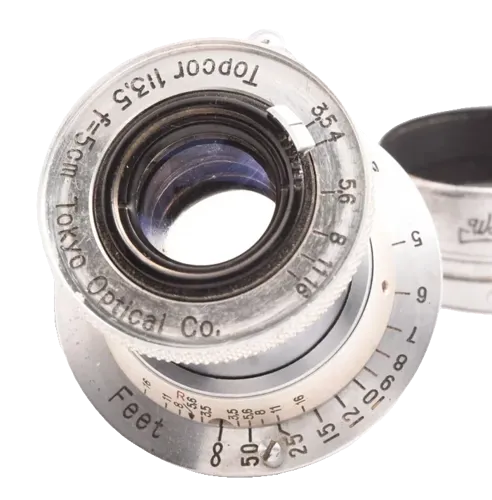
Tokyo Kogaku Topcor 50mm f/3.5 ELMAR
LTM mount
No listings tracked for this lens right now.
The Tokyo Kogaku Topcor 50mm f/3.5 ELMAR is a LTM-mount lens for Leica rangefinder cameras. Leica price index →
How it compares
Measured against the 108 other 50mm LTM-mount lenses in the catalogue.
Specification
About this lens
Tokyo Kogaku Topcor 50mm f/3.5 ELMAR
Among the standard lenses Tokyo Kogaku produced in Leica screw mount, the 50mm f/3.5 is the most modest and least common of the company's Topcor 5cm options, a compact four-element design that sits below the better-known f/2, f/1.8 and f/1.5 Topcors in the lineup. The maker, Tokyo Kogaku (Tokyo Optical Co.), built these lenses chiefly for use on Leotax rangefinder cameras and other 39mm screw-mount bodies, and the line has long been a focus for collectors who pair the various Topcor focal lengths with Leotax bodies [1][2][3]. Documentation specific to the f/3.5 version is sparse, and even longtime Topcor collectors note that little information circulates about it.
Optically the lens uses four elements in three groups, the classic Tessar-type layout that the slow-aperture "Elmar" naming evokes, and it carries a small 34mm filter thread in keeping with its compact dimensions. The diaphragm uses ten blades, and focusing reaches to about 1.07m. It mounts in the 39mm Leica thread (LTM/M39), so it fits screw-mount Leica bodies and copies as well as the Leotax cameras it was sold alongside, although it is not rangefinder-coupled. Production began around 1955; surviving examples carry the silver chrome finish typical of the era. The lens is light and small, weighing only a few ounces, consistent with its short barrel and modest maximum aperture.
At least two barrel styles are reported by collectors, including a rigid version with a fluted focusing barrel; collapsible Elmar-type 50mm lenses were common in this class, but the documented Topcor f/3.5 examples described in detail are of the rigid fluted type. Because reliable published data on this particular lens is limited, identification rests mainly on the engraving (Topcor or Tokyo Kogaku, marked in either 5cm or 50mm), the 39mm screw mount, and the f/3.5 maximum aperture.
Optical qualities
Rendering Detailed published testing of the f/3.5 Topcor is scarce. The most concrete user account comes from a collector who found a rigid fluted-barrel example to render with notable sharpness and contrast in early use, consistent with the reputation Topcor lenses generally hold among rangefinder users. As a four-element Tessar-type design at a slow maximum aperture, it would be expected to perform well stopped down across the frame, but firm, widely corroborated data on its bokeh, flare behavior, distortion and vignetting is not available, so those characteristics are best treated as undocumented rather than assumed.
History
Development and Launch Tokyo Kogaku marketed its Topcor screw-mount lenses primarily for Leotax rangefinder cameras, building a family of 5cm optics that ranged from the fast f/1.5 and f/1.8 down to slower, more affordable options, alongside wide and telephoto focal lengths such as the 3.5cm f/2.8, 9cm f/3.5 and 13.5cm f/3.5. The 50mm f/3.5 occupied the entry level of the 5cm group. Tokyo Kogaku's screw-mount lenses are listed among the Japanese makers who produced 39mm-thread optics in this period, the company also being associated with the State and Simlar names in Leica screw mount.
Special editions No widely documented factory special editions of the 50mm f/3.5 are recorded in the consulted sources. Collectors do note distinctive variants elsewhere in the Topcor 5cm range, such as a black-finish f/2 and a "Panda" version of the f/2, but no comparable special factory variants of the f/3.5 are established in available references.
Collector Notes The f/3.5 is among the scarcer Topcor 5cm screw-mount lenses, and prices for the rarer Topcor optics have risen sharply over time, so condition and originality matter when buying. Buyers should confirm the engraving and the 39mm screw mount, check for haze or cleaning marks common to lenses of this age, and verify smooth focusing on rigid fluted-barrel examples. As the lens is not rangefinder-coupled, it cannot be focused via a body rangefinder and is best used by scale or on a mirrorless camera with an adapter. Reliable reference data on this specific model is limited, so verifying the maker's markings against the seller's photos is the most dependable identification check.
Sources
Where to buy
Related lenses
Similar lenses you might be interested in
Topcor 50mm f/3.5 TESSAR
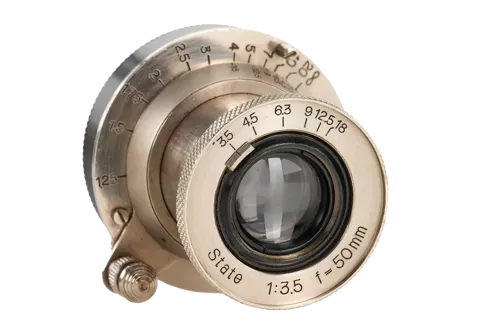
State 50mm f/3.5 (Collapsible)
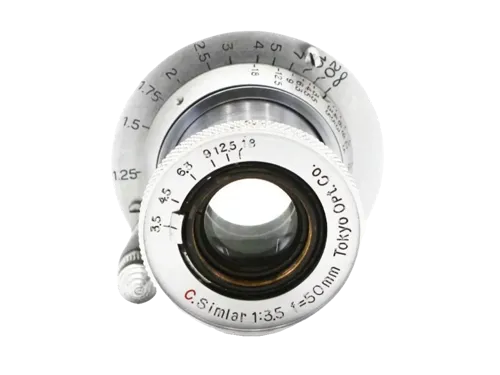
C Simlar 50mm f/3.5 (Collapsible)
Simlar 50mm f/3.5 (Collapsible)
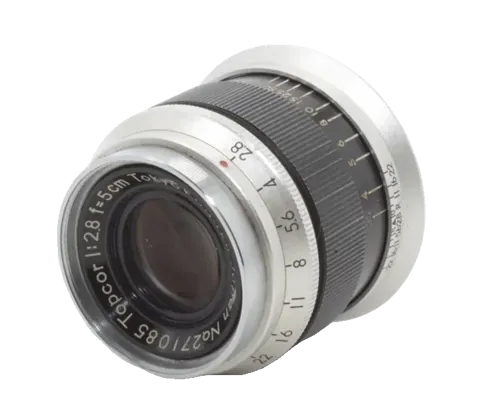
Topcor 50mm f/2.8
Comments