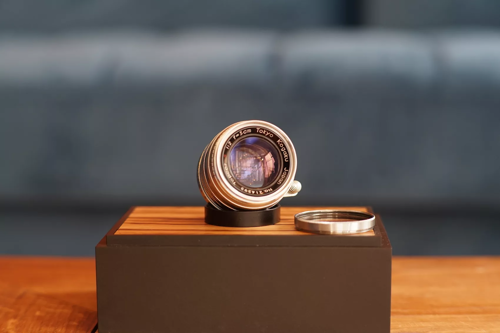
Tokyo Kogaku's Topcor 50mm f/3.5 is a coated four-element Tessar in Leica screw mount, a scarce Leotax-era standard lens prized by collectors.
Tokyo Kogaku Topcor 50mm f/3.5 TESSAR
LTM mount
No listings tracked for this lens right now.
The Tokyo Kogaku Topcor 50mm f/3.5 TESSAR is a LTM-mount lens for Leica rangefinder cameras. Leica price index →
How it compares
Measured against the 108 other 50mm LTM-mount lenses in the catalogue.
Specification
About this lens
Tokyo Kogaku Topcor 50mm f/3.5 TESSAR
Among the standard lenses Tokyo Kogaku produced in Leica screw mount, the 50mm f/3.5 is the modest, classically configured option, a coated four-element Tessar type sold most often as a companion to Japanese Leica-style rangefinders rather than as a stand-alone product. Tokyo Optical Company, founded in 1932, was one of Japan's established optical makers, and it adopted the Topcor lens name in 1954, soon replacing its earlier State, Toko and Simlar designations [1][3]. The 5cm f/3.5 sits at the entry point of the company's screw-mount normal lenses, below the faster f/2.8, f/2 and f/1.5 Topcors that the firm also offered [2].
The optical layout is the familiar Tessar arrangement of four elements in three groups, the same formula used by the Zeiss Tessar and the Leitz Elmar that defined the compact standard lens for decades. The barrel is all chrome, a 50mm normal lens with a small front and a 36mm filter thread, and it is built to a high mechanical standard with a smoothly clicking ten-blade diaphragm. As an LTM lens it threads onto 39mm screw-mount bodies, and although it carries no separate rangefinder cam of its own, it relies on the standard screw-mount focusing helical for use on coupled rangefinder cameras of the period. These lenses were a common pairing with Leotax bodies and also appear on other Japanese Leica copies such as Nicca.
Documentation specific to this lens is limited, and most surviving information comes from collector compendiums and the screw-mount finder community rather than from a formal manufacturer archive. Collectors record both a collapsible version and a rigid-barrel variant of the 50mm f/3.5 Topcor, the latter sometimes noted with an aluminum barrel, though detailed production data is sparse. Because the lenses were typically distributed with cameras rather than separately, exact production figures are not well established [4].
Optical qualities
Rendering Reports on the 50mm f/3.5 Topcor are consistent if not numerous. As a coated Tessar of the 1950s it is described as performing on a par with, and by some accounts slightly ahead of, a good Zeiss Tessar or a Leitz Elmar of the same speed. One experienced collector found a collapsible 50mm f/3.5 Topcor to edge out a prized red-scale Leitz Elmar for sharpness at the widest apertures while matching its smooth, rounded rendition and pleasant bokeh, and noted that the rigid aluminum-barrel version performs similarly. As with most Tessar designs of the era, expectations should be set to a slow, contrasty, sharp-centered standard lens rather than to a fast lens with strong subject isolation.
History
Development and Launch The Topcor name dates to 1954, when it began to supplant Tokyo Kogaku's older lens labels, and the screw-mount normal lenses followed the chronological progression from State to C Simlar, Simlar, Topcor and Topcor S. After the Second World War the company turned its optical work toward Leica Thread Mount lenses for Leotax cameras before it launched its own Exakta-mount SLR, the Topcon R, in 1957. The 50mm f/3.5 belongs to this rangefinder-lens chapter of the firm's history.
Production Evolution Within the screw-mount line the 50mm f/3.5 is documented in more than one form, including a collapsible mount and a rigid barrel, with the rigid version associated with an aluminum barrel. Coated optics are standard for these examples. Because the lenses were generally sold alongside cameras, serial-number tracking and precise dating are difficult, and surviving production information is fragmentary.
Special editions No widely documented military, export or special factory variants of the 50mm f/3.5 Topcor are recorded beyond the collapsible and rigid barrel forms noted by collectors.
Collector Notes These lenses are uncommon and are most often encountered today as separated optics or still mounted on Leotax and similar bodies. As with any chrome lens of this age, the points worth checking before purchase are internal haze, cleaning marks on the glass and the smoothness of the focusing helical; examples that have had a competent clean, lubricate and adjust are commonly offered and tend to function well even after decades [5]. Buyers should confirm the lens is the f/3.5 Tessar rather than one of the faster Topcor normals, which differ in optical formula and value.
Sources
- Camera-wiki.org. Tōkyō Kōgaku lenses in Leica screw mountcamera-wiki.org →
- Rangefinderforum. The Topcon Lens Saga: Optical Excellence, Mediocre Marketingrangefinderforum.com →
- Camera-wiki.org. Tōkyō Kōgakucamera-wiki.org →
- Mike Eckman. Topcon R (1957)mikeeckman.com →
- PicClick. Tokyo Kogaku Topcor lens 5cm 50mm f/3.5 Leica 39mm Leica Screw Mount CLAdpicclick.com →
Where to buy
Related lenses
Similar lenses you might be interested in
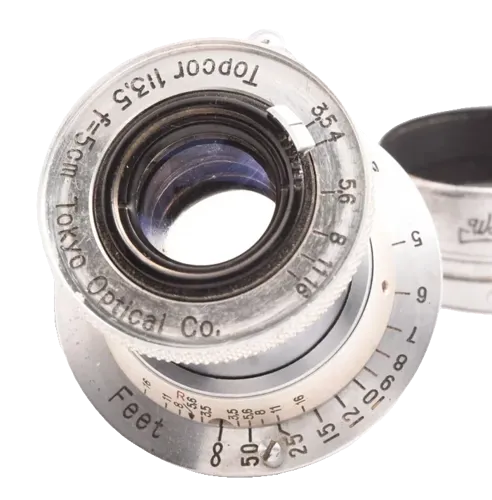
Topcor 50mm f/3.5 ELMAR
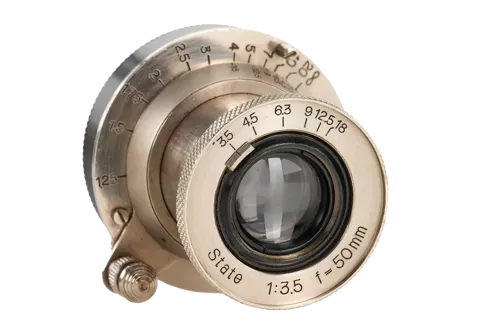
State 50mm f/3.5 (Collapsible)
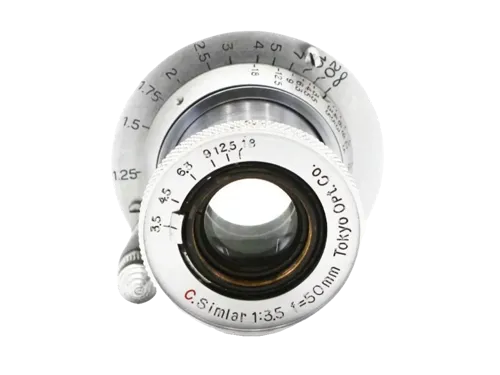
C Simlar 50mm f/3.5 (Collapsible)
Simlar 50mm f/3.5 (Collapsible)
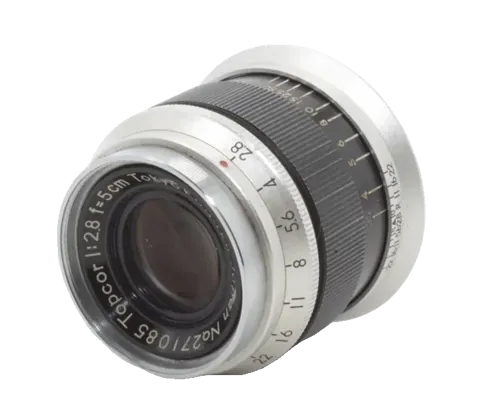
Topcor 50mm f/2.8
Comments