Tokyo Kogaku's Topcor S "Panda" is a 50mm f/2 LTM rangefinder lens, a sought-after double-Gauss Leotax normal prized by Leica screw-mount collectors.
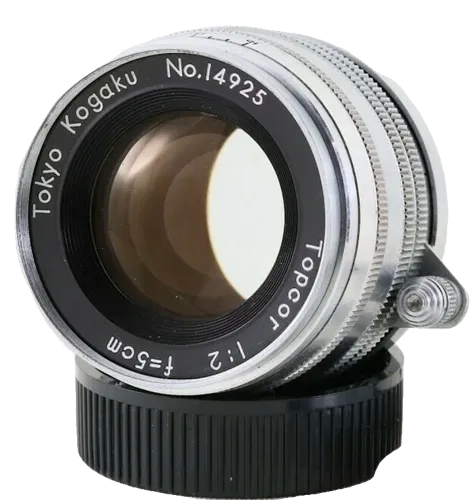
Tokyo Kogaku Topcor S "Panda"
LTM mount
No listings tracked for this lens right now.
The Tokyo Kogaku Topcor S "Panda" is a LTM-mount lens for Leica rangefinder cameras. Leica price index →
How it compares
Measured against the 108 other 50mm LTM-mount lenses in the catalogue.
Specification
About this lens
Tokyo Kogaku Topcor S "Panda"
Among Japanese Leica thread-mount normals of the 1950s, the Topcor S 50mm f/2 stands out as much for its two-tone "Panda" livery as for its reputation, with some collectors describing it as the only double-Gauss lens of its type offered in screw mount [1]. It was built by Tokyo Kogaku Kikai K.K. (Tokyo Optical Company), a firm founded in Tokyo in 1932 that began making lenses in 1935, supplied optics to the Japanese military, and turned to Leica thread-mount lenses after the war under the names State, Simlar, C.Simlar and finally Topcor [2]. The "S" in Topcor S has been read as standing for "Special". The lens reached photographers as the standard optic on the Leotax rangefinder cameras rather than as a separately boxed product, which is one reason clean, body-free examples are uncommon today.
The optical design is a six-element, four-group double-Gauss arrangement, and this formula was carried unchanged across the barrel revisions of the f/2. The lens uses a ten-bladed diaphragm and a 40.5 mm filter thread, focuses by a coupled helicoid down to 1 m, and is built to a heavy, all-metal standard that owners frequently compare favourably with contemporary Nikkor, Canon and Leitz screw-mount lenses. Handling differs by version: the earlier barrels rotate through a long throw for the full focus range and carry one-third-stop aperture markings, while the later straight barrel has a much shorter throw, a focusing tab, and full-stop click detents, giving quicker operation on a rangefinder body. As a Leica thread-mount lens it mounts on M39 bodies and, via an adapter, on M-mount and mirrorless cameras; it is rangefinder coupled on the screw-mount cameras for which it was made.
Several variants are documented. A plain Topcor 5cm f/2 (without the "S") appeared around 1956 with a different six-element, five-group design and should not be confused with the later lens. The Topcor S itself was offered first in full chrome and then in the chrome-and-black "Panda" finish, followed by a black aluminium-barrel version. Published accounts of the exact sequence and dating vary, with one collector source placing the chrome Topcor S in 1957, the panda update in 1958 and a black version the same year. A later black Topcor S 5cm f/1.8, introduced with the Leotax G around 1961, shares the same six-element, four-group layout, ten blades and 40.5 mm filter but has visibly different front elements; it is rarer and more costly than the f/2.
Optical qualities
Rendering The Topcor S is regularly praised as one of the better pre- and early-Summicron-era 50mm screw-mount lenses, with users rating it at least the equal of period Summicrons in build and image quality. Its rendering combines a relatively modern, high-contrast look with a gentle "swirl" in out-of-focus areas associated with the double-Gauss design, most visible against busy or leafy backgrounds.
Sharpness Centre sharpness is usable from f/2 and improves noticeably by f/2.8, becoming excellent by f/4. A mid-zone dip is reported wide open, so off-centre detail benefits from stopping down, with strong corner results from about f/5.6 onward.
Contrast and color Contrast is high even wide open for a lens of its age, and the colour rendering is well regarded; comparisons against a modern aspherical Summicron describe the Topcor as slightly less contrasty but pleasing, with backgrounds that are less harsh.
Flare resistance The lens is coated and controls flare reasonably for its era, but with the sun just outside the frame it can lose some contrast, and a light source within the frame can produce ghosting.
Distortion and vignetting Distortion is described as virtually absent. Vignetting is visible at f/2 and improves markedly by f/2.8.
Aberrations A slight focus shift toward the rear is noted on stopping down to around f/4, worth keeping in mind when focusing wide open on a rangefinder, though it is small enough to rarely cause problems in practice.
Digital use On mirrorless cameras with an adapter the lens performs well, and one reviewer reports clean results using an autofocus adapter, with the characteristic swirl and high contrast preserved.
History
Development and Launch Tokyo Kogaku, established in 1932 and producing lenses from 1935, moved into Leica thread-mount optics after the Second World War, evolving its branding from State and Simlar to Topcor. The Topcor S 50mm f/2 served as a standard lens for the Leotax line of Barnack-style rangefinders built by another Japanese maker, Leotax, and was sold on bodies such as the F, T, K, FV, TV2 and T-2L from the mid-1950s into the early 1960s rather than as a stand-alone lens. One account links the design lineage to a 44mm f/2 lens used in the fixed-lens Topcon 35-S.
Production Evolution Across its life the f/2 retained its six-element, four-group optical formula, ten-blade diaphragm and 40.5 mm filter thread while the barrel changed. Early lenses were chrome with a long focus throw and third-stop aperture engravings; the later straight barrel adopted a short focus throw, a focus tab and full-stop clicks for faster handling. The chrome-and-black "Panda" finish and a black aluminium-barrel version followed, with sources differing on precise dates.
Special editions No major factory special editions of the Topcor S 50mm f/2 are widely documented beyond the recognised chrome, panda and black-barrel finishes and the related, separately introduced f/1.8 lens.
Collector Notes Total production numbers are not firmly established and clean examples are scarce, partly because so many lenses remain attached to Leotax bodies. Because the design was reused, the plain non-"S" Topcor 5cm f/2 and the later f/1.8 can be confused with the Topcor S, so checking the engraving and front element layout helps confirm identity. Condition is the main concern: haze can erode the high contrast that distinguishes the lens, and fungus is common in examples stored in humid conditions, so the glass should be inspected carefully before purchase. The two-piece construction, an optical block joined to the focusing block by a rear retaining ring, means a loose optical unit can sometimes be re-tightened rather than treated as a fault.
Sources
Where to buy
Related lenses
Similar lenses you might be interested in

Comments