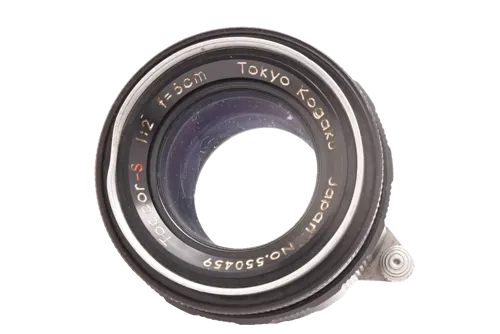
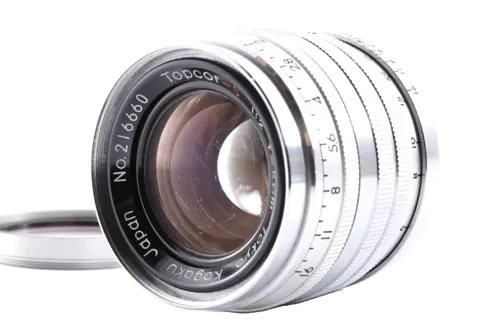
The Tokyo Kogaku Topcor 50mm f/1.5 is a fast LTM rangefinder standard lens from Japan's Topcon maker, prized by collectors of vintage screw-mount optics.
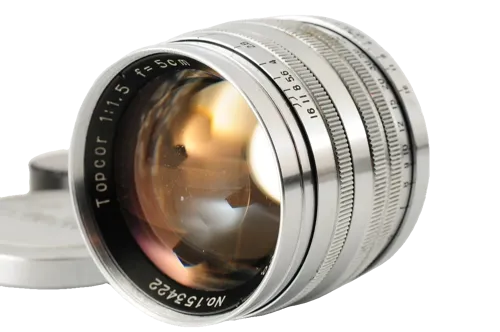
Tokyo Kogaku Topcor 50mm f/1.5
LTM mount
No listings tracked for this lens right now.
The Tokyo Kogaku Topcor 50mm f/1.5 is a LTM-mount lens for Leica rangefinder cameras. Leica price index →
How it compares
Measured against the 108 other 50mm LTM-mount lenses in the catalogue.
Specification
About this lens
Tokyo Kogaku Topcor 50mm f/1.5
This fast standard lens comes from Tokyo Kogaku, the Japanese optical firm better known today as Topcon, and belongs to the family of Leica thread mount lenses the company built during the 1950s for screw-mount rangefinders such as the Leotax [1][2]. Tokyo Kogaku had a long history as a precision optics supplier, originally founded in 1932 and tied to the Hattori (Seiko) group, and after the Second World War it broadened from military and third-party work into consumer photographic lenses, including Leica thread mount designs. The screw-mount Topcors and the earlier Simlar line that preceded them are the company's rangefinder-era optics, and they sit apart from the later Exakta-bayonet and RE-bayonet SLR Topcor lenses that made the brand famous. With a maximum aperture of f/1.5, this 50mm is among the faster offerings in that early lineup.
The optical design uses seven elements in four groups, a configuration consistent with the fast Sonnar-derived standard lenses of the era, paired with a twelve-blade diaphragm that gives a near-circular aperture opening. The lens is built in Leica thread mount (M39 / LTM) and weighs about 315 grams, with a 40mm filter thread and a minimum focusing distance of roughly 1.07 metres. LeicaLensList records this example as not rangefinder coupled, so focusing should be confirmed against the body in use rather than assumed; many LTM lenses of this period were coupled, and an uncoupled example would require care when mounting on a coupled rangefinder. The lens carries no six-bit coding, which is expected for a vintage screw-mount optic of this age.
Detailed, lens-specific documentation for this particular 50mm f/1.5 is limited compared with the company's later SLR lenses, and much of what is written about Tokyo Kogaku's rangefinder optics treats the Simlar and Topcor screw-mount lenses as a group rather than model by model. Buyers should therefore rely on direct inspection and reputable references when verifying a specific example.
Optical qualities
Rendering Dedicated, repeatable test data for this exact lens is scarce, so claims about its rendering should be treated cautiously. In the broader collector literature, Tokyo Kogaku's vintage lenses, including the early screw-mount Simlars and Topcors, are generally regarded as strong performers that can match or occasionally surpass their contemporaries from other makers, though the most extravagant praise is usually reserved for later SLR designs such as the 58mm f/1.4 RE Auto-Topcor. As a fast 1950s standard lens, an f/1.5 design of this type would be expected to render with lower contrast and softer edges wide open, sharpening and gaining contrast as it is stopped down, but specific behavior will vary with the individual sample and its coating condition.
History
Development and Launch Tokyo Kogaku Kikai K.K., the Tokyo Optical Company, traces its origins to 1932 and spent its early years as a supplier of optics to the Imperial Japanese Army, following a path broadly parallel to that of Nippon Kogaku, the future Nikon. After the war, the firm expanded its catalogue toward consumer photographic products and produced lenses in the Leica thread mount, supplied for screw-mount rangefinders including the Leotax. The 50mm f/1.5 Topcor belongs to this rangefinder chapter of the company's output, before Tokyo Kogaku committed to its own 35mm SLR system beginning with the Topcon R in the late 1950s.
Special editions No widely documented military, export, or special factory variants of this screw-mount 50mm f/1.5 are established in the accessible references. The screw-mount Topcors are generally discussed alongside the earlier Simlar lenses as part of Tokyo Kogaku's rangefinder-era production rather than as a series with separately catalogued editions.
Collector Notes Vintage Topcor lenses retain a following among collectors of Japanese optics, and prices for the brand's lenses have remained healthy in the used market. Because dedicated documentation for this specific model is thin, prospective buyers should verify the mount and focusing behavior, check the glass for haze, fungus, separation, and coating wear that are common in lenses of this age, and confirm that engravings and finish are consistent with an original example. Beware confusion with the later SLR Topcor lenses, which share the brand name but use entirely different mounts; note also that Cosina later produced a modern Topcon-styled lens marked Tokyo Kogaku, which is unrelated to the vintage screw-mount optics.
Sources
Where to buy
Related lenses
Similar lenses you might be interested in

Comments