The Tokyo Kogaku Topcor 50mm f/2 is a six-element double-Gauss LTM standard lens supplied with Leotax rangefinders, prized by collectors for its sharpness.
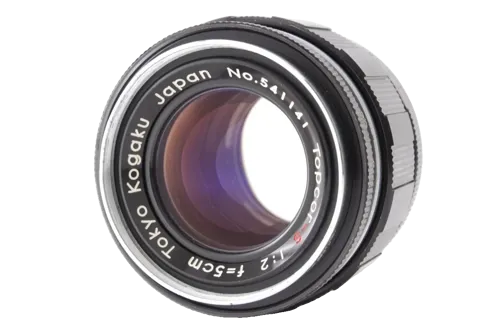
Tokyo Kogaku Topcor 50mm f/2
LTM mount
No listings tracked for this lens right now.
The Tokyo Kogaku Topcor 50mm f/2 is a LTM-mount lens for Leica rangefinder cameras. Leica price index →
How it compares
Measured against the 108 other 50mm LTM-mount lenses in the catalogue.
Specification
About this lens
Tokyo Kogaku Topcor 50mm f/2
The Topcor 50mm f/2 is a standard lens that reached most photographers not as a separate purchase but as the normal optic bolted to a Leotax rangefinder body. Built by Tokyo Kogaku (Tokyo Optical Company, later known as Topcon), it carries the reputation that surrounds the firm's early Leica thread mount glass: optically capable and tightly made, but produced in modest numbers, which is much of the reason collectors seek it today [1][2]. Tokyo Kogaku was established in Tokyo in 1932 and began making lenses in the mid 1930s, first supplying larger format and military optics before turning to Leica thread mount lenses after the war under a sequence of names that ran through State, Simlar and C.Simlar before settling on Topcor.
The lens uses a six-element double-Gauss layout, a Biotar-derived formula that places it firmly in the classic fast normal tradition rather than among the Sonnar types [3]. The aperture runs on ten blades with click stops down to f/16, and the barrel focuses by a lever without an infinity lock. It takes a small front filter and is a true M39 screw mount lens, so it threads onto Leica thread mount and compatible bodies; it does not have its own rangefinder coupling cam, relying instead on the host camera's mechanism for focus confirmation. Build quality is generally described as good and comparable to the contemporary Canon and Nikkor screw mount lenses of the period, with the earlier chrome examples machined in heavy chrome and the later barrels lightened in aluminium.
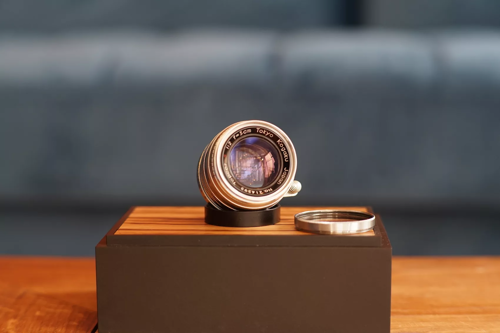
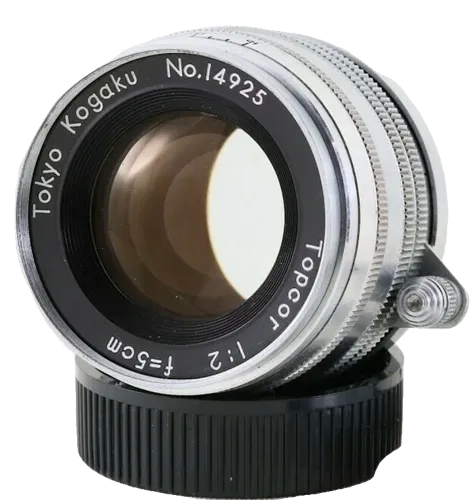
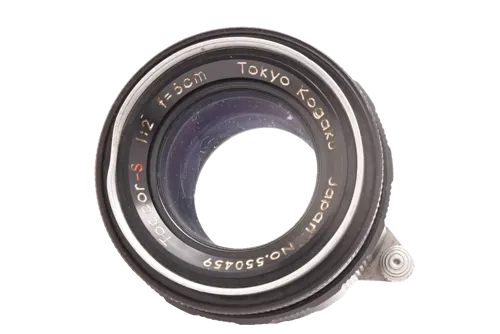
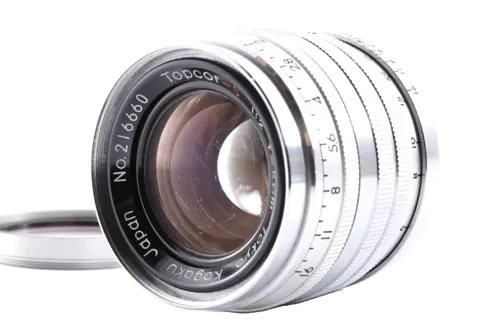
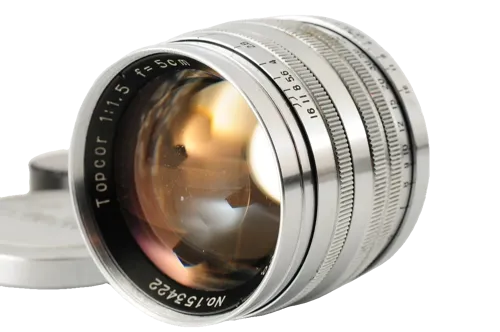
Several finish variations exist. Early production examples are chrome and marked simply "Topcor 5cm f/2" without the later S suffix, while later examples are black, and the placement and design of the controls differ enough between them that the internal construction is probably not identical. One detailed account traces the sequence as the chrome f/2 appearing in 1956, a chrome Topcor-S arriving in 1957, a black and chrome panda version in 1958, and a black aluminium barrel version also in 1958; when the Leotax G appeared in 1961 the standard optic became a black Topcor-S 5cm f/1.8 of broadly similar construction. The S in Topcor-S has sometimes been read as indicating element count, but this is speculation rather than a documented fact.
Optical qualities
Rendering Direct, well-controlled testing of this lens is scarce because surviving examples are uncommon, so reports lean on collector consensus rather than systematic review. Within that limited record the lens is regarded as notably sharp for a 1950s normal, consistent with the high opinion of Tokyo Kogaku's optical work, and it is sometimes claimed to rival period Summicrons once stopped down, though such comparisons are subjective and should be treated with caution. Beyond sharpness there is little reliably documented about its bokeh, flare or color signature, and firm claims in those areas are not well supported.
History
Development and Launch The Topcor 50mm f/2 belongs to the run of Leica thread mount lenses Tokyo Kogaku produced alongside the Leotax rangefinders. It was offered with the Leotax line from the mid 1950s into the early 1960s, fitted to bodies including the F, T, K, FV, TV2 and T 2L, and it does not appear to have been widely sold on its own. As the faster, more expensive member of the normal lineup sitting above the slower 5cm f/3.5, it competed in role with the Canon and Nikkor 50mm screw mount lenses of the same years.
Production Evolution Across its life the lens shifted from chrome to black finish and from heavier chrome construction to a lighter aluminium barrel, with control layouts changing along the way. One source dates the principal steps to 1956 through 1958 and notes the 1961 transition to the Topcor-S 5cm f/1.8 on the Leotax G, a lens of similar internal design but with visibly different front elements.
Special editions No major factory special editions of the Topcor 50mm f/2 are widely documented; the meaningful variation is between the early chrome and later black versions rather than commemorative or export-specific models.
Collector Notes Because the lens usually came attached to a Leotax, examples still mounted on a body tend to sell for less, while clean lenses sold separately command a premium, a pricing quirk noted by long-time collectors. Two finishes, chrome early and black later, are the main identification point, and the presence or absence of the S in the engraving helps date a given barrel. As with any 1950s Japanese rangefinder lens, check the iris for stiffness or oil and the glass for haze and cleaning marks before buying. One point of caution on specifications: some collector write-ups list this lens with a roughly 40.5mm filter thread and, in at least one case, a seven-element count, which conflicts with the verified six-element design and 40mm filter recorded here; buyers measuring an example should rely on the verified figures.
Sources
Where to buy
Related lenses
Similar lenses you might be interested in

Comments