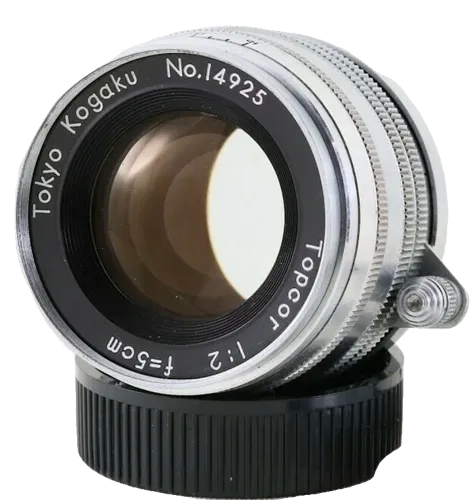
The Tokyo Kogaku Topcor 50mm f/2.8 is a scarce silver Leica thread-mount (LTM) normal lens from the Leotax era, prized by Topcon collectors.
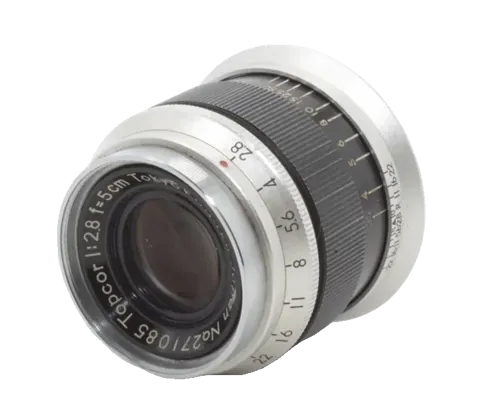
Tokyo Kogaku Topcor 50mm f/2.8
LTM mount
No listings tracked for this lens right now.
The Tokyo Kogaku Topcor 50mm f/2.8 is a LTM-mount lens for Leica rangefinder cameras. Leica price index →
How it compares
Measured against the 108 other 50mm LTM-mount lenses in the catalogue.
Specification
About this lens
Tokyo Kogaku Topcor 50mm f/2.8
Among the Leica thread-mount normal lenses that Tokyo Kogaku built for the Leotax rangefinder system, the 50mm f/2.8 is one of the less common and less documented members. Tokyo Kogaku Kikai K.K. (the Tokyo Optical Company) was established in 1932 and began producing lenses in 1935, initially making larger-format and military optics before turning to Leica thread-mount lenses after the war [1]. The company's screw-mount lenses passed through several brand names, sold first as "State," then "Simlar" and "C.Simlar," before settling on the "Topcor" name that the firm later carried over to its Topcon cameras. The f/2.8 sits in the lineup as a moderate-aperture alternative to the better-known fast Topcor normals, and surviving examples are uncommon enough that detailed published reviews of this specific aperture are scarce.
The lens uses a compact five-element, three-group optical design and a silver chrome barrel, with a ten-blade diaphragm and a 34 mm filter thread. It is a Leica thread-mount (LTM / M39) lens that is not rangefinder coupled, and it focuses to roughly 1.07 m. As with the related Topcor normals, these were primarily offered as part of the Leotax rangefinder system rather than as freely sold accessory optics, which helps explain their relative scarcity today[2]. Build quality of Tokyo Kogaku's thread-mount lenses of this period is generally regarded as good and broadly comparable to contemporaneous Japanese and German screw-mount optics.
Because the f/2.8 is far less frequently encountered than the f/2 and f/1.8 Topcor normals, version differences, coating changes, and finish variants are not well documented in the collector literature, and surviving information should be treated with caution. The wider Topcor normal range did evolve through the late 1950s, with the faster lenses appearing in chrome and later black-and-chrome and aluminum finishes alongside changing maximum apertures, while a 50mm f/3.5 and a fast 50mm f/1.5 were also offered as standard options on the Leotax bodies.
Optical qualities
Rendering Independent, published evaluations of the 50mm f/2.8 specifically are limited, so claims about its rendering should be made cautiously. In general terms, Tokyo Kogaku's Leica thread-mount lenses of the 1950s earned a reputation for being notably sharp for their era, reflecting a high standard of optical design, with build quality on par with the better Japanese and German screw-mount lenses of the time. The five-element, three-group construction is a relatively simple, classic normal-lens layout, but the absence of detailed, repeatable test data for this particular variant means its specific behavior regarding contrast, bokeh, flare, and field uniformity is not well established in reliable sources.
History
Development and Launch Tokyo Kogaku entered the postwar Leica thread-mount market with normal lenses sold under evolving brand names, culminating in the Topcor label, and these optics were supplied chiefly for the Leotax family of Leica-style rangefinder cameras. The 50mm f/2.8 belongs to this Topcor normal-lens program, which was active through the late 1950s and into the early 1960s.
Special editions No widely documented factory special editions, military variants, or unusual finishes of the Topcor 50mm f/2.8 appear in the available collector literature.
Collector Notes The Topcor name is shared across a range of Tokyo Kogaku lenses, including the far better-known Topcon SLR optics, so buyers should confirm that an example is the Leica thread-mount normal rather than an SLR-mount lens, and that it is the f/2.8 rather than the more frequently seen f/2 or f/1.8. Because these lenses are uncommon and were generally tied to the Leotax system, examples often surface attached to bodies; as with any lens of this age, it is worth checking the glass for haze and cleaning marks and confirming smooth focus and aperture action, since old Topcors can develop stiff or oily iris movement. Reported production numbers for the Topcor normals are not firmly established, and the slower apertures are believed to be scarce, so condition and originality should be weighed carefully against price.
Sources
Where to buy
Related lenses
Similar lenses you might be interested in
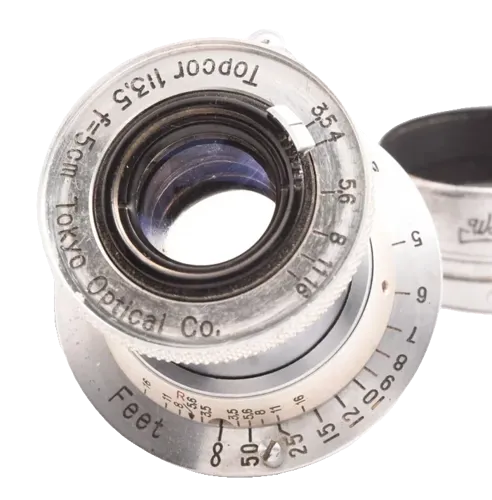
Topcor 50mm f/3.5 ELMAR
Topcor 50mm f/3.5 TESSAR
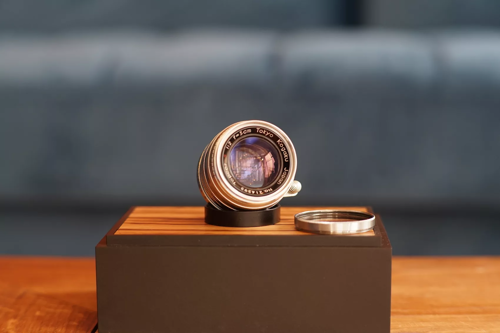
Topcor S 5cm f/2 Type 1
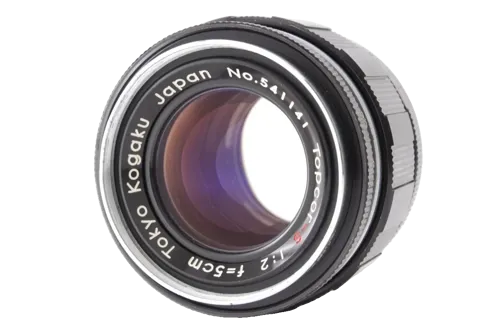
Topcor 50mm f/2
Topcor S "Panda"
Comments