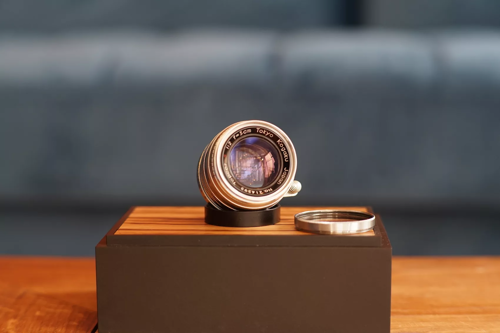
A collapsible Tokyo Optical 50mm f/3.5 for Leotax rangefinders, spanning early f/18 and later f/16 versions in native coupled Leica thread mount.
Tokyo Kogaku Simlar 50mm f/3.5 (Collapsible)
LTM mount
No listings tracked for this lens right now.
The Tokyo Kogaku Simlar 50mm f/3.5 (Collapsible) is a LTM-mount lens for Leica rangefinder cameras. Leica price index →
How it compares
Measured against the 108 other 50mm LTM-mount lenses in the catalogue.
Specification
About this lens
Tokyo Kogaku Simlar 50mm f/3.5 (Collapsible)
The Simlar 50mm f/3.5 is a collapsible standard lens made by Tokyo Optical for Leotax rangefinder cameras. It uses native Leica thread mount registration and mechanical rangefinder coupling. The unprefixed Simlar name occurs both before and after the C Simlar stage, so it does not identify one narrowly dated cosmetic version.
The optical construction is generally reported as four elements in three groups. The cited Leotax chronology attributes this through specialist collector research rather than a reproduced factory diagram. It is therefore appropriate to record the numerical formula while avoiding an unconditional claim that every Simlar is a direct copy of a particular named design.
The lens focuses to approximately 3.5 feet, or 1.07 metres, and uses A36 clamp-on accessories. Early examples can show an old aperture scale ending at f/18 and a 50mm engraving. Later examples commonly stop at f/16 and are marked 5cm. The collapsible barrel must be extended fully and locked before use.
Optical qualities
Rendering
Reliable measured performance evidence for the exact Simlar production stages is limited. A modern collector review found one Simlar sample broadly comparable with an Elmar of the period, but that observation cannot establish the behaviour of every early and later example.
Sharpness
No controlled source cited here defines a repeatable sharpness profile across the frame or aperture range. Results from the C Simlar should not automatically be transferred to every unprefixed lens unless the exact optical stage is established.
Contrast and flare resistance
The generic Simlar name spans early and later periods, so coating should be assessed from the actual version rather than inferred from the absence of the C prefix. Haze, coating scratches and internal reflections can materially change present-day contrast.
Digital use
A suitable LTM adapter permits mirrorless use with direct sensor focusing. Confirm rear clearance before collapsing the barrel into any digital body. Adapter thickness and internal camera geometry vary, and the tube should never be pushed against an obstruction.
History
Development and Launch
Tokyo Optical supplied collapsible standard lenses for the Leotax system during the postwar return of Japanese Leica-style rangefinder production. The Leotax Special D II and D III, introduced in 1947, are documented with both Simlar and C Simlar 50mm f/3.5 lenses.
Early unprefixed Simlar examples preceded the coated C-marked stage. The name returned after the C prefix was removed around the beginning of the Leotax D IV period.
Production Evolution
The State, first Simlar and C Simlar versions are documented with an older aperture sequence ending at f/18 and a 50mm focal-length marking. The C denotes coating.
Around 1951 the unprefixed Simlar returned with an updated aperture scale ending at f/16 and a 5cm engraving. These changes provide useful dating evidence. The available sources do not establish that they accompanied a new optical formula, so the profile retains them as production evolution rather than separate optical generations.
Special Editions/Variants
No separate factory special edition has been reliably documented. Early and later engravings are production variants within the Simlar identity unless stronger evidence demonstrates a material optical or mechanical redesign.
Collector Notes
Record the complete front-ring text, aperture sequence, focal-length notation and barrel details. A lens mounted on a Leotax body provides period context, but cameras and lenses have often been recombined during later ownership.
Check that the barrel extends securely, the rangefinder cam travels smoothly and the aperture is free of oil. Inspect the front element for fine cleaning marks and coating wear. The accessory fitting is A36 clamp-on, not a normal 36mm threaded filter mount.
Sources
Where to buy
Related lenses
Similar lenses you might be interested in
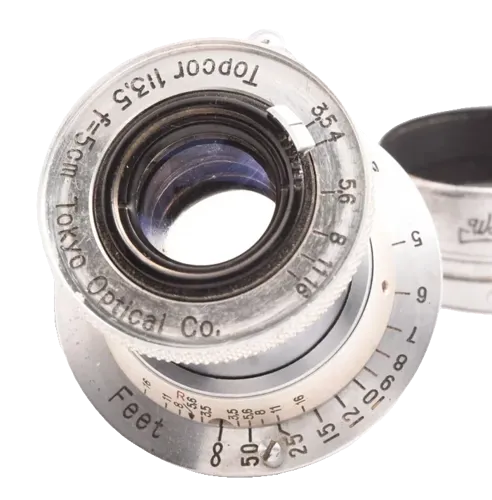
Topcor 50mm f/3.5 ELMAR
Topcor 50mm f/3.5 TESSAR
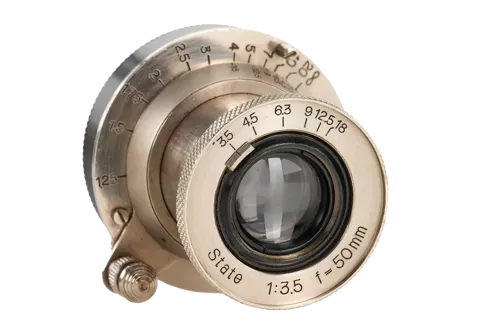
State 50mm f/3.5 (Collapsible)
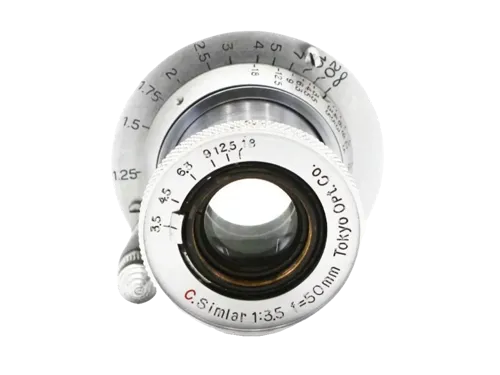
C Simlar 50mm f/3.5 (Collapsible)
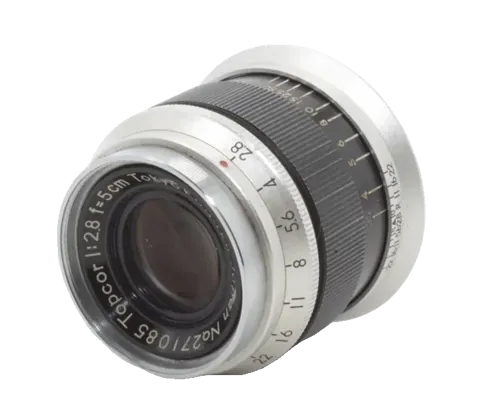
Topcor 50mm f/2.8
Comments