A 1940s American 47mm f/2 six-element standard lens with Kodak Lumenized coating, coupled in Leica M39 for the Premier Kardon camera.
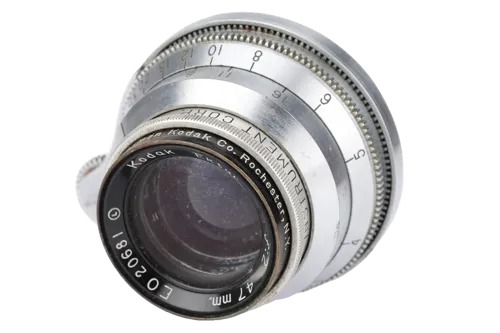
Kodak Ektar 47mm f/2 (Kardon)
LTM mount
No listings tracked for this lens right now.
The Kodak Ektar 47mm f/2 (Kardon) is a LTM-mount lens for Leica rangefinder cameras. Leica price index →
Specification
About this lens
Kodak Ektar 47mm f/2 (Kardon)
The Kodak Ektar 47mm f/2 is an American standard lens produced for the Premier Instrument Kardon rangefinder in the mid-1940s. Kodak supplied the optical cell, while Premier Instrument designed and made the rigid focusing mount. The lens uses six elements in four groups, Kodak's hard Lumenized antireflection coating, manual focusing, and a mechanical rangefinder cam. Its mount is the standard Leica 39mm screw fitting, not a proprietary “Kardon mount,” so a correctly adjusted example can be used on compatible Leica-thread cameras.
The optical design was derived from the six-element Ektar used on Kodak's Bantam Special. That camera described the lens as 45mm, while Kardon documentation used 47mm or 1.9 inches; the specialist history attributes this to different focal-length measurement rather than a new formula. The Kardon version opens to f/2 and focuses from approximately 3.5 feet to infinity. Premier's focusing barrel uses a prominent wheel designed for operation with gloves. Reliable sources used here do not establish the diaphragm-blade count, filter fitting, exact weight, or identical baffling across every mount.
Optical qualities
Rendering
The six-element, four-group construction is a high-speed standard-lens formula designed to cover the 35mm frame at f/2. Kodak's Ektar name identified a premium optical range rather than one universal formula, so characteristics from an unrelated Ektar should not be transferred to this lens. No factory MTF chart or controlled comparison of multiple Kardon lenses has been located. Claims about exceptional sharpness or a fixed vintage “glow” therefore need to be treated as observations of individual examples.
At full aperture, focus accuracy and optical condition have a strong influence on the result. Stopping down normally improves field evenness, but the exact progression should be tested on the lens in hand. The 47mm focal length gives a slightly wider normal view than a nominal 50mm lens.
Contrast and flare
Kodak's Lumenized coating is historically significant. It reduces surface reflections and improves transmission compared with an equivalent uncoated optical cell, which was especially valuable in a six-element f/2 design. Coating does not make the lens immune to flare. Aged haze, cleaning damage, internal reflections, and loss of blackening can lower contrast, while a suitable hood can help when strong light is near the frame.
Out-of-focus rendering
The f/2 aperture permits subject separation at close and medium distances. No dependable blade count or controlled highlight study has been found for the exact Kardon mount. The shape of defocused points, transition character, and any outlining should be described from photographs made at a known aperture with a correctly calibrated lens rather than from the Ektar name alone.
Colour and digital use
No measured colour response is available for this version. On a digital sensor, white balance, cover-glass thickness, and sensor reflections may change its appearance from film-era use. Adaptation does not compensate for a worn cam or incorrect infinity setting.
History
Development and Launch
The Kardon began as an American response to the wartime loss of German camera imports. After the New York branch of Ernst Leitz came under United States government control, Premier Instrument was asked to develop an American Leica-style camera. Peter Kardon's team used the Leica IIIa as its mechanical starting point. Completed samples appeared in 1945, and a civilian Kardon was advertised by the end of 1946.
Kodak did not manufacture the Kardon body. Instead, Premier purchased an existing Kodak lens design and received the optical cells for installation in its own focusing mounts. This division of responsibility explains why the lens carries Kodak's Ektar identity but has Kardon-specific mechanics. Leitz Auction documents a civilian camera with the f/2 47mm Ektar and dates it to 1945, while the broader camera history places regular civilian and military manufacture from the late 1940s into the early 1950s.
Production Evolution
Civilian Kardons generally used bright chrome, while military “cold camera” versions had a duller satin finish and different focus-wheel placement. The available history continues to identify the same Kodak six-element 47mm f/2 optical design.
Military camera orders were delivered in two main postwar periods, ending in 1954. The number of civilian cameras is less certain, and the total number of loose or spare Ektar lenses is not established. Camera production figures should therefore not be presented as an exact lens-production total.
Special Editions/Variants
The principal documented variants are the civilian and military barrel presentations. Hybrid cameras and swapped parts also exist, so finish or focus-wheel position alone cannot prove original military provenance. The related Bantam Special Ektar shares the optical design but uses a different camera installation and focal-length marking. It is historical context, not the same interchangeable Kardon lens.
Collector Notes
Identification should combine the Kodak Ektar 47mm f/2 engraving, rigid Premier focusing barrel, Leica M39 thread, rangefinder cam, and characteristic focus wheel. Before use, verify infinity, close-focus agreement, and smooth cam travel. A lens can screw onto an L39 body while remaining incorrectly registered or coupled.
Inspect the optical cell for haze, coating damage, separation, and cleaning marks, and check that the aperture remains dry and even. Auction condition reports apply only to the object sold.
Sources
Where to buy
Related lenses
Similar lenses you might be interested in
![Chiyoda Kogaku Super Rokkor 50mm f/2 [C]](https://assets.leicalenslist.com/images/2063_medium.webp)
Comments