Best price Used
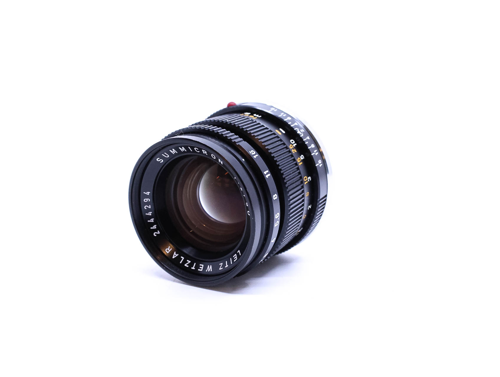
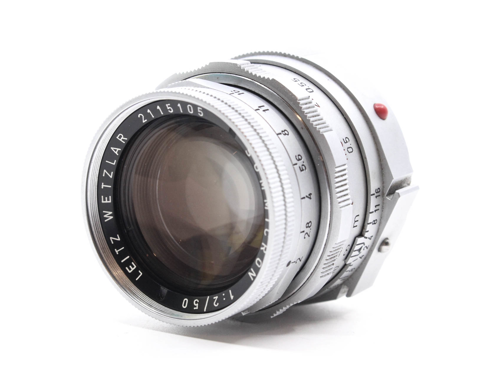
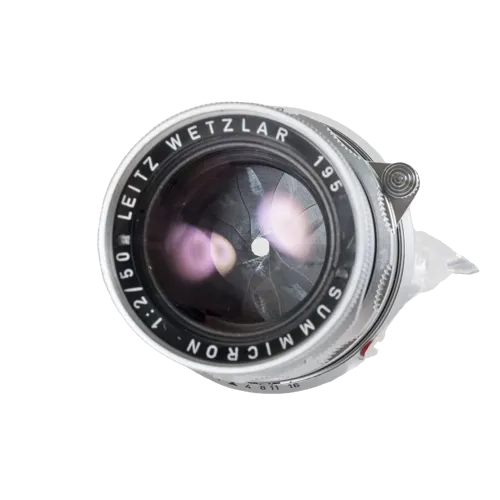
Leica 5cm f2 Summicron Collapsible A5103003
Sold by Aperture UK
€354 ≈ $383
The Leica Summicron 50mm f/2 Version 1 (Collapsible) is the lens that defined the modern "Leica look." Produced between 1953 and 1960, it features a classic 7-element optical design housed in a dense, satin-chrome brass barrel that retracts for portability. Famed for its "radioactive" thorium glass elements that often warm with age, the V1 offers a unique, lower-contrast vintage rendering with a signature glow at f/2, sharpening significantly when stopped down.
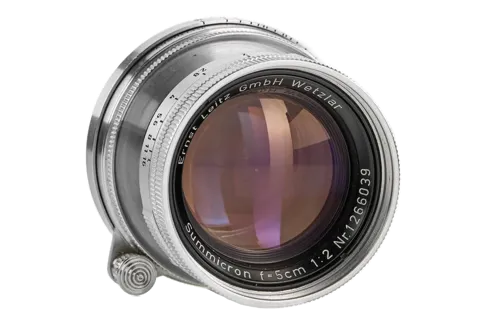
M / LTM mount
The Leica Summicron 50mm f/2 I (Collapsible) is a M / LTM-mount lens for Leica rangefinder cameras. As of October 2026, it sells from €354 used across 29 listings, with a 30-day median of €926. Leica price index →
Measured against the 181 other 50mm lenses in the catalogue.
The Leica Summicron 50mm f/2 Version 1, widely known as the "Collapsible Summicron," is a landmark rangefinder lens produced by Ernst Leitz Wetzlar from 1953 to 1960. As the successor to the Summitar, it was the first optic to carry the "Summicron" designation, a name that became synonymous with the f/2 aperture optics in the Leica system. The lens is celebrated for its dense mechanical construction and its ability to retract into the camera body, making a full-frame Leica setup pocketable.
The Version 1 utilizes a classic double-Gauss optical design comprising seven elements in six groups. A major evolution from the preceding Summitar was the introduction of an air-spaced front element, which significantly improved the correction of coma and astigmatism while increasing overall resolving power.
The rendering is distinctively vintage. At the maximum aperture of f/2, the lens exhibits moderate spherical aberration, creating a soft "glow" around high-contrast edges that is highly prized for portraiture. When stopped down to f/4, the resolution increases drastically, delivering sharpness that rivals many modern optics. The aperture diaphragm consists of 10 blades, producing a nearly circular opening for smooth out-of-focus backgrounds.
A defining characteristic of early production units (typically those with serial numbers below 1.1 million) is the use of radioactive thorium oxide in the glass elements. Leitz utilized thorium to achieve a high refractive index with low dispersion.
Over decades, the radiation causes the glass to amber or yellow.
The lens barrel is machined from heavy brass with a satin chrome finish (rare screw mount and fixed versions exist), giving it a dense, premium tactile feel. The focus ring features a spring-loaded infinity lock—a quirk of the era.
Digital Camera Warning: While the collapsible design is safe for film bodies (M3, M6, etc.), extreme caution is required on digital Leicas (M9, M10, M11, SL). The sensor stack on digital cameras is thicker than film; fully collapsing the lens can cause the rear element to strike the sensor or shutter. Many users employ a rubber O-ring on the barrel to limit the collapse depth for safe digital use.
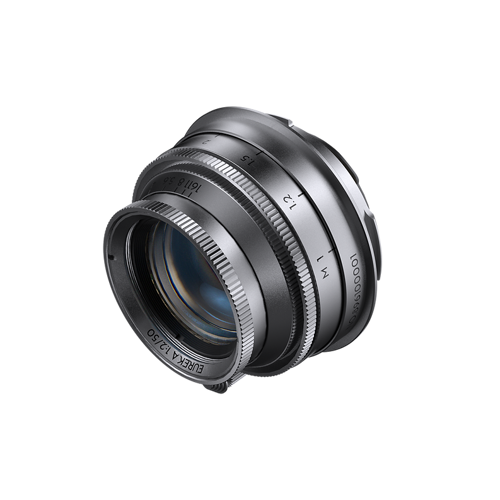
Released in 2024, the Thypoch Eureka is a modern tribute to this specific lens. While it mimics the collapsible mechanism and aesthetic:
The "Rigid" and "Dual Range" Summicrons followed the V1. They utilize a nearly identical optical formula but housed in non-collapsible, rigid barrels.
Later generations marked a departure from the classic look.
Good time to buy. The lowest listing is 62% below the 30-day average.
Lowest price Click a mark to open that listing · arrow keys to step, Enter to open
Price against condition for 29 listings of Leica Summicron 50mm f/2 I (Collapsible), €354 to €2,079, median €909. Excellent: 9 at €581, €802, €973, €1,195, €1,350, €1,497, €1,559, €1,871, €2,079. Good: 8 at €364, €552, €564, €644, €684, €909, €926, €1,038. Fair: 5 at €434, €463, €829, €833, €1,064. Used: 7 at €354, €458, €736, €926, €1,255, €1,292, €1,384. The full table follows.
| Condition | Lowest | Median |
|---|---|---|
| Excellent | €581 | €1,350 |
| Good | €364 | €664 |
| Fair | €434 | €829 |
| Other | €354 | €926 |
Over the last 18 weeks the median price for the Leica Summicron 50mm f/2 I (Collapsible) has fallen, ranging from €925 to €1,458 (now €926).
Weekly price (EUR). Median (Good or better) and lowest (Good or better) across 18 weeks. The full figures follow in the table below.
| Week | Median | Lowest |
|---|---|---|
| Jun 1, 2026 | €1,489 | €605 |
| Jun 8, 2026 | €1,489 | €605 |
| Jun 15, 2026 | €1,852 | €605 |
| Jun 22, 2026 | €1,553 | €412 |
| Jun 29, 2026 | €1,553 | €949 |
| Jul 6, 2026 | €1,489 | €736 |
| Jul 13, 2026 | €1,520 | €949 |
| Jul 20, 2026 | €949 | €261 |
| Jul 27, 2026 | €1,266 | €500 |
| Aug 3, 2026 | €1,127 | €500 |
| Aug 10, 2026 | €1,161 | €500 |
| Aug 17, 2026 | €1,161 | €552 |
| Aug 24, 2026 | €1,215 | €552 |
| Aug 31, 2026 | €990 | €552 |
| Sep 7, 2026 | €990 | €552 |
| Sep 14, 2026 | €990 | €552 |
| Sep 21, 2026 | €926 | €552 |
| Sep 28, 2026 | €926 | €364 |
Every shop grades differently. Leica Classic uses letters, Ffordes uses E++ and E+, German dealers write "Zustand B", Japanese dealers write A−. We map all of them onto the one ladder below. Where a shop states its own grade, we print it under ours.
As of October 2026, the Leica Summicron 50mm f/2 I (Collapsible) sells from €354 used, with a 30-day median of €926, across 29 active listings.
As of October 2026, the Leica Summicron 50mm f/2 I (Collapsible) is sold by 5 sources (29 listings), from €354 used: all compared cheapest-first on this page.
Similar lenses you might be interested in
Comments