The Carl Zeiss Sonnar 5cm f/2 collapsible, the slower companion to the famous f/1.5, is a six-element Contax rangefinder classic prized by collectors.
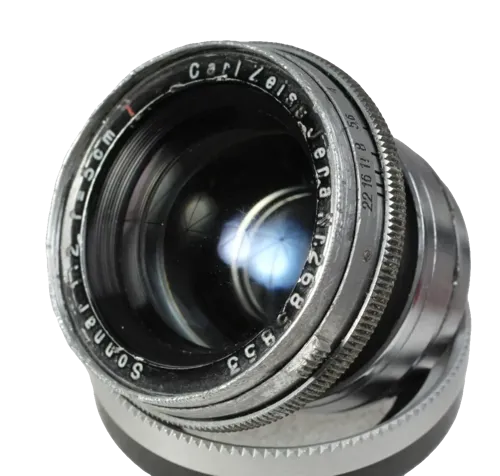
Carl Zeiss Sonnar 5cm f/2 (Collapsible)
Contax RF mount
No listings tracked for this lens right now.
The Carl Zeiss Sonnar 5cm f/2 (Collapsible) is a Contax RF-mount lens for Leica rangefinder cameras. Leica price index →
Specification
About this lens
Carl Zeiss Sonnar 5cm f/2 (Collapsible)
This is the quieter sibling of the celebrated 5cm f/1.5, the lens that gave the Sonnar line its starting point rather than its top speed. The Sonnar type was conceived by Ludwig Bertele, who had earlier developed the fast Ernostar at Ernemann in Dresden and then carried the work into Carl Zeiss after Ernemann was absorbed into Zeiss Ikon [1][2]. The 5cm f/2 introduced in 1931 used a six-element, three-group layout in a 1-3-2 configuration, and the design was so compact that splitting its rear doublet into a triplet produced the seven-element f/1.5 version that followed. As a budget alternative to that headline lens, the f/2 has historically lived in the shadow of its faster relative, but its smaller front group and gentle rendering have earned it a steady following among collectors and users of converted Sonnars.
Built for the Contax rangefinder, this is an internal-mount lens: it relies on the focusing helical built into the Contax body rather than carrying its own coupled helical, so on the camera there is no separate rangefinder coupling mechanism in the lens itself. The optical advantage of the Sonnar formula was the reduction of air-to-glass interfaces by cementing elements into groups, which improved light transmission and reduced flare at a time before anti-reflection coating was common. The collapsible barrel keeps the assembly very short when retracted, in keeping with the compactness that the asymmetric Sonnar design allows. To use one on a Leica, the prewar Contax-mount lens must be adapted or converted, often by rebuilding it into a Soviet Jupiter focus mount.
Across its life the Sonnar 5cm f/2 appeared in both uncoated and coated forms. Carl Zeiss began applying lens coating in 1936, and coated and uncoated examples were produced concurrently from that point, with coated optics becoming the norm by the end of the decade; coated lenses carry the red "T" marking. Postwar production continued under the divided company, and a notable practical difference from the f/1.5 is the glass used for the front element: the f/1.5 used a hard glass while the f/2 used a softer glass that is far more prone to wear.
Optical qualities
Rendering The Sonnar's asymmetric, lightly corrected design gives a distinctive look rather than clinical accuracy. Wide open, residual spherical aberration and field curvature spread the plane of focus and produce the soft, three-dimensional "plastic" quality long associated with the type, along with a swirly, comet-and-sphere character in out-of-focus areas. Stopping down to around f/4 sharpens the image markedly and raises contrast across the field. Uncoated examples show lower contrast and more muted color than coated ones, which many users regard as part of the appeal for black-and-white work; the design is not intended for flat-field, brick-wall sharpness.
Aberrations The compact Sonnar layout introduces focus shift, in which the point of best focus moves as the lens is stopped down because the center of the lens has a slightly longer effective focal length than the edges. This is inherent to the formula and is worth understanding when focusing wide open and then closing down.
History
Development and Launch The Sonnar grew directly out of Bertele's Ernostar. By filling the air space between elements of the Ernostar with low-index glass, he cut the number of air-to-glass surfaces and improved transmission, creating a new lens type for the Contax rangefinder. The 5cm f/2, introduced in 1931 as a six-element, three-group design, served as the more affordable normal lens alongside the faster f/1.5 that arrived shortly after.
Production Evolution Mechanical construction of the prewar Sonnars was substantially improved in the mid-1930s, including the addition of a filter ring and a mount that was easier to service. Coating of optical surfaces began in 1936, after which coated and uncoated lenses were made side by side, with coated optics carrying the red "T" mark. After the Second World War the Zeiss organization was split between East and West Germany, and Sonnar production continued under the changed corporate arrangements.
Special editions No widely documented factory special editions of the collapsible 5cm f/2 are recorded; its variety lies mainly in coated versus uncoated optics and in cosmetic and mechanical changes over time rather than in named limited runs. The formula did, however, inspire later descendants, including Soviet copies and a 1955 Tanar 5cm f/2 in Leica mount, and in recent years specialist workshops have rehoused original prewar f/2 Sonnars and developed new lenses based on the 1-3-2 formula.
Collector Notes The chief difficulty in buying this lens is condition of the front element. Because the f/2 used a softer glass than the f/1.5, the great majority of surviving examples show cleaning marks, scratches, or other surface damage, sometimes severe enough to affect image quality, so the glass should be inspected carefully before purchase. With uncoated lenses, the natural "bloom" that develops on aged glass can act somewhat like a coating and should be cleaned only with great care so it is not removed. Buyers should also confirm whether an example is original Contax internal-mount or has been converted to Leica mount, since prewar lenses require an adapter or a rebuilt mount for use on a Leica, and the wartime and immediate postwar lenses in particular can be mechanically fragile due to wartime material substitutions.
Sources
Where to buy
Related lenses
Similar lenses you might be interested in
Comments