Best price Good
Carl Zeiss 50mm f2 Planar T* ZM
Sold by Kamerastore
€595 ≈ $643
The Carl Zeiss Planar T* 50mm f/2 ZM is a Cosina-built six-element double-Gauss standard lens in Leica M mount, prized for sharpness and flare control.
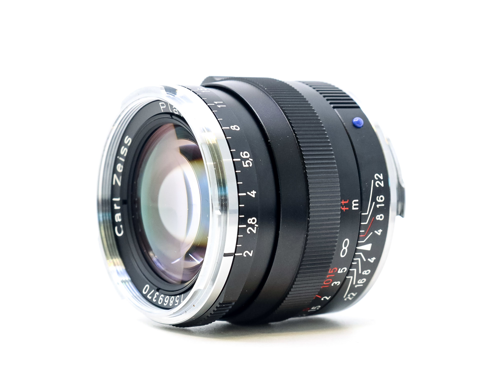
M mount
The Carl Zeiss Planar T* 50mm f/2 ZM is a M-mount lens for Leica rangefinder cameras. As of October 2026, it sells from €595 used across 6 listings, with a 30-day median of €669. Leica price index →
Measured against the 76 other 50mm M-mount lenses in the catalogue.
The Planar T* 50mm f/2 ZM is a modern interpretation of one of the oldest and most successful formulas in photographic optics, the double Gauss. It uses a true symmetrical double-Gauss arrangement of six elements in four groups with no extra correcting elements, a layout descended from the original Zeiss Planar patented in 1896 and refined repeatedly over more than a century [1]. As the standard lens in the ZM rangefinder line, it sits as a moderate-speed normal that reviewers regard as one of the most technically faultless 50mm lenses available for the M system.
Optically it relies entirely on spherical surfaces coated with Zeiss's T* multicoating, and the lens is manual focus only as is standard for the M mount. The barrel is built almost entirely of metal and glass, with an aluminium housing and a chromed-brass front ring, and it is offered in black and silver finishes. Handling departs slightly from Leica convention: the focusing ring carries a small protrusion or nub intended to bridge the gap between a focus tab and a plain ring, the throw is roughly 90 degrees, and the ten-bladed diaphragm clicks in third-stop increments rather than the half-stops common on Leica and Voigtländer lenses. It couples to the rangefinder mechanism, focuses to 0.7 m, and accepts 43 mm filters; an optional vented metal hood shared with the 35mm f/2 Biogon is available but not included.
The lens is manufactured by Cosina in Japan, the same firm that produces Voigtländer lenses, and there are no separate optical versions to track, the design having remained essentially unchanged since its 2004 launch. Build quality is high, though reviewers note that some ZM samples can develop focusing wear, binding, or play in the optical cell more quickly than other manual-focus lenses, issues that are usually resolved by routine servicing and that appear less common in later production batches. The optical design is closely related to the Zeiss 45mm f/2 Planar made for the Contax G cameras, and the Sony E-mount Loxia 50mm f/2 is essentially the same optic adapted for the thicker filter stack of mirrorless bodies[3].
Rendering The Planar is described as an exceptionally competent, predictable performer with a modern, transparent signature. Contrast and resolution are high and even across the frame, color reproduction is warm and saturated, and the overall look is clean rather than characterful, which some users find slightly clinical.
Sharpness On-axis resolution is excellent wide open, with definition falling off gently and evenly toward the edges; corners are already strong at f/2 and improve quickly on stopping down, with contrast reaching very high levels by f/2.8 to f/4.
Bokeh and transitions Out-of-focus rendering is generally smooth but retains some texture, and close inspection can reveal mild double-line outlining and color fringing in demanding situations; focus transitions are moderate with fairly defined planes.
Flare resistance Flare control is a standout trait, with high contrast retained and little or no ghosting even with the sun in the frame; in the rare cases it does break down it does so as a gentle veiling flare.
Distortion and vignetting The lens shows just under two percent simple barrel distortion, easily corrected and rarely visible outside architectural work, and modest wide-open vignetting that becomes insignificant by f/4.
Aberrations Coma is well controlled and there is no significant astigmatism, field curvature, or focus shift; longitudinal chromatic aberration appears as occasional color fringing only in extreme high-contrast conditions.
Digital use On Leica digital bodies the output is pleasant and the Summicron 50mm profile gives good results without obvious color shift; on Sony A7-series cameras the thicker filter stack and ray-angle issues cause some edge smearing wide open that clears up by f/2.8 to f/5.6.
Development and Launch Zeiss introduced the ZM lens line in 2004 in cooperation with Cosina, reviving the Carl Zeiss name on rangefinder optics for the Leica M mount. The 50mm f/2 Planar served as the conventional standard lens of the range, a moderate-speed normal positioned against the Leica Summicron 50mm f/2, to which it is frequently compared because both are true double-Gauss designs with near-identical specifications. It carries forward the Planar name that Zeiss has applied to double-Gauss derivatives since the 1896 original.
Production Evolution The lens has remained optically unchanged since launch, with no distinct versions to identify. Reviewers report small cosmetic drift across the ZM range over the years, such as black finishes becoming slightly more matte and the red imperial scale markings becoming brighter on later lenses, though these are observations across the line rather than formal revisions.
Special editions No major factory special variants of the 50mm f/2 ZM are widely documented; it has been sold principally in black and silver finishes. The most relevant relatives are not editions of this lens but close optical cousins: the Contax G 45mm f/2 Planar that the design is said to derive from, and the Sony E-mount Loxia 50mm f/2, essentially the same optic recomputed for mirrorless.
Collector Notes The ZM Planar is sometimes confused with the Summicron 50mm f/2 because of their similar specifications and rendering, and with the Contax G 45mm Planar and Loxia 50mm because of their shared lineage. Buyers should check the focusing action for binding or wobble, since some ZM samples wear faster than other manual-focus lenses, and confirm the helicoid is smooth; such faults are typically fixable by servicing. The ZM front caps are widely considered poor and loose, so many owners substitute third-party caps, and the optional vented hood, shared with the 35mm f/2 Biogon, is worth confirming if a kit claims to include it. One discrepancy worth noting is weight: one detailed review lists the lens at 211 g, while LeicaLensList records 230 g.
Good time to buy. The lowest listing is 11% below the 30-day average.
Lowest price Click a mark to open that listing · arrow keys to step, Enter to open
Price against condition for 6 listings of Carl Zeiss Planar T* 50mm f/2 ZM, €595 to €925, median €747. New: 2 at €925, €925. Mint: 1 at €832. Excellent: 1 at €602. Good: 2 at €595, €661. The full table follows.
| Condition | Lowest | Median |
|---|---|---|
| New | €925 | €925 |
| Mint | €832 | €832 |
| Excellent | €602 | €602 |
| Good | €595 | €628 |
Over the last 18 weeks the median price for the Carl Zeiss Planar T* 50mm f/2 ZM has fallen, ranging from €630 to €755 (now €669).
Weekly price (EUR). Median (Good or better) and lowest (Good or better) across 18 weeks. The full figures follow in the table below.
| Week | Median | Lowest |
|---|---|---|
| Jun 1, 2026 | €749 | €581 |
| Jun 8, 2026 | €665 | €440 |
| Jun 15, 2026 | €648 | €440 |
| Jun 22, 2026 | €648 | €440 |
| Jun 29, 2026 | €630 | €440 |
| Jul 6, 2026 | €676 | €598 |
| Jul 13, 2026 | €676 | €598 |
| Jul 20, 2026 | €634 | €440 |
| Jul 27, 2026 | €658 | €440 |
| Aug 3, 2026 | €658 | €440 |
| Aug 10, 2026 | €658 | €440 |
| Aug 17, 2026 | €630 | €440 |
| Aug 24, 2026 | €731 | €440 |
| Aug 31, 2026 | €832 | €440 |
| Sep 7, 2026 | €832 | €598 |
| Sep 14, 2026 | €832 | €598 |
| Sep 21, 2026 | €879 | €598 |
| Sep 28, 2026 | €747 | €595 |
Every shop grades differently. Leica Classic uses letters, Ffordes uses E++ and E+, German dealers write "Zustand B", Japanese dealers write A−. We map all of them onto the one ladder below. Where a shop states its own grade, we print it under ours.
As of October 2026, the Carl Zeiss Planar T* 50mm f/2 ZM sells from €595 used, with a 30-day median of €669, across 6 active listings.
As of October 2026, the Carl Zeiss Planar T* 50mm f/2 ZM is sold by 3 sources (6 listings), from €595 used: all compared cheapest-first on this page.
Similar lenses you might be interested in
Comments