The Voigtländer Heliar 50mm f/2 is an M-mount rangefinder lens reviving the classic Heliar formula, made by Cosina and prized by collectors.
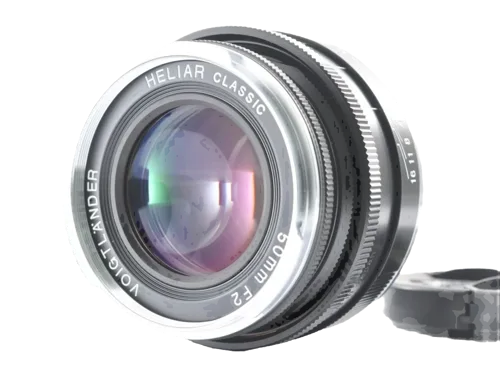
Voigtländer Heliar 50mm f/2
M mount
No listings tracked for this lens right now.
The Voigtländer Heliar 50mm f/2 is a M-mount lens for Leica rangefinder cameras. Leica price index →
How it compares
Measured against the 76 other 50mm M-mount lenses in the catalogue.
Specification
About this lens
Voigtländer Heliar 50mm f/2
This lens is notable for reviving the historic Heliar name in a fast, compact normal lens for the Leica M mount. It was produced by Cosina under the Voigtländer brand and introduced in 2006 as the Heliar Classic, released to mark the firm's 250th anniversary alongside a Bessa R2M rangefinder body [1][3]. The optical layout is a modern interpretation of the classic Heliar design rather than the more common double-Gauss approach used by most fast 50mm lenses of the period. Reviewers describe the Heliar as a five-glass, three-group Cooke triplet derivative in which both the front and rear elements are split into cemented doublets, similar in principle to the APO-Lanthar, with the f/2 maximum aperture representing an unusually fast result for that configuration.
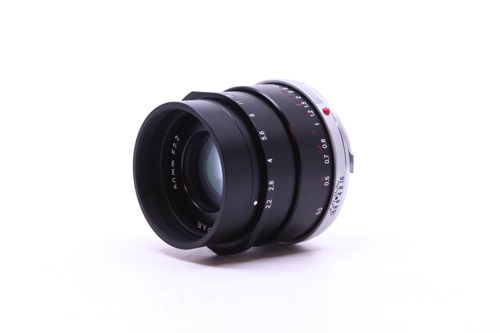
The lens is a collapsible, all-metal design weighing about 260 g, which is heavier than a comparable rigid lens of similar glass. Rather than a focusing tab, it uses a slim focusing collar on the fixed part of the mount, and reviewers note that a finger spur would have been even easier to use on a collapsible barrel. The aperture ring is unusual in spacing: f/2 to f/8 are roughly evenly spaced with half-stop click detents, while f/11 and f/16 sit closer together with full-stop detents only, and there is no f/22 as found on many other Voigtländer lenses. The distance scale runs to a traditional minimum focus of 1 m and is engraved in meters only, and the lens is rangefinder coupled for use on M-mount and compatible bodies. The five-element, three-group construction is documented consistently across sources [2].
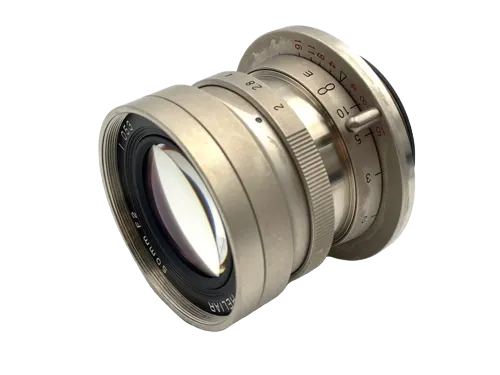
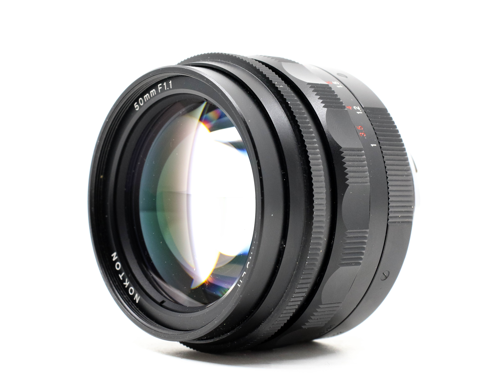
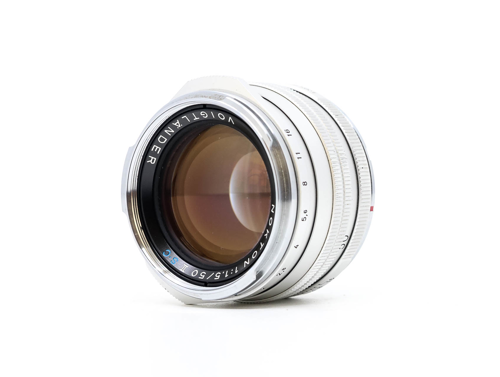
The Heliar 50mm f/2 exists in more than one form and finish, which is a common point of confusion. The anniversary M-mount Heliar Classic was offered in black and silver and carries the "1756-2006 250 Jahre" engraving shared with its companion Bessa body. A separate nickel-plated version was sold in Leica screw mount (M39) with an infinity lock, a finish unusual among Voigtländer lenses, which are normally black or silver chrome. Buyers should confirm the exact mount, finish, and engraving when identifying a specific example.
Optical qualities
Rendering Documentation of this lens is limited compared with mass-market 50mm lenses, but the available material points to a classic, contrasty rendering. The simple Heliar construction is described as producing a contrasty image, and reviewers characterize the lens as having a distinct optical signature that is more legible than usual, while noting that at this level of build and design, sharpness, contrast, and resolving power can generally be taken for granted.
Contrast and color The triplet-derived design is reported to give good contrast, a trait that older Heliar formulas were known for.
History
Development and Launch The Heliar 50mm f/2 Classic was introduced in 2006 as part of Voigtländer's 250th anniversary program under Cosina. It was paired with the Bessa R2M, a mechanical-shutter coupled rangefinder, and both items carried matching anniversary engraving. The choice of a Heliar formula, rather than the more common fast double-Gauss, deliberately referenced Voigtländer's historic lens heritage.
Special editions The lens is itself tied to the 250 Jahre anniversary release, and the M-mount Heliar Classic was sold in black and silver finishes. A nickel-plated screw-mount (M39) version with an infinity lock was also marketed, distinguished by its finish and mount.
Collector Notes When identifying an example, verify the mount and finish, since both an M-mount Heliar Classic and a nickel-plated M39 version exist. The anniversary lens should carry the "1756-2006 250 Jahre" engraving consistent with its companion body. Note that some published specification listings disagree on details such as blade count, weight, and finish; LeicaLensList records eleven aperture blades, a weight of 260 g, and a black finish for the M-mount lens, while at least one specification source lists a different blade count and a lighter weight for the nickel screw-mount version.
Sources
Where to buy
Related lenses
Similar lenses you might be interested in
Comments