
★ Best price Mint
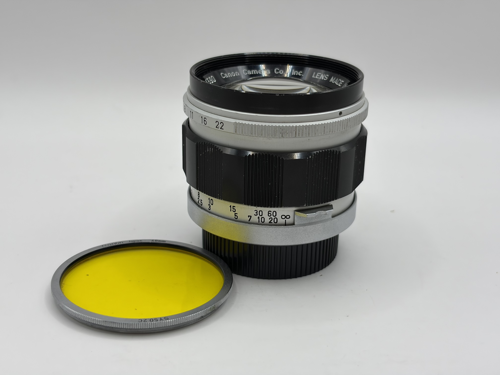
Carl Zeiss Jena Biotar 50mm f1.4 for Leica M (Copy)
Sold by cameraobscuraelburg.nl
€1,807 ≈ $1,951

The Carl Zeiss Biotar 5cm f/1.4 is a LTM-mount lens for Leica rangefinder cameras. As of August 2026, it sells from €1,807 used across 1 listing, with a 30-day median of €1,807. Leica price index ↗
Reference maintained by Thomas Boots· prices updated August 2026
The Carl Zeiss Jena Biotar 5cm f/1.4 profiled here is the exceptionally rare Leica screw-mount version calculated for the full 24×36mm still-photography format. It must not be confused with the earlier Kinamo cinema lens, the later Pentaflex 16 lens, or modern rangefinder conversions. The Leica-specific calculation was completed on 6 May 1929, and historical research indicates that approximately 100 examples were manufactured in Leica fittings. A documented 1932 example, serial number 1365672, was identified by Leitz Photographica Auction as having an original rangefinder-coupled Leica screw mount and a distance scale in feet.
The lens uses Willy Merté’s asymmetrical double-Gauss construction, comprising six elements in four groups. Its f/1.4 maximum aperture was unusually fast for a 50mm still-camera lens of this period. The profiled version has manual focusing, a mechanical diaphragm and rangefinder coupling. Exact dimensions, weight, filter fitting, aperture-blade count and minimum focusing distance have not been reliably documented. On a modern Leica M camera, a correctly calibrated example can be mounted with a standard LTM-to-M adapter. It has no six-bit coding.
Several physically similar lenses require careful separation. The 1928 Kino-Biotar 5cm f/1.4 was calculated for the smaller 18×24mm cinema frame. The 1929 Leica calculation expanded the field beyond 45 degrees and used a substantially enlarged rear element to cover 24×36mm. Postwar Biotar 50mm f/1.4 lenses for the AK16 and Pentaflex 16 systems were cinema lenses with different production histories. Industrial and X-ray versions may lack a focusing mount or diaphragm, while modern conversions can use newly manufactured LTM or M-mount focusing barrels.
Rendering
Controlled optical testing of the original Leica-mounted Biotar 5cm f/1.4 is extremely limited. Historical design research cautions that expanding the 1929 optical formula to cover the full 24×36mm field did not produce optimal performance across the entire image. No reliable factory MTF data has been located, so specific claims about resolution, bokeh or stopped-down performance should be treated cautiously. The lens is principally significant as an early full-frame f/1.4 double-Gauss design.
Contrast and flare
Early examples predate the general adoption of Zeiss anti-reflection coating. Their six-element, four-group construction presents eight glass-to-air surfaces, making an uncoated example susceptible to glare, ghosting and reduced contrast around strong light sources. Zeiss’s technical history describes these effects as characteristic limitations of early uncoated Gauss lenses. Use of the original black-painted hood is advisable.
Digital use
The original coupled version can be used on Leica M cameras through a correctly selected LTM-to-M adapter. Rangefinder calibration should be checked carefully because the shallow depth of field at f/1.4 makes small mechanical errors visible. Uncoupled, non-standard or converted specimens are better evaluated with live view until their registration and coupling have been verified.
Development and Launch
Willy Merté developed the Biotar family at Carl Zeiss Jena during the late 1920s. German patent DE485,798, filed on 30 September 1927, protected the asymmetrical Gauss-type construction. Carl Zeiss records describe a series of f/1.4 and f/2 Biotar designs intended for still and motion-picture formats.
The Leica-specific 5cm f/1.4 calculation was completed on 6 May 1929. It was derived from an earlier 4cm Biotar but modified to cover the Leica’s 24×36mm frame. Approximately 100 lenses are reported to have been manufactured with Leica fittings, making this one of the least common prewar third-party lenses made for the Leica system.
Production Evolution
The complete production period is not confirmed. Leitz Photographica Auction documented serial number 1365672 as a 1932 lens in an original rangefinder-coupled Leica screw mount, demonstrating that at least one finished example dates from that year. No dependable complete serial-number range or Zeiss order number has been published.
Early examples are associated with black finishes and uncoated optics. Later Biotar 5cm f/1.4 lens heads exist for cinema, Robot, X-ray and industrial applications, including some marked with the red T coating symbol. These must not automatically be classified as factory Leica lenses, even when subsequently fitted to LTM or Leica M focusing mounts.
Special Editions/Variants
Leitz Photographica Auction has documented an original uncoupled Leica screw example made for a Leica I C Non Standard. Such a lens should not be assumed to maintain correct infinity registration on later standardized LTM cameras without testing.
A separate black example, serial number 888964, was auctioned by Flints in a rangefinder-coupled Leica screw mount with an experimental waist-level finder housing. The auction description confirms the unusual assembly, but its precise development status and factory provenance require further documentation.
Modern conversions of Kinamo, Robot, X-ray and Pentaflex lens heads also exist. These conversions belong in LeicaLensList only when the finished lens has a functional Leica-compatible mount, and they should be catalogued separately from the original 1929 Leica version.
Collector Notes
Collectors should verify the complete engraving, serial number, focusing mount and rangefinder cam rather than relying only on the Biotar name. Original factory Leica fittings are substantially scarcer than later conversions. A genuine coupled example should be tested for infinity registration and accurate rangefinder tracking at both near and distant settings.
The uncoupled Leica I C Non Standard version presents an additional compatibility concern because early non-standard cameras and lenses could be individually matched. Surviving optics should be examined for cleaning marks, haze, cement separation and internal reflections. Diaphragm operation and blade condition also require inspection. Original Zeiss caps and the black-painted hood are uncommon and materially affect completeness.
As of August 2026, the Carl Zeiss Biotar 5cm f/1.4 sells from €1,807 used, with a 30-day median of €1,807, across 1 active listing.
As of August 2026, the Carl Zeiss Biotar 5cm f/1.4 is sold by 1 source (1 listing), from €1,807 used — all compared cheapest-first on this page.
About the usual price. The lowest listing is around the 30-day average.
Similar lenses you might be interested in
Comments