Best price
Canon (キヤノン) 50/1.4 (LEICA L39)
Sold by Nisshin Camera
€174 ≈ $188
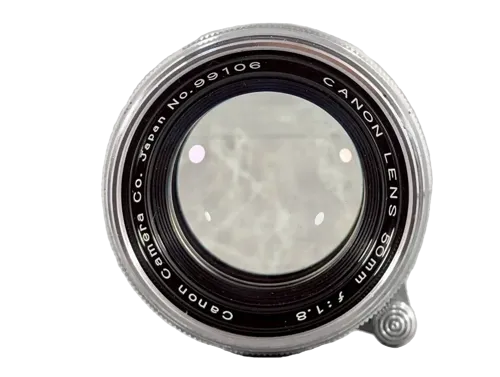
Canon 50mm f/1.4 I, a compact six-element LTM rangefinder lens of the late 1950s, the "Japanese Summilux" prized by collectors as an affordable fast fifty.
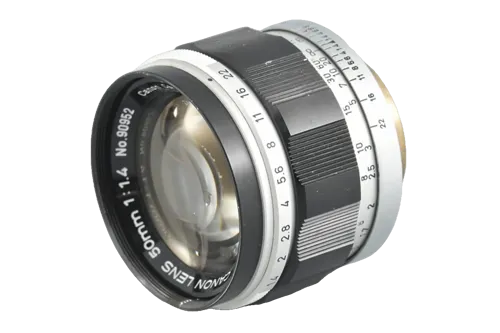
LTM mount
The Canon 50mm f/1.4 I is a LTM-mount lens for Leica rangefinder cameras. As of October 2026, it sells from €174 used across 1 listing, with a 30-day median of €174. Leica price index →
Measured against the 108 other 50mm LTM-mount lenses in the catalogue.
Often nicknamed the "Japanese Summilux," the Canon 50mm f/1.4 in Leica thread mount is the most popular of Canon's fast rangefinder fifties, sitting below the exotic 50mm f/0.95 and 50mm f/1.2 but outselling both on the strength of its compact size, balanced rendering, and modest cost [1][3]. Sources note that Canon's f/1.4 predates Leica's first Summilux by roughly two years, so the popular nickname, while a tribute to its quality, slightly understates that the Canon was not a copy of the German lens. Its optical design is a six-element, four-group Double Gauss (Planar or Biotar type), notable because most contemporary f/1.4 fifties of the 1950s and 1960s used seven elements to reach comparable performance; the Canon achieved its results with a simpler formula, helped by then-new high-refractive optical glass and building on the earlier Canon 50mm f/1.8 [2].
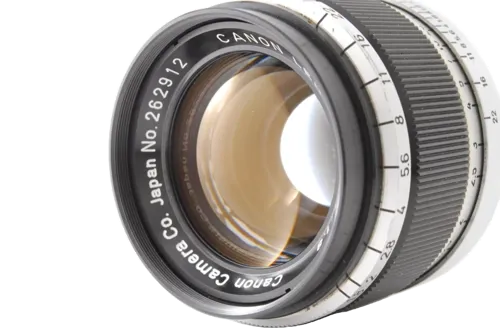
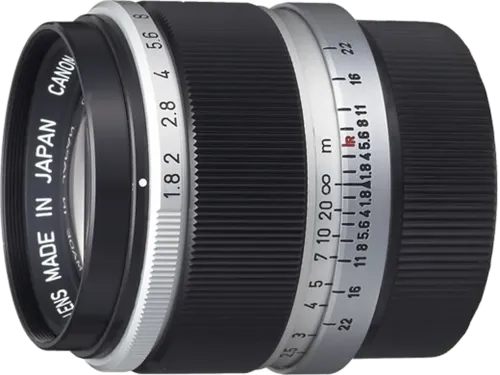
The barrel is all metal with engraved, paint-filled markings, and surviving examples generally hold up well mechanically. The aperture ring has distinct, evenly spaced full-stop clicks running to f/22, and the nine inwardly curved blades take on a "ninja-star" outline when stopped down. Focus travels roughly 180 degrees to a 1 metre minimum, the front element does not rotate, and the barrel carries an infinity lock of the spring-loaded type seen on some older Leica lenses. As an M39 lens it mounts directly on Barnack and other LTM bodies and couples to the rangefinder; with an M39-to-M adapter it works on Leica M cameras, and with appropriate adapters it is widely used on mirrorless digital cameras, including via the Techart LM-EA9 autofocus adapter. Reviewers note that two-tone chrome and black finish and the unusual 48mm filter thread.
Two versions share the same optical formula and differ mainly in their distance scale. The first version carries a smaller scale marked in either metres or feet, while the second version, introduced in 1959, shows both metres and feet together. Beyond that the differences are described as essentially cosmetic.
Rendering For its era the lens is regarded as relatively contrasty while retaining a degree of spherical-aberration "glow" wide open, a combination that gives the subject separation its admirers value. Sharpness is usable at f/1.4 and improves on stopping down.
Sharpness At portrait distances around 1.5 metres the lens is soft but usable at f/1.4, with contrast rising noticeably by f/2.0. At infinity the whole frame is soft wide open; the centre becomes good by about f/2.8 while the midframe lags due to field curvature, and the corners only reach decent performance around f/11. It is therefore better suited to portraits and general use than to demanding infinity landscape or architecture work.
Bokeh and transitions Background blur is often described as smooth and pleasing at mid distances, but complex or high-contrast backgrounds can render busy, with outlining and double-edged structures and some swirl toward the corners. Strong optical vignetting truncates out-of-focus highlights into triangular shapes near the edges.
Flare resistance Typical of a 1957 single-coated design, flare control is limited: ghosts and even a ring flare can appear wide open, improving when stopped down, and veiling flare is possible with the sun outside the frame.
Distortion and vignetting Distortion is mild and fairly uniform, correcting easily. Light falloff is heavy at f/1.4, around 3.4 EV, but drops quickly on stopping down and becomes very low from f/5.6.
Aberrations Coma is strong wide open and largely clears only around f/5.6, and longitudinal chromatic aberration shows green and magenta outlining with noticeable purple fringing near the focal plane, mostly gone by f/2.8; lateral CA is low to moderate.
Development and Launch The lens was developed as the top of Canon's standard rangefinder fifty line, one of two f/1.4 entries among the many 50mm rangefinder lenses Canon produced between the mid-1940s and mid-1960s. Some references, including Canon's own museum, give a 1957 release, while others place its practical introduction nearer 1959, noting that the V/L cameras of 1957 are more often seen with the 50mm f/1.2 and that a 1958 sales brochure omits the f/1.4 entirely. The lens is most commonly encountered on the Canon 7 of 1961 and sometimes on the Canon P.
Production Evolution Both versions used the same six-element optical layout, with the change between them being the distance scale, single-unit metres or feet on the first version and combined metres and feet on the second from 1959 onward. After Canon left rangefinder production in the early 1970s, the company concentrated on SLRs.
Special editions No widely documented factory special editions, military variants, or rare finishes are recorded for this lens in the consulted sources; it is generally found in its standard chrome-and-black trim.
Collector Notes Reported finish is a black, white, and chrome combination, with a chrome body and black focus-ring and front sections. The matching factory hood is identified as the S-50, with an all-black version said to have been made for the Japanese market. As with many Canon LTM lenses, age-related faults are common, including fungus, balsam separation, haze, and oily aperture blades, some not easy to spot, so buying unseen carries risk. The unusual 48mm filter thread and the 1 metre minimum focus are practical points worth noting before purchase. Measured weights cited by reviewers vary slightly around the mid-240-gram range.
About the usual price. The lowest listing is around the 30-day average.
Over the last 15 weeks the median price for the Canon 50mm f/1.4 I has fallen, ranging from €172 to €292 (now €174).
Weekly price (EUR). Median (Good or better) and lowest (Good or better) across 15 weeks. The full figures follow in the table below.
| Week | Median | Lowest |
|---|---|---|
| Jun 1, 2026 | €424 | €273 |
| Jun 8, 2026 | €424 | €273 |
| Jun 15, 2026 | €424 | €273 |
| Jun 22, 2026 | €424 | €273 |
| Jun 29, 2026 | €424 | €273 |
| Jul 6, 2026 | €424 | €273 |
| Jul 13, 2026 | €424 | €273 |
| Jul 20, 2026 | €424 | €273 |
| Jul 27, 2026 | €424 | €273 |
| Aug 24, 2026 | €172 | Unknown |
| Aug 31, 2026 | €176 | Unknown |
| Sep 7, 2026 | €179 | Unknown |
| Sep 14, 2026 | €174 | Unknown |
| Sep 21, 2026 | €175 | Unknown |
| Sep 28, 2026 | €174 | Unknown |
Every shop grades differently. Leica Classic uses letters, Ffordes uses E++ and E+, German dealers write "Zustand B", Japanese dealers write A−. We map all of them onto the one ladder below. Where a shop states its own grade, we print it under ours.
As of October 2026, the Canon 50mm f/1.4 I sells from €174 used, with a 30-day median of €174, across 1 active listing.
As of October 2026, the Canon 50mm f/1.4 I is sold by 1 source (1 listing), from €174 used: all compared cheapest-first on this page.
Similar lenses you might be interested in
Comments