Best price
Canon 50mm f1.2 - Leica M
Sold by One Of Many Cameras
€681 ≈ $736
The Canon 50mm f/1.2 is a fast LTM rangefinder lens from the 1950s, prized by collectors for its compact build and distinctive vintage rendering.
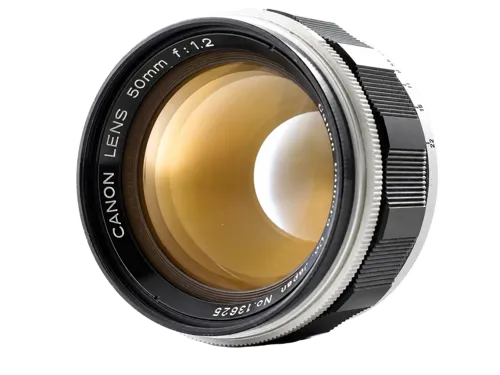
LTM mount
The Canon 50mm f/1.2 is a LTM-mount lens for Leica rangefinder cameras. As of October 2026, it sells from €681 used across 2 listings, with a 30-day median of €681. Leica price index →
Measured against the 108 other 50mm LTM-mount lenses in the catalogue.
Among Canon's large family of screw-mount rangefinder lenses, the 50mm f/1.2 stands out as one of the fastest standard lenses the company built before it shifted its attention to SLRs. Canon produced no fewer than 59 different Leica Thread Mount (M39) lenses between 1946 and 1964, and within that lineup the 50mm f/1.2 was the second-fastest design, sitting below only the later 50mm f/0.95 "Dream Lens" [1]. It was released in 1956 as part of Canon's push to offer affordable high-speed optics for its rangefinder bodies, at a time when ultra-fast normal lenses such as the f/1.1 Nikkor and f/1.1 Zunow were rare and expensive[3].
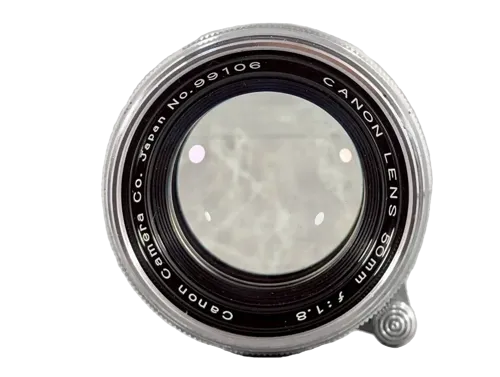
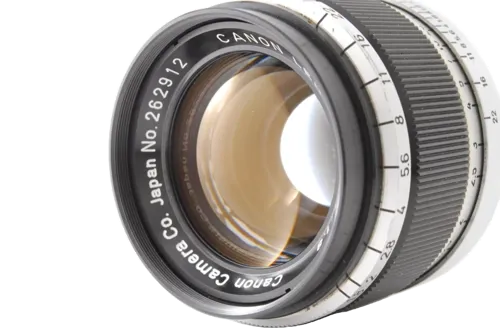
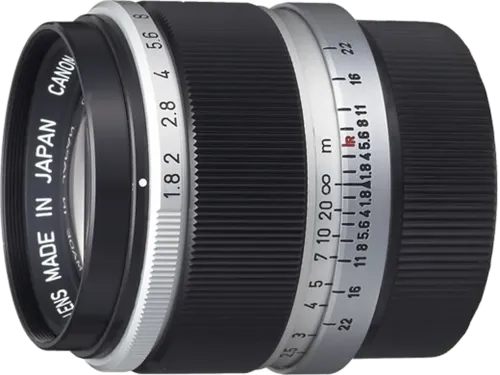
Optically the lens uses a seven-element, five-group design with one cemented rear group, and it focuses to a minimum distance of 1 m, which is long by later standards. The barrel is short and stocky, built almost entirely of metal with engraved, paint-filled markings, and the 11-bladed aperture stops down with distinct, equally spaced full-stop clicks; the inward-curved blades shape the out-of-focus highlights as the lens is closed down. The front element does not rotate during focus, the focus ring travels roughly 180 degrees, and the lens carries an infinity lock of the type common to LTM optics of the era, which helps mount and unmount the lens without straining the focus helicoid. Because it is fully M39 rangefinder-coupled, it mounts on Leica screw bodies and, with a simple M39-to-M adapter, on Leica M cameras and most mirrorless systems; its short, wide barrel means rangefinder blockage is minimal at infinity and grows only modestly at close focus.
Canon's lens history records 16 different 50mm rangefinder lenses made between 1946 and 1964, but only one with an f/1.2 maximum aperture, so the model is not subject to the multiple optical revisions seen in some of its other fifties. As with most Canon LTM glass, samples can vary in condition rather than formula, and the lens is generally cited as having been produced from 1956 into the early 1960s.
Rendering The Canon 50mm f/1.2 is valued today chiefly for its vintage character rather than clinical performance. Wide open it shows heavy undercorrected spherical aberration, producing a soft, low-contrast image with visible glow around bright areas; contrast improves markedly by f/2.0, where the lens behaves much more like a modern optic. Reviewers describe it as a lens with a dual personality, gentle and atmospheric near maximum aperture and notably sharper and more contrasty when stopped down.
Sharpness At infinity the whole frame is soft at f/1.2 to f/1.4, with the center becoming good from f/2.0 and very good by f/2.8; field curvature keeps the mid-frame weaker until the lens is stopped well down, and the extreme corners never become excellent. The design appears optimized for portrait distances around 1.5 m rather than for distant flat-field work, and strong focus shift is reported at the 1 m minimum distance that largely disappears at slightly greater distances.
Bokeh and transitions The lens delivers a distinctive out-of-focus look that improves with stopping down, with many users preferring its rendering around f/2.0; the 11 curved blades render highlights as soft circles wide open that take on an 11-sided and then scalloped shape by f/2.8.
Flare resistance With 1950s coatings, flare resistance is limited. Shooting into strong light produces ghosting and veiling flare, and stopping down can introduce reflections of the aperture blades, though some photographers seek out these flare effects deliberately for their aesthetic.
Distortion and vignetting Distortion is negligible across most of the frame but becomes noticeable toward the corners, requiring a lens-specific profile for full correction. Vignetting is on the order of about 3 EV wide open, falling as the lens is stopped down, which is comparable to other fast compact 50mm lenses.
Aberrations Coma is strong and persists even at small apertures, and there is moderate lateral chromatic aberration that corrects well in software, plus some longitudinal color that clears slowly on stopping down.
Collector and user notes By modern measures the lens is not a strong performer, and it appeals mainly to collectors and to photographers seeking a specific vintage look; it is frequently noted as a more affordable entry into 1950s f/1.2 rangefinder glass than the rarer fast Leica, Fujinon, Hexanon or Zunow alternatives.
Development and Launch Canon built rangefinder cameras and lenses before moving to FD-mount SLRs, and its 50mm f/1.2 appeared in 1956 as the second-fastest member of a deep LTM lens line. Contemporary accounts place its introduction in the mid-to-late 1950s and frame it as a comparatively attainable high-speed normal lens at a time when the fastest fifties from other makers were scarce and costly. The fastest of all Canon's series-production rangefinder fifties, the 50mm f/0.95 "Dream Lens," followed later, in 1963.
Production Evolution Canon's own records list only one f/1.2 among its sixteen 50mm rangefinder lenses, so the model is regarded as a single optical design rather than a series of reworked versions, produced from 1956 into the early 1960s.
Special editions No widely documented factory special editions, military variants or alternate finishes of the Canon 50mm f/1.2 LTM are commonly cited in collector sources.
Collector Notes Because these lenses are now around seventy years old, condition is the central concern. Fungus, haze, oily aperture blades and balsam separation of the cemented rear group are all reported, and some of these faults are hard to detect, making remote purchases risky. Balsam separation in particular can affect bokeh, contrast and flare, so the rear group is worth inspecting carefully. Buyers should verify glass clarity and smooth aperture and focus action, and for use on digital Leica M bodies a quality M39-to-M adapter that brings up the correct 50/75 mm framelines is recommended, since cheaper adapters can disturb rangefinder accuracy. The detailed reference work by Peter Kitchingman, "Canon M39 Rangefinder Lenses 1939-1971," is cited by collectors as the authoritative source on the variations within this family.
About the usual price. The lowest listing is around the 30-day average.
Lowest price Click a mark to open that listing · arrow keys to step, Enter to open
Price against condition for 2 listings of Canon 50mm f/1.2, €681 to €4,583, median €2,632. Excellent: 1 at €4,583. Unknown: 1 at €681. The full table follows.
| Condition | Lowest | Median |
|---|---|---|
| Excellent | €4,583 | €4,583 |
| Other | €681 | €681 |
Over the last 18 weeks the median price for the Canon 50mm f/1.2 has risen, ranging from €435 to €704 (now €681).
Weekly price (EUR). Median (Good or better) and lowest (Good or better) across 18 weeks. The full figures follow in the table below.
| Week | Median | Lowest |
|---|---|---|
| Jun 1, 2026 | €500 | €399 |
| Jun 8, 2026 | €500 | €399 |
| Jun 15, 2026 | €500 | €399 |
| Jun 22, 2026 | €435 | Unknown |
| Jun 29, 2026 | €435 | Unknown |
| Jul 6, 2026 | €435 | Unknown |
| Jul 13, 2026 | €435 | Unknown |
| Jul 20, 2026 | €563 | Unknown |
| Jul 27, 2026 | €566 | Unknown |
| Aug 3, 2026 | €568 | Unknown |
| Aug 10, 2026 | €569 | Unknown |
| Aug 17, 2026 | €573 | Unknown |
| Aug 24, 2026 | €571 | Unknown |
| Aug 31, 2026 | €570 | Unknown |
| Sep 7, 2026 | €704 | Unknown |
| Sep 14, 2026 | €696 | Unknown |
| Sep 21, 2026 | €692 | Unknown |
| Sep 28, 2026 | €681 | Unknown |
Every shop grades differently. Leica Classic uses letters, Ffordes uses E++ and E+, German dealers write "Zustand B", Japanese dealers write A−. We map all of them onto the one ladder below. Where a shop states its own grade, we print it under ours.
As of October 2026, the Canon 50mm f/1.2 sells from €681 used, with a 30-day median of €681, across 2 active listings.
As of October 2026, the Canon 50mm f/1.2 is sold by 2 sources (2 listings), from €681 used: all compared cheapest-first on this page.
Similar lenses you might be interested in
Comments