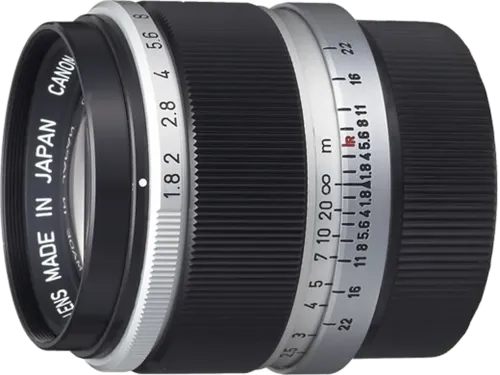
Canon 50mm f/1.8 III is a compact six-element LTM rangefinder standard lens from 1958, a cheap, well-regarded vintage fifty for screw-mount and M bodies.
Canon 50mm f/1.8 III
LTM mount
No listings tracked for this lens right now.
The Canon 50mm f/1.8 III is a LTM-mount lens for Leica rangefinder cameras. Leica price index →
How it compares
Measured against the 108 other 50mm LTM-mount lenses in the catalogue.
Specification
About this lens
Canon 50mm f/1.8 III
Among the inexpensive normal lenses that Canon built for its postwar rangefinder cameras, the 50mm f/1.8 III is one of the most widely used and easiest to find today. It is a compact, all-metal standard lens in Leica thread mount, descended from the Serenar line of 50mm optics Canon developed after the war, and it remained a staple option for owners of Canon's screw-mount bodies into the 1960s [2][3]. Canon's own records date its marketing to December 1958 at an original price of 20,000 yen [1].
The optical formula is a six-element design arranged in four groups, a Planar-type layout typical of fast normal lenses of the period, with a nine-blade diaphragm stopping down to f/22 and a closest focusing distance of one meter. Build is all metal and the lens is notably small and light, which makes it balance well on a Barnack-style or Canon rangefinder body. The aperture detents are firm and the focus throw is fairly long, which aids precise manual focusing. Because it uses the Leica thread mount, it couples with the rangefinder and can be fitted to Leica M bodies through a simple LTM-to-M adapter while retaining rangefinder coupling.
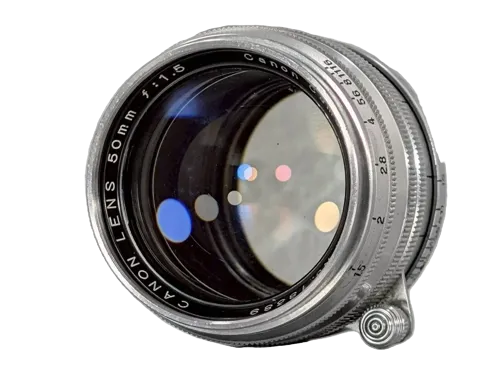
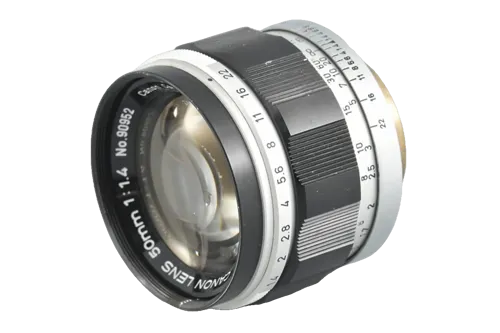
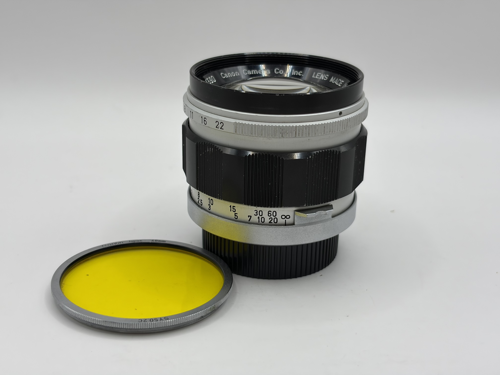
The 50mm f/1.8 appeared in more than one generation. Early examples were finished in bright chrome, while later versions, including this one, used lighter metals and a two-tone finish; the optical design across the variants is described as essentially the same, with only minor differences claimed by some users and not firmly established. The "III" designation places it as the later iteration in this family of f/1.8 fifties.
Optical qualities
Rendering The lens resolves a good level of detail and separates subjects easily, but its character is shaped strongly by contrast behavior and, in many surviving copies, by internal haze. Wide open it can show a soft, slightly misty glow with reduced contrast, an effect that stopping down reduces; reviewers note this look can read as soft on film but works well as a filmic, lower-contrast rendering on digital sensors.
Bokeh and transitions Out-of-focus areas are described as smooth, with clean subject separation and without the busy backgrounds that some Planar-type designs can produce, though the f/1.8 maximum aperture is not an extreme bokeh lens.
Contrast and color Colors are muted in the way expected of an older lens, without a strong identifiable cast; the lower contrast tends to tame saturated digital files toward a film-like look.
Flare resistance With period coatings, flare resistance is modest and contrast drops noticeably when shooting into bright light, an effect made worse on hazy copies.
Digital use Adapted to mirrorless and digital rangefinder bodies, the lens is valued for a soft, vintage rendering; users report pleasing results on CCD-sensor Leica M cameras and on APS-C bodies, where it acts as a short-telephoto equivalent.
History
Development and Launch Canon manufactured rangefinder cameras and lenses in Leica thread mount during the early postwar decades, and its normal lenses evolved from the Serenar designs of the late 1940s and early 1950s. The 50mm f/1.8 III was marketed from December 1958 as one of the standard options for Canon's screw-mount system, sitting below the faster f/1.4 and f/1.2 fifties in the lineup.
Production Evolution The f/1.8 fifty passed through more than one version. The earliest were bright chrome, while later production, including this iteration, moved to lighter alloy barrels and a two-tone finish; collectors generally treat the optical design as carried over with little change between versions.
Collector Notes These lenses are common and have long been inexpensive, often selling well under 100 US dollars, with many copies sourced from Japan, though prices have been rising. The most important point to check before buying is internal haze: the design is prone to haze on the middle elements near the diaphragm, and if left untreated it can etch the glass and become permanent, degrading contrast and adding a misty veil. A hazy copy remains usable and some users even like the look, but it should be reflected in the price.
Sources
Where to buy
Related lenses
Similar lenses you might be interested in
Comments