The Canon 50mm f/1.8 II is a compact LTM screw-mount rangefinder normal lens, a well-regarded and affordable double-Gauss fifty favored by film and digital users.
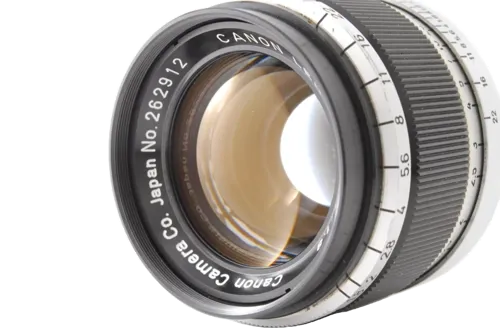
Canon 50mm f/1.8 II
LTM mount
No listings tracked for this lens right now.
The Canon 50mm f/1.8 II is a LTM-mount lens for Leica rangefinder cameras. Leica price index →
How it compares
Measured against the 108 other 50mm LTM-mount lenses in the catalogue.
Specification
About this lens
Canon 50mm f/1.8 II
Among the inexpensive Japanese rangefinder normals from the 1950s, the Canon 50mm f/1.8 has earned a lasting following for delivering far more than its low price suggests. It belongs to a family of rigid 50mm lenses that Canon built for its Leica Thread Mount cameras, descended from the company's earlier Serenar-branded optics. The first 50mm f/1.8 LTM appeared in 1951, still branded Serenar, and progressively new models of this rigid normal lens were produced until 1958. The lens reviewed here is a six-element design in four groups, a layout that several writers describe as a double-Gauss configuration. It is a double-Gaussian design, which is also the basis for the Zeiss Biotar that led to the Planar, and it is constructed with six elements in four groups. The optics were the work of one of Canon's well-known designers. The lens was designed by Hiroshi Ito, and manufacturing took place during the 1950s.
Physically the lens is small, light, and entirely metal, and it couples to the rangefinder through its LTM thread. It was a very compact lens designed for Canon's original rangefinder series of cameras, based on the post-war Serenar lens designs made by Canon. Because the mount is standard 39mm screw thread, the lens fits Barnack Leicas directly and mounts on Leica M bodies through an inexpensive adapter that preserves rangefinder coupling. M mount accepts LTM lenses through a cheap adapter, and it also keeps the rangefinder coupling. Handling is straightforward, with a front-mounted, clicked aperture ring and a focus ring that turns smoothly to a minimum distance of one metre. The aperture ring is easy to turn but not so easy that it moves by accident; it is a clicked aperture and the click can still be felt, although somewhat dampened. The barrel also carries an infinity lock, a small toggle that releases the focus ring from the infinity position, a feature common to Canon screw-mount lenses of the era. When focused on infinity the focus ring locks, and to release it the user presses the infinity lock toggle and turns the lens.
The f/1.8 was produced in several finishes over its run. The earliest copies came in an all-chrome configuration, which evolved over time so that black-and-chrome versions were also released. Collectors generally treat the optical formula across these finishes as essentially the same. The first f/1.8 lenses came in a shiny chrome build, while later ones were built with lighter metals and a different color; the optics are almost identical, though some claim slight differences exist. The verified specifications for this entry record a two-tone finish, nine aperture blades, and a 270 g weight; published collector accounts of individual copies sometimes differ on minor points such as blade count, so identification should rest on the lens in hand rather than a single secondary source.
Optical qualities
Rendering The lens has a vintage signature shaped by its early coatings and double-Gauss design: good central detail, moderate contrast, and a tendency toward a soft glow wide open that many users find pleasing on both film and digital. The lens has good sharpness and resolves plenty of detail, though lower contrast and a misty look can soften the impression of sharpness. Stopping down improves contrast and reduces the glow. Closing the lens down improves contrast and lessens the misty look.
Sharpness Performance is strong in the center and softer at the edges wide open, improving on stopping down. The corners lose a bit of sharpness, especially at wider apertures, but the fall-off is not huge; like most lenses it corrects beyond f/4 and is sharp across the whole frame.
Contrast and color Contrast is modest by modern standards, in line with the lens's age, and the color rendering is neutral rather than strongly cast. Contrast is a little on the low side, which is what one would expect of a lens of this vintage. The lens does not have a specific color cast, and the colors are muted as expected from an old lens.
Bokeh and transitions Out-of-focus rendering is generally smooth, without the busy backgrounds that some double-Gauss designs can show. The bokeh appears smooth, and although planar-design lenses can sometimes have a busy background, that has not been seen in this example.
Flare resistance As an early-coated lens, it is vulnerable to veiling flare and contrast loss in strong backlight, an effect worsened on hazy copies. Flare resistance is not the best, and the contrast loss when shooting against the sun can be quite significant.
Digital use On digital bodies, especially older CCD sensors, the lens's lower contrast and glow are often valued for a film-like look. On digital the smaller contrast and misty look make pictures look more like film, while the detail is still there and easier to post-process.
History
Development and Launch Canon entered lens manufacture in the years after the Second World War, initially under the Serenar name. It was not until the late 1940s that Canon started to manufacture their own lenses; initially they were labeled Serenar, which caused confusion as customers were looking for a Precision Optical camera and a Serenar lens, so in the early 1950s the company and branding changed to Canon. The f/1.8 normal grew out of this lineage, with the screw-mount fifties developed for Canon's own rangefinder bodies as well as Leica-compatible cameras.
Production Evolution The rigid 50mm f/1.8 was revised repeatedly across the 1950s, with the chrome early versions giving way to lighter, darker-finished later examples while the basic six-element optical design carried through. Progressively new models of this rigid normal lens were produced until 1958, with early all-chrome copies later evolving into black-and-chrome versions.
Collector Notes The most important point for buyers is internal haze. This lens is prone to hazing in the middle elements near the aperture blades, and if the haze is not dealt with in time it can etch the glass and become permanent. A hazy copy will show reduced contrast and a stronger misty effect, so inspecting the glass before purchase is essential. Most of the degradation from haze is reduced contrast, but it can also give a light mist-like look. Despite this, the lens remains affordable and highly regarded. Although these lenses are cheap, they are well regarded, and prices have begun to rise.
Sources
Where to buy
Related lenses
Similar lenses you might be interested in
Comments