The Canon 5cm f/2 Serenar Collapsible is a scarce postwar Double Gauss LTM rangefinder lens, prized by Canon screw-mount collectors more for rarity than speed.
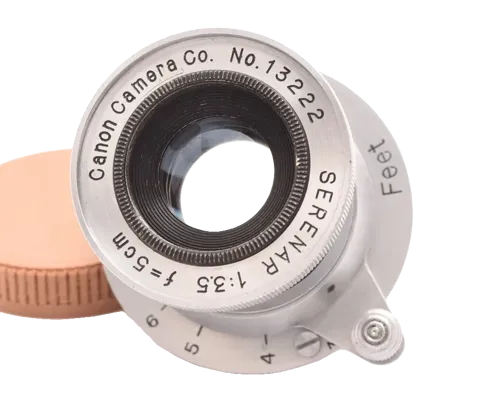
Canon 5cm f/2 Serenar Collapsible
LTM mount
No listings tracked for this lens right now.
The Canon 5cm f/2 Serenar Collapsible is a LTM-mount lens for Leica rangefinder cameras. Leica price index →
How it compares
Measured against the 108 other 50mm LTM-mount lenses in the catalogue.
Specification
About this lens
Canon 5cm f/2 Serenar Collapsible
Among the early postwar Canon screw-mount lenses, the collapsible 5cm f/2 Serenar is one of the scarcer normal lenses, made in small numbers over a brief production run and now sought after by Canon rangefinder collectors more for its rarity than for its modest maximum aperture [2][3]. Canon released it in February 1947 as a faster alternative to the f/3.5 Serenar, offering it as an option for the Canon S II body, and the "Serenar" name itself came from a prewar in-house naming process meaning serene or tranquil [1][4].
Optically the lens is a six-element, four-group Double Gauss design, distinct from the Sonnar-type formula used by the contemporary Nikkor f/2, and its collapsible barrel closely resembles that of the Leitz Summitar of the same era. It uses a thirteen-blade diaphragm and, in keeping with lenses of its period, has no click stops on the aperture ring. The filter thread is 40 mm and the front cap size is 42 mm. As an LTM (Leica thread mount, M39) lens it is rangefinder coupled and focuses to about one metre, mounting on Canon and other 39 mm screw bodies, though some early Canon mounts were cut to a deliberately loose "semi-universal" tolerance that affects cross-body fit. The Canon Camera Museum lists the lens at a 25,000 yen launch price.
Collector references identify several barrel and marking variants. Drawing on Peter Kitchingman's research, four types are recognised: the first two carry a depth-of-field scale running from f/2 to f/16 while the aperture itself stopped to f/11, with the only difference between them being the maker name change from "Seiki-Kogaku" to "Canon Camera Co." in October 1947; the lower-case engraving became upper case from the second type onward. Type 3 lenses adopted a true f/16 minimum aperture with a matching scale and were the first to receive coated elements, and the Type 4 of April 1949, the most numerous, reverted to an f/11 minimum with a corresponding scale. The locking bayonet and barrel details differ from the later 50mm f/1.9 Serenar, with a wider bare-brass bayonet flange and thicker bayonets on the f/2.
Optical qualities
Rendering Documented impressions of this lens are limited, reflecting how few were made. As a 1940s Double Gauss with early or no coating, it is consistent with the gentle, lower-contrast rendering typical of the period; a collector using one on a digital body described a soft look wide open that tightens up noticeably by f/2.8, where performance improves beyond expectation. Most accounts emphasise that the lens is collected for its scarcity rather than for outstanding optical performance.
History
Development and Launch Canon introduced the 5cm f/2 Serenar in February 1947 as a faster normal lens to accompany the Canon S II rangefinder, positioned above the slower f/3.5 Serenar in the early postwar lineup. The Serenar name predated the war, having been selected in an internal company contest for Canon's first 50mm f/3.5 and 135mm f/4 lenses and chosen to convey calm and clarity.
Production Evolution Production was short, running only into 1949 before the recomputed 50mm f/1.9 Serenar took over as the standard fast normal lens. Across that run the lens passed through four documented types, marked by the maker-name change of October 1947, a shift between f/11 and f/16 minimum apertures and their depth-of-field scales, and the introduction of lens coating with the third type. Serial numbers for the line began at 20001, with the earliest example located by Kitchingman numbered 20008.
Special editions No widely documented military, export, or special factory editions of this lens are recorded; the principal variations are the four production types described above.
Collector Notes Total production was very small, with collector counts ranging from a few hundred for the earliest types up to roughly 1,300 or so for the most common Type 4, and the lens has long had a reputation for being hard to find. Buyers can confirm type and era through the maker name (Seiki-Kogaku versus Canon Camera Co.), the case of the engraving, and the aperture and depth-of-field scale markings, since coated optics appear only from the third type onward. Note that the Canon Camera Museum's published figures differ slightly from collector data: the museum lists a roughly 47.5 by 42 mm size, a 230 g weight, and a 1.07 m closest focusing distance, and does not record a blade count or filter size for the lens.
Sources
Where to buy
Related lenses
Similar lenses you might be interested in
Comments