Best price Good
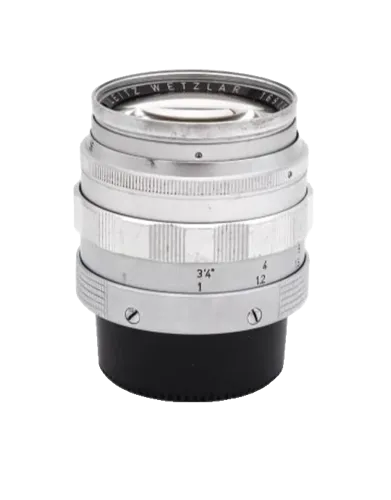
Leitz Xenon 1.5 / 5cm in Leica screw mount
Sold by Fotohandel Delfshaven
€883 ≈ $954
Leica's Xenon 50mm f/1.5 in LTM screw mount was the company's first super-speed standard lens, a 1930s Schneider-built rival to the Zeiss Sonnar prized by collectors.
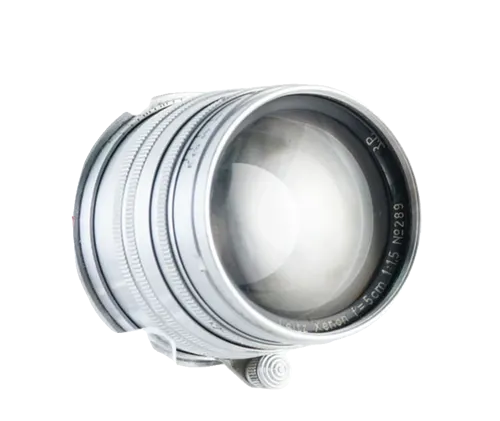
LTM mount
The Leica Xenon 50mm f/1.5 is a LTM-mount lens for Leica rangefinder cameras. As of October 2026, it sells from €883 used across 3 listings, with a 30-day median of €1,111. Leica price index →
Measured against the 108 other 50mm LTM-mount lenses in the catalogue.
The Xenon 5cm f/1.5 was Leitz's answer to the fast standard lens race of the 1930s, when Zeiss had seized the high-speed market with its Sonnar on the Contax. Leica, an up-and-coming competitor to the Contax with the recently released Leica IIIa, needed a fast lens to compete with the Sonnar, so Ernst Leitz engaged Schneider-Kreuznach to create one. The Leitz Xenon 5cm f/1.5, referencing Taylor-Hobson British patent 373950 and US patent 2019985 and originally conceived as a cinema lens, came into production in 1936. The Xenon name itself was Schneider's trade name for its asymmetric double-Gauss family, and the underlying design traces to Albrecht Wilhelm Tronnier's work at Schneider, which in turn drew on H. W. Lee's Opic of 1920 [1][2].
In the screw-mount Leica system the Xenon is a rangefinder-coupled standard lens of seven elements in five groups, with a six-bladed diaphragm and a one-meter close focus [3]. It is an uncoated design, reflecting its mid-1930s origins, and is among the heavier and larger fast fifties of its era. A user who serviced one for internal haze confirmed the uncoated, seven elements in five groups construction and was impressed after shooting it on the M Monochrom and M9, which illustrates that surviving examples adapt to modern digital M bodies through the standard thread-to-bayonet path. Because the lens was sold into English-speaking markets, distance scales reflect that audience.
Production history is unusual. Erwin Puts has noted that the Leitz production records do not mention the Xenon, indicating it was manufactured by Schneider for Leitz, whereas the factory records show the later Summarit was made by Leitz. The Xenon also carried Taylor-Hobson markings on lenses destined for the US and UK. By one collector's review of historical documents and about 200 samples, the total of Taylor-Hobson engraved Xenons would be close to 2000 lenses, and all TTH-Xenons used a feet scale in order to sell in the US and Britain. The Xenon was eventually superseded by the Summarit 50mm f/1.5, and the lineage continued into the Summilux. The first Summilux 50mm f/1.5 of 1959 was identical in cross-section to the Xenon and Summarit but improved through the use of newly available high-refractive-index lanthanum glass.
Rendering Documentation of the Xenon's rendering is limited, and most observations come from collectors rather than formal testing. As an uncoated 1930s super-speed design it is most distinctive for its handling of contrast and flare. One user reported more flare than the Summarit and that the lens was not quite as sharp wide open as a contemporary Sonnar, which is consistent with its early uncoated construction. The same user speculated that the shape of the aperture was intended to minimize focus shift. Reports of stopped-down use indicate the lens tightens up at smaller apertures, again in line with its double-Gauss heritage.
Development and Launch The Xenon design originated in the mid-1920s when Tronnier, chief designer at Jos. A. Schneider in Bad Kreuznach, was tasked with producing a fast lens to rival the Ernostar. He patented the Xenon f/2 in 1925 as an asymmetrical double-Gauss of six elements in four groups, equivalent to the Opic, under German patent DE 439556. When Bertele's Sonnar reached the market on the Contax in 1932 and became a great commercial success, Leitz needed a competitor, which led to the Leitz Xenon 5cm f/1.5 of 1936. The Sonnar had already captured the market, however, and the Xenon sold only a fraction of the quantity that the Sonnar did.
Production Evolution The precise authorship of the 5cm f/1.5 design has long been debated. A patent, DE647830, describing a seven-element Gauss-type f/1.5 lens was filed by Ernst Leitz GmbH in September 1934 and issued in 1937, naming no inventor but very possibly designed by Tronnier of Schneider. Lenses carry a DRPa engraving meaning German patent pending, and the US and British patents referenced on TTH-marked Xenons and Summarits originated from a design by H. W. Lee on behalf of Kapella, which granted rights to Taylor, Taylor-Hobson. The Xenon was later replaced by the Leitz Summarit 50mm f/1.5, which the factory built in-house.
Special editions No major factory special editions of the screw-mount Xenon 5cm f/1.5 are widely documented. The most notable production distinction is the Taylor-Hobson engraved, feet-scaled examples made for the English-language markets.
Collector Notes The Xenon is collected as Leica's first super-speed standard lens and as a scarce alternative to the Sonnar. Surviving numbers are small, with one estimate placing the Taylor-Hobson engraved examples at close to 2000 lenses. Because the optics are uncoated, internal haze and cleaning marks are common concerns; one buyer found internal haze on an eBay example and cleaned the inner surfaces successfully after obtaining disassembly tips, so prospective buyers should inspect the glass carefully. The presence of Taylor-Hobson markings and a feet distance scale helps confirm an export example. The Xenon is also frequently discussed alongside its successor the Summarit and the later Summilux, so buyers should be careful not to confuse the three lenses, which share a related design lineage.
Good time to buy. The lowest listing is 20% below the 30-day average.
Lowest price Click a mark to open that listing · arrow keys to step, Enter to open
Price against condition for 3 listings of Leica Xenon 50mm f/1.5, €883 to €1,851, median €1,111. Excellent: 1 at €1,851. Good: 1 at €883. Unknown: 1 at €1,111. The full table follows.
| Condition | Lowest | Median |
|---|---|---|
| Excellent | €1,851 | €1,851 |
| Good | €883 | €883 |
| Other | €1,111 | €1,111 |
Over the last 18 weeks the median price for the Leica Xenon 50mm f/1.5 has risen, ranging from €850 to €1,851 (now €1,111).
Weekly price (EUR). Median (Good or better) and lowest (Good or better) across 18 weeks. The full figures follow in the table below.
| Week | Median | Lowest |
|---|---|---|
| Jun 1, 2026 | €850 | €850 |
| Jun 8, 2026 | €850 | €850 |
| Jun 15, 2026 | €850 | €850 |
| Jun 22, 2026 | €850 | €850 |
| Jun 29, 2026 | €850 | €850 |
| Jul 6, 2026 | €900 | €900 |
| Jul 13, 2026 | €898 | €898 |
| Jul 20, 2026 | €895 | €895 |
| Jul 27, 2026 | €1,444 | €904 |
| Aug 3, 2026 | €1,445 | €908 |
| Aug 10, 2026 | €1,446 | €910 |
| Aug 17, 2026 | €1,452 | €921 |
| Aug 24, 2026 | €916 | €916 |
| Aug 31, 2026 | €915 | €915 |
| Sep 7, 2026 | €912 | €912 |
| Sep 14, 2026 | €902 | €902 |
| Sep 21, 2026 | €897 | €897 |
| Sep 28, 2026 | €1,367 | €883 |
Every shop grades differently. Leica Classic uses letters, Ffordes uses E++ and E+, German dealers write "Zustand B", Japanese dealers write A−. We map all of them onto the one ladder below. Where a shop states its own grade, we print it under ours.
As of October 2026, the Leica Xenon 50mm f/1.5 sells from €883 used, with a 30-day median of €1,111, across 3 active listings.
As of October 2026, the Leica Xenon 50mm f/1.5 is sold by 2 sources (3 listings), from €883 used: all compared cheapest-first on this page.
Similar lenses you might be interested in
Comments