Best price
Leica LTM 50mm 5cm f2.5 Nickel Hektor lens
Sold by Cardinal Camera Used
€555 ≈ $599
The Leica Hektor 5cm f/2.5 is a 1930s LTM standard lens, the fastest early screw-mount Leitz fifty and a sought-after Barnack-era collector piece.
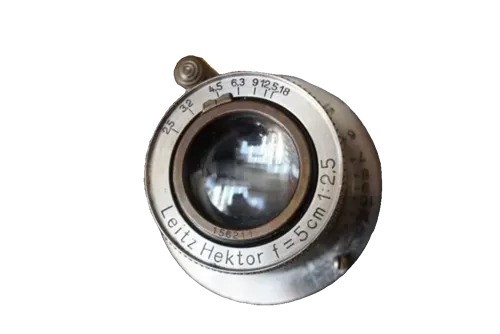
LTM mount
The Leica Hektor 5cm f/2.5 is a LTM-mount lens for Leica rangefinder cameras. As of October 2026, it sells from €555 used across 6 listings, with a 30-day median of €831. Leica price index →
Measured against the 108 other 50mm LTM-mount lenses in the catalogue.
The Hektor 5cm f/2.5 was the fastest standard lens Leitz offered in the early years of the Leica screw-mount system, sitting above the slower f/3.5 Elmar that most early Leica I bodies carried [1]. Its unusual optical layout, a six-element design arranged in three cemented groups, gives it a place in Leica history as an early step in Leitz's long search for a faster normal lens, a path that would later lead through the Summar and Summitar to the Summicron. Some of the very first examples began life as fixed lenses on the Leica I, and only a small number of those cameras left the factory with a Hektor rather than an Elmar[2].
The lens is a compact, slim barrel in 39mm Leica thread mount (LTM), and its narrow profile sits well on Barnack bodies without crowding the viewfinder. The focusing control is a tab at the base of the barrel, which is easy to reach on a screw-mount Leica but more awkward to operate on later M-series cameras through an adapter, and the aperture is set by a small index at the front of the lens in the manner of the contemporary Elmar. It is a collapsible (retractable) design, and the front-cell aperture setting and base-mounted focus together make handling distinctly old-fashioned by modern standards. Early examples were not coupled to the rangefinder; the lens itself carries no coating, as befits its pre-war origins.
Examples are found in both nickel and chrome finishes, with either a pin-type or a domed infinity release, and these details help place a given lens within the production run [3]. Early nickel versions show features such as the so-called eleven o'clock arrangement, the absence of an infinity lock on the earliest pieces, and engravings related to mount standardization; collectors note that lenses converted from fixed-mount Leica I cameras and later interchangeable lenses can be distinguished by markings on the focusing arm and inner barrel. Total production was modest, on the order of a few thousand lenses.
Rendering The Hektor 5cm f/2.5 is described by users as rendering with a soft, gentle character near maximum aperture, with the sharpest result at the plane of focus and only mild blurring in the near foreground and background. Documented testing is limited and tends to be based on single, often aged examples, so firm conclusions about its behavior in difficult conditions such as backlight are not well established.
Collector and user notes Because the three groups are cemented, many surviving lenses suffer from haze or separation in the cemented elements after roughly a century, so clean, well-corrected examples are uncommon.
Development and Launch Leitz introduced the Hektor 5cm f/2.5 around 1930 as a faster alternative to the f/3.5 Elmar within the early Leica screw-mount range. A number of the first lenses were fitted as fixed optics to Leica I cameras, of which only a small fraction carried a Hektor; the design represented Leitz's early attempt at a higher-speed normal lens before the f/2 Summar arrived.
Production Evolution Over its production the lens appeared in nickel and chrome finishes and with different infinity-release styles, from pin-type to domed releases. Early lenses converted from or matched to specific fixed-mount Leica I bodies were individually paired with their cameras, while later standardized interchangeable examples could be fitted to any standardized body, a change reflected in engravings on the focusing arm such as a focal-length group marking.
Collector Notes When evaluating a Hektor 5cm f/2.5, buyers should check for haze and separation in the cemented groups, confirm rangefinder coupling and focus accuracy where relevant, and inspect the finish and release type to judge originality, since nickel and chrome versions and pin or domed releases correspond to different periods. Markings related to mount standardization and focal-length grouping can confirm whether an early lens was originally fixed or interchangeable. Auction and dealer records show a wide spread of realized prices depending heavily on condition, with clean examples commanding a substantial premium over hazy or scratched ones. Suitable accessories for the period include the FIKUS adjustable hood used on contemporary Leitz lenses.
Good time to buy. The lowest listing is 33% below the 30-day average.
Lowest price Click a mark to open that listing · arrow keys to step, Enter to open
Price against condition for 6 listings of Leica Hektor 5cm f/2.5, €555 to €1,085, median €728. Good: 3 at €728, €728, €935. Fair: 1 at €1,085. Unknown: 2 at €555, €728. The full table follows.
| Condition | Lowest | Median |
|---|---|---|
| Good | €728 | €728 |
| Fair | €1,085 | €1,085 |
| Other | €555 | €641 |
Over the last 18 weeks the median price for the Leica Hektor 5cm f/2.5 has risen, ranging from €739 to €852 (now €831).
Weekly price (EUR). Median (Good or better) and lowest (Good or better) across 18 weeks. The full figures follow in the table below.
| Week | Median | Lowest |
|---|---|---|
| Jun 1, 2026 | €744 | €744 |
| Jun 8, 2026 | €744 | €744 |
| Jun 15, 2026 | €744 | €744 |
| Jun 22, 2026 | €744 | €744 |
| Jun 29, 2026 | €744 | €744 |
| Jul 6, 2026 | €744 | €744 |
| Jul 13, 2026 | €744 | €744 |
| Jul 20, 2026 | €744 | €744 |
| Jul 27, 2026 | €744 | €744 |
| Aug 3, 2026 | €748 | €748 |
| Aug 10, 2026 | €750 | €750 |
| Aug 17, 2026 | €758 | €758 |
| Aug 24, 2026 | €755 | €755 |
| Aug 31, 2026 | €753 | €753 |
| Sep 7, 2026 | €751 | €751 |
| Sep 14, 2026 | €743 | €743 |
| Sep 21, 2026 | €739 | €739 |
| Sep 28, 2026 | €728 | €728 |
Every shop grades differently. Leica Classic uses letters, Ffordes uses E++ and E+, German dealers write "Zustand B", Japanese dealers write A−. We map all of them onto the one ladder below. Where a shop states its own grade, we print it under ours.
As of October 2026, the Leica Hektor 5cm f/2.5 sells from €555 used, with a 30-day median of €831, across 6 active listings.
As of October 2026, the Leica Hektor 5cm f/2.5 is sold by 3 sources (6 listings), from €555 used: all compared cheapest-first on this page.
Similar lenses you might be interested in
Comments