Best price Fair
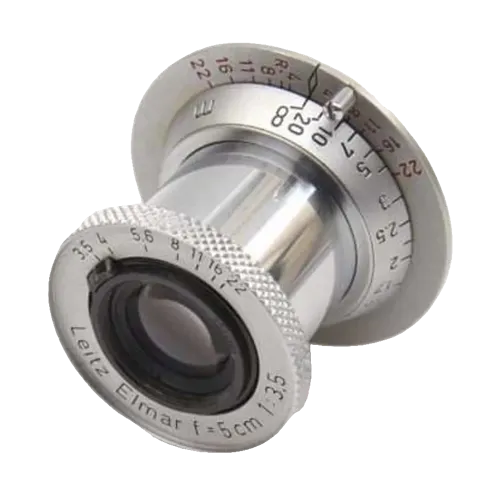
Leica Leitz Elmar 3.5 / 5cm, LTM, Nickel/chrome
Sold by Fotohandel Delfshaven
€259 ≈ $280
The Leica Elmar 50mm f/3.5 Nickel is an early collapsible LTM standard lens from Leica's transition to standardized, rangefinder-coupled lenses.
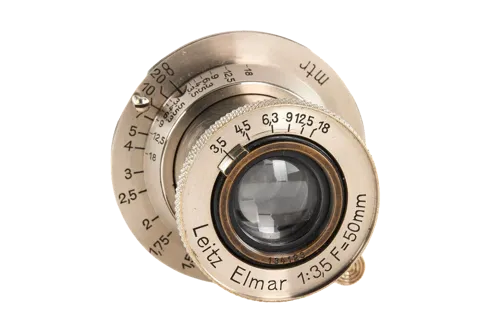
LTM / M39 mount
The Leica Elmar 50mm f/3.5 LTM Nickel (1930) is a LTM / M39-mount lens for Leica rangefinder cameras. As of October 2026, it sells from €259 used across 11 listings, with a 30-day median of €458. Leica price index →
Measured against the 117 other 50mm lenses in the catalogue.
The Leica Elmar 50mm f/3.5 Nickel is an early collapsible standard lens produced for Leica screw-mount cameras during the transition from fixed-lens Leica I cameras to standardized interchangeable L39 lenses. The optical design was developed by Max Berek and uses four elements arranged in three groups .
This entry covers nickel-finished collapsible 50mm f/3.5 Elmar lenses in Leica L39 / LTM / M39 screw mount. It includes the principal early focusing-lock variations, such as pin release, square release and later domed or bell-shaped release controls. These mechanical details are collector-relevant variants of the same basic lens and do not require separate optical entries.
This lens must remain separate from the Elmar 35mm f/3.5 Nickel, which is a different wide-angle lens, and from the later 50mm f/3.5 Elmar produced in M mount under model number 11110.
Rendering
The Elmar 50mm f/3.5 produces the classic rendering associated with early Leica photography. At full aperture, the centre can provide useful detail while the outer image is gentler and lower in contrast. Leica notes that stopping down by one or two stops significantly improves the outer zones.
Sharpness
Central sharpness is generally good for a compact lens of its period, particularly when the optical surfaces are clean and the lens is correctly focused. Definition becomes more even across the frame at medium apertures.
Contrast and color
Early nickel Elmars were normally uncoated. Contrast is therefore lower than on later postwar coated examples, especially when strong light falls directly on the front element.
The dedicated FISON hood or another suitable A36 hood can substantially reduce veiling flare. A hood is particularly useful on digital sensors, which may make flare and internal reflections more visible.
Bokeh and transitions
With a maximum aperture of f/3.5, the Elmar is not designed primarily for shallow depth of field. At closer distances, however, it can still provide gentle separation between the focused subject and background.
Distortion and vignetting
The four-element, three-group design provides a natural standard-lens perspective with limited geometric distortion. Some corner darkening and reduced peripheral definition can be visible at f/3.5.
Handling
The lens collapses into the camera body for transport. It must be fully extended and locked before taking photographs. Care is required on digital cameras and adapted bodies because the rear tube projects into the camera when collapsed.
Focusing extends from approximately one metre to infinity. The focusing lock secures the lens at infinity and also provides a convenient control for turning the focusing mount.
Early nickel lenses may have the lock positioned at approximately 11 o’clock, while later examples moved it toward the 7 o’clock position. Pin, square and domed release mechanisms appeared during this period of rapid mechanical development.
Filters and hoods use the A36 clamp-on fitting. Small screw-in filters may also be encountered around the front optical cell, but A36 is the appropriate database specification for the standard external accessory fitting.
Digital use
Standardized rangefinder-coupled examples can be used directly on Leica screw-mount cameras and on Leica M bodies with a suitable L39-to-M adapter.
The lens has no six-bit coding. Before collapsing it on a digital or adapted camera, rear-element clearance must be checked carefully. Leaving the lens extended is the safest practice when compatibility is uncertain.
Development and Launch
The 50mm f/3.5 Elmar developed from Max Berek’s early optical work for the Leica camera. The fixed version replaced the earlier Anastigmat and Elmax lenses on the Leica I during the 1920s.
The interchangeable screw-mount Elmar appeared in 1930. This coincided with Leica’s transition from fixed-lens cameras toward the Leica C, standardized screw mount and eventually the rangefinder-coupled Leica II.
Production Evolution
The years from 1930 through 1932 were particularly complex. Some early lenses were produced for non-standardized cameras and individually matched to their bodies. Others were later returned to Leitz and converted to standardized or rangefinder-coupled mounts.
The infinity-lock mechanism changed several times. Documented forms include:
Special Editions/Variants
The square-release lens is not a commemorative Special Edition. It is a rare normal-production mechanical variant.
Other collector-relevant variations include:
Collector Notes
Important identification points include the front-ring engraving, serial number, nickel finish, focusing-lock shape, focusing-lock position, distance scale and the presence of a standardized rangefinder cam.
Condition checks should include haze, fungus, cleaning marks, separation, aperture operation, smooth extension of the collapsible tube, focusing stiffness and wear to the locking mechanism.
Good time to buy. The lowest listing is 43% below the 30-day average.
Lowest price Click a mark to open that listing · arrow keys to step, Enter to open
Price against condition for 11 listings of Leica Elmar 50mm f/3.5 LTM Nickel (1930), €259 to €685, median €458. Excellent: 4 at €328, €340, €612, €685. Good: 4 at €369, €397, €458, €576. Fair: 1 at €259. Used: 2 at €458, €570. The full table follows.
| Condition | Lowest | Median |
|---|---|---|
| Excellent | €328 | €476 |
| Good | €369 | €428 |
| Fair | €259 | €259 |
| Other | €458 | €514 |
Over the last 21 weeks the median price for the Leica Elmar 50mm f/3.5 LTM Nickel (1930) has risen, ranging from €320 to €469 (now €458).
Weekly price (EUR). Median (Good or better) and lowest (Good or better) across 21 weeks. The full figures follow in the table below.
| Week | Median | Lowest |
|---|---|---|
| Jun 1, 2026 | €320 | Unknown |
| Jun 8, 2026 | €369 | €369 |
| Jun 15, 2026 | €369 | €369 |
| Jun 22, 2026 | €320 | Unknown |
| Jun 29, 2026 | €320 | Unknown |
| Jul 6, 2026 | €596 | €397 |
| Jul 13, 2026 | €794 | €794 |
| Jul 20, 2026 | €366 | €226 |
| Jul 27, 2026 | €454 | €328 |
| Aug 3, 2026 | €480 | €328 |
| Aug 10, 2026 | €480 | €328 |
| Aug 17, 2026 | €528 | €328 |
| Aug 24, 2026 | €458 | €328 |
| Aug 31, 2026 | €383 | €328 |
| Sep 7, 2026 | €383 | €328 |
| Sep 14, 2026 | €383 | €328 |
| Sep 21, 2026 | €383 | €328 |
| Sep 28, 2026 | €383 | €328 |
| Oct 5, 2026 | €428 | €328 |
| Oct 12, 2026 | €427 | €328 |
| Oct 19, 2026 | €428 | €328 |
Every shop grades differently. Leica Classic uses letters, Ffordes uses E++ and E+, German dealers write "Zustand B", Japanese dealers write A−. We map all of them onto the one ladder below. Where a shop states its own grade, we print it under ours.
As of October 2026, the Leica Elmar 50mm f/3.5 LTM Nickel (1930) sells from €259 used, with a 30-day median of €458, across 11 active listings.
As of October 2026, the Leica Elmar 50mm f/3.5 LTM Nickel (1930) is sold by 4 sources (11 listings), from €259 used: all compared cheapest-first on this page.
The Leica Elmar 50mm f/3.5 LTM Nickel (1930) takes 36 mm screw-in filters (E36).
The Leica Elmar 50mm f/3.5 LTM Nickel (1930) focuses down to 1 m, and the rangefinder stays coupled over the whole range.
The Leica Elmar 50mm f/3.5 LTM Nickel (1930) weighs 125 g, lighter than 82% of the 67 other 50mm lenses in the catalogue.
The Leica Elmar 50mm f/3.5 LTM Nickel (1930) is a Leica screw-mount (M39/LTM) lens. It fits Leica M bodies with a screw-to-M adapter, which keeps rangefinder coupling, and mirrorless cameras with an M39 adapter. It carries no 6-bit code, so select the lens profile by hand on a digital M.
The Leica Elmar 50mm f/3.5 LTM Nickel (1930) was produced from 1930 to 1933.
Similar lenses you might be interested in
Comments