Best price Good
LEICA (ライカ) Summitar ズミタール 50/2 (L39) 1950年製
Sold by Nisshin Camera
€310 ≈ $335
The Leica Summitar 5cm f/2 is a collapsible LTM-mount normal lens of 1939, a seven-element Leitz design prized by screw-mount collectors and film shooters.
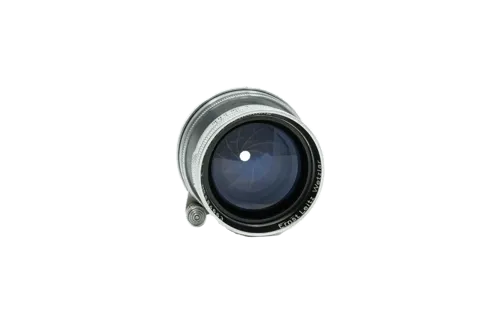
LTM mount
The Leica Summitar 5cm f/2 is a LTM-mount lens for Leica rangefinder cameras. As of October 2026, it sells from €310 used across 18 listings, with a 30-day median of €833. Leica price index →
Measured against the 108 other 50mm LTM-mount lenses in the catalogue.
The Summitar marked a clear step beyond the lens it replaced, the Summar, by adopting a larger and more complex front group to control light falloff and improve coverage. Its optical layout uses seven elements in four groups, an unusually rich count for a normal lens of its era, when most rival 50mm f/2 designs for rangefinder cameras stopped at six elements [1]. Leitz positioned it as its highest-performance standard lens from its 1939 introduction until the Summicron arrived in the early 1950s, and it was promoted as particularly well suited to the emerging demands of color photography.
Built in chrome-plated brass, the Summitar is a collapsible screw-mount (LTM) lens that retracts into the camera body for a very compact package, then twists and pulls out to its working position [3]. It is rangefinder coupled and focuses to one meter, with a long focus throw of close to 180 degrees that lends precise control [2]. The aperture is clickless, since detented stops were not introduced on the normal Leica 50 until the Summicron, and on early examples the engraved scale follows a non-standard sequence reading roughly f/2, 2.2, 3.2, 4.5, 6.3, 9 and 12.5, which can briefly confuse photographers used to modern full stops. With a screw-to-bayonet adapter the lens mounts and couples on later M cameras, although owners should note that collapsing it fully into some thin-bodied digital M cameras can risk contact with internal components.
Two production traits help identify and date a given lens. Examples made before the war are uncoated, while lenses from about 1946 carry a single blue coating on the optics. The diaphragm originally used ten blades, and around 1950 Leitz switched to a six-blade assembly, reportedly using up earlier Summar-type parts, so blade count is a useful clue to vintage. The front element is made from relatively soft glass that scratches easily, which is why many surviving lenses show cleaning marks.
Rendering The Summitar is known for strong central sharpness with softer corners by modern standards, a balance typical of late-1930s computation that prioritized the center of the frame. Wide open it shows a gentle, detailed softness that firms up by roughly f/3.5 to f/4, and stopping down improves edge performance though corners can still trail the center, an effect more visible on digital sensors than on film. The ten-blade aperture of early examples produces a smooth, painterly out-of-focus rendering, and some users describe a degree of background swirl at wide apertures, while others find the swirl modest; reports of dramatic swirl are not consistent. Coated examples can give surprisingly clean, even modern-looking contrast when in good condition, whereas hazy or uncoated lenses are more prone to veiling flare.
Development and Launch The Summitar was introduced in 1939 as the successor to the Summar 50mm f/2, which had been Leitz's flagship fast normal lens through the 1930s. The redesign enlarged the front optics relative to the Summar to reduce mechanical vignetting and light falloff, and replaced the Summar's single front element with a cemented pair, changes Leitz tied to the growing interest in color film. It remained the company's top normal lens until the Summicron 50mm f/2 superseded it in the early 1950s.
Production Evolution Production ran from 1939 into the mid-1950s. Lenses were uncoated before the war and single-coated from about 1946. The diaphragm began with ten blades and changed to a six-blade design around 1950. The barrel shares much of its handling and construction character with the first-generation Summicron that followed, reflecting the continuity in Leitz's screw-mount lens line.
Collector Notes When evaluating a Summitar, the most common points to check are the condition of the soft front element, which is easily scratched and frequently shows cleaning marks, and the smoothness of the clickless aperture, which can develop play with age. Whether a lens is coated or uncoated, and whether it has the ten-blade or six-blade diaphragm, both affect identification, dating and rendering, so these are worth confirming. Period accessories that suit the lens include screw-mount hoods and the E36 filter fitting, and a screw-to-M adapter is needed for use on M bodies.
Good time to buy. The lowest listing is 63% below the 30-day average.
Lowest price Click a mark to open that listing · arrow keys to step, Enter to open
Price against condition for 18 listings of Leica Summitar 5cm f/2, €310 to €4,021, median €456. Mint: 1 at €452. Excellent: 6 at €462, €519, €531, €576, €670, €830. Good: 4 at €310, €364, €366, €417. Fair: 2 at €366, €458. Unknown: 5 at €310, €352, €366, €670, €4,021. The full table follows.
| Condition | Lowest | Median |
|---|---|---|
| Mint | €452 | €452 |
| Excellent | €462 | €553 |
| Good | €310 | €365 |
| Fair | €366 | €412 |
| Other | €310 | €366 |
Over the last 18 weeks the median price for the Leica Summitar 5cm f/2 has risen, ranging from €244 to €833 (now €833).
Weekly price (EUR). Median (Good or better) and lowest (Good or better) across 18 weeks. The full figures follow in the table below.
| Week | Median | Lowest |
|---|---|---|
| Jun 1, 2026 | €439 | €324 |
| Jun 8, 2026 | €439 | €324 |
| Jun 15, 2026 | €674 | €324 |
| Jun 22, 2026 | €727 | €364 |
| Jun 29, 2026 | €629 | €364 |
| Jul 6, 2026 | €727 | €364 |
| Jul 13, 2026 | €727 | €364 |
| Jul 20, 2026 | €244 | €187 |
| Jul 27, 2026 | €576 | €364 |
| Aug 3, 2026 | €529 | €291 |
| Aug 10, 2026 | €529 | €291 |
| Aug 17, 2026 | €531 | €291 |
| Aug 24, 2026 | €495 | €306 |
| Aug 31, 2026 | €527 | €306 |
| Sep 7, 2026 | €529 | €306 |
| Sep 14, 2026 | €527 | €306 |
| Sep 21, 2026 | €527 | €306 |
| Sep 28, 2026 | €462 | €310 |
Every shop grades differently. Leica Classic uses letters, Ffordes uses E++ and E+, German dealers write "Zustand B", Japanese dealers write A−. We map all of them onto the one ladder below. Where a shop states its own grade, we print it under ours.
As of October 2026, the Leica Summitar 5cm f/2 sells from €310 used, with a 30-day median of €833, across 18 active listings.
As of October 2026, the Leica Summitar 5cm f/2 is sold by 6 sources (18 listings), from €310 used: all compared cheapest-first on this page.
Similar lenses you might be interested in
Comments