Best price Good
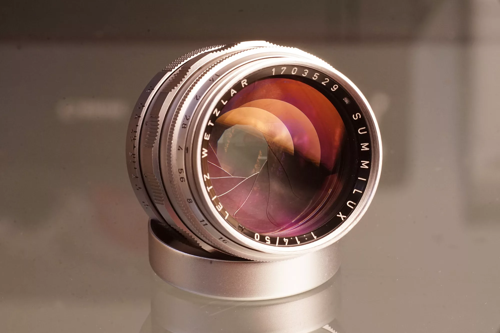
Leica 50mm f1.4 Summilux (Type I) (Silver, SOOME / 11114)
Sold by Kamerastore
€1,589 ≈ $1,716
Leica Summilux-M 50mm f/1.4 I, the 1959 M-mount first-generation Summilux with 7/5 optics, E43 filter thread and major collector relevance.
M mount
The Leica Summilux-M 50mm f/1.4 I is a M-mount lens for Leica rangefinder cameras. As of October 2026, it sells from €1,589 used across 17 listings, with a 30-day median of €3,003. Leica price index →
Measured against the 76 other 50mm M-mount lenses in the catalogue.
The Leica Summilux-M 50mm f/1.4 I is the original M-mount version of Leica's 50mm Summilux, introduced in 1959 as the successor to the 50mm f/1.5 Summarit. It established the Summilux name for Leica's high-speed f/1.4 lenses and occupied the fast standard-lens position in the Leica M system. The regular chrome M-mount version is associated with the Leitz code SOOME and catalogue number 11114. The original optical design had a comparatively short production period before Leica introduced a recomputed second-generation formula.
The first-generation lens uses seven elements in five groups and a 16-blade diaphragm. It has an E43 filter thread, rangefinder-coupled focusing to 1 metre and a substantial chrome-plated metal barrel. The regular chrome M-mount version weighs approximately 360 g. Its scalloped focusing ring and early barrel design are useful identification features, although external appearance alone is not sufficient to establish the optical version.
The Version I Summilux must be distinguished from the later Version II. Leica retained seven elements in five groups for the recomputed design, but changed the internal optical arrangement. Early examples of the succeeding version can also resemble the original lens externally. Serial number, production period and barrel characteristics should therefore be considered together when identifying an example. The contemporary SOWGE/11014 Leica Thread Mount version is closely related optically but should be treated as a separate database entry because it uses a different mount, catalogue designation and mechanical construction.
—
Rendering
The original Summilux design developed from the optical lineage of the earlier 50mm f/1.5 Summarit while incorporating newer optical glass. The first-generation formula is generally documented as having more restrained contrast and a gentler appearance at maximum aperture than the recomputed version that followed. Definition and contrast improve noticeably when the lens is stopped down.
Contrast and color
The Summilux represented an optical development beyond the earlier Summarit generation, but surviving lenses can vary considerably in apparent contrast because of age and condition. Haze, cleaning marks, coating deterioration and internal contamination can significantly influence the performance of an individual example.
—
Development and Launch
Leitz introduced the 50mm f/1.4 Summilux in 1959 as the replacement for the 50mm f/1.5 Summarit. It was the first production Leica lens to carry the Summilux name, which subsequently became Leica's designation for its fast f/1.4 lens class.
The M-bayonet version was produced for Leica M cameras and became the principal form of the new lens. The regular chrome version is associated with the Leitz code SOOME and catalogue number 11114. Its introduction occurred during the established Leica M3 era, when the M bayonet had already become Leica's primary interchangeable-lens mount.
Production Evolution
The original optical construction used seven elements arranged in five groups. Around the transition to the second generation, Leica recomputed the optical system while retaining the same total number of elements and groups. The later design became the basis of the long-lived second-generation 50mm Summilux.
Because early Version II lenses retained styling closely related to Version I, the two generations can be difficult to identify solely from photographs. The scalloped focusing ring is characteristic of early lenses but should not be used as the only means of determining the optical formula. Serial-number and production information remain important for accurate identification.
Special Editions/Variants
A rare black-lacquer M-mount version of the first-generation Summilux is documented and is associated with catalogue number 11113. It was produced in much smaller numbers than the standard chrome lens and is an important collector variant.
Prototype and pre-production lenses associated with the transition from the Summarit to the Summilux are also documented. Some early experimental examples retain Summarit-related engraving or other pre-series details and should not be confused with normal production SOOME lenses.
The Leica Thread Mount SOWGE/11014 is a related factory version from the same period. It should not be grouped under the regular SOOME/11114 M-mount profile because its mount, weight, catalogue identity and production rarity differ.
Collector Notes
Collectors should verify the serial number, mount, barrel configuration and optical condition when identifying a first-generation Summilux. The element and group count alone cannot separate Version I from Version II because both employ seven elements in five groups.
Original finish is also important, particularly with rare black examples where repainted chrome lenses can cause confusion. Buyers should inspect the optics for haze, cleaning marks, coating damage, separation and internal contamination, and should confirm smooth focusing, correct rangefinder coupling and proper aperture operation.
Original period accessories such as Leica hoods, caps, filters and packaging can add collector interest, particularly when they can be matched confidently to the lens's production period.
11113, black lacquer: Rare factory M-mount Version I variant.
11114 / SOOME, silver chrome: Standard production M-mount version covered by this profile.
Good time to buy. The lowest listing is 47% below the 30-day average.
Lowest price Click a mark to open that listing · arrow keys to step, Enter to open
Price against condition for 17 listings of Leica Summilux-M 50mm f/1.4 I, €1,589 to €18,707, median €3,066. Mint: 1 at €3,741. Excellent: 5 at €1,667, €2,572, €3,066, €3,835, €4,156. Good: 5 at €1,589, €1,959, €2,838, €3,378, €18,707. Fair: 3 at €2,079, €2,753, €3,394. Used: 3 at €2,301, €4,209, €13,512. The full table follows.
| Condition | Lowest | Median |
|---|---|---|
| Mint | €3,741 | €3,741 |
| Excellent | €1,667 | €3,066 |
| Good | €1,589 | €2,838 |
| Fair | €2,079 | €2,753 |
| Other | €2,301 | €4,209 |
Over the last 18 weeks the median price for the Leica Summilux-M 50mm f/1.4 I has risen, ranging from €2,365 to €3,282 (now €3,003).
Weekly price (EUR). Median (Good or better) and lowest (Good or better) across 18 weeks. The full figures follow in the table below.
| Week | Median | Lowest |
|---|---|---|
| Jun 1, 2026 | €2,838 | €1,249 |
| Jun 8, 2026 | €2,838 | €1,249 |
| Jun 15, 2026 | €2,845 | €1,249 |
| Jun 22, 2026 | €2,838 | €1,249 |
| Jun 29, 2026 | €2,838 | €1,249 |
| Jul 6, 2026 | €2,838 | €1,249 |
| Jul 13, 2026 | €3,060 | €1,249 |
| Jul 20, 2026 | €2,838 | €1,249 |
| Jul 27, 2026 | €2,621 | €1,249 |
| Aug 3, 2026 | €2,489 | €1,249 |
| Aug 10, 2026 | €2,405 | €1,249 |
| Aug 17, 2026 | €2,405 | €1,249 |
| Aug 24, 2026 | €2,405 | €1,667 |
| Aug 31, 2026 | €2,328 | €1,667 |
| Sep 7, 2026 | €2,328 | €1,667 |
| Sep 14, 2026 | €2,405 | €1,667 |
| Sep 21, 2026 | €2,489 | €1,604 |
| Sep 28, 2026 | €2,838 | €1,589 |
Every shop grades differently. Leica Classic uses letters, Ffordes uses E++ and E+, German dealers write "Zustand B", Japanese dealers write A−. We map all of them onto the one ladder below. Where a shop states its own grade, we print it under ours.
As of October 2026, the Leica Summilux-M 50mm f/1.4 I sells from €1,589 used, with a 30-day median of €3,003, across 17 active listings.
As of October 2026, the Leica Summilux-M 50mm f/1.4 I is sold by 3 sources (17 listings), from €1,589 used: all compared cheapest-first on this page.
Similar lenses you might be interested in
Comments