Best price Excellent
Leica 50mm f1.4 Summilux (II) 11868
Sold by One Of Many Cameras
€1,947 ≈ $2,103
The Leica Summilux-M 50mm f/1.4 (third version) is an M-mount fast standard lens with a built-in hood and E46 filter, prized as the last pre-aspherical 50.
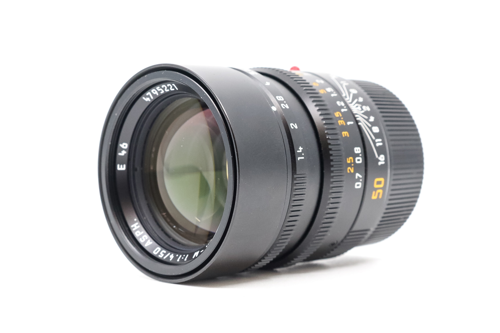
M mount
The Leica Summilux-M 50mm f/1.4 III is a M-mount lens for Leica rangefinder cameras. As of October 2026, it sells from €1,947 used across 25 listings, with a 30-day median of €3,009. Leica price index →
Measured against the 76 other 50mm M-mount lenses in the catalogue.
The third version of the Summilux-M 50mm f/1.4 is the last and most refined incarnation of Leica's long-running pre-aspherical fast fifty, a design whose optical layout had served the M system since the early 1960s. What sets this version apart from its predecessors is not the glass but the barrel: it introduced a built-in telescoping hood and switched the filter thread to E46, while retaining the same well-corrected double-Gauss formula of seven elements in five groups [1][2]. Collectors and users often refer to it simply as the "pre-ASPH" Summilux, distinguishing it from the aspherical successor that replaced it in 2004.
Optically the lens uses a seven-element, five-group construction with a twelve-blade diaphragm that forms a notably round aperture, and it stops down to f/16 with half-stop clicks. Compared with the earlier E43 barrels, this version focuses down to 0.7 m rather than 1 m, a meaningful gain in close-up flexibility for a 50mm rangefinder lens. It couples to the M rangefinder mechanically and works on all M-mount bodies; the black anodized aluminum version weighs about 275 g, while the brass-bodied silver and titanium finishes are heavier. The built-in telescoping hood replaced the separate clamp-on hoods of the older barrels, simplifying handling at the cost of some finder intrusion when extended.
This version was produced from 1992 to 2004 and carried order numbers 11868 for black and 11856 for silver, with titanium and other finishes assigned their own numbers. The Leica Wiki documents a production run of more than 18,000 units across all finishes through to the mid-2000s, including black anodized aluminum, silver and titanium lacquered brass, and a later scalloped-knurl variant. The optical formula and single coatings were carried over essentially unchanged across the entire pre-aspherical lineage, so the third version's images are widely considered equivalent in character to the earlier E43 barrels despite the new mechanics.
Rendering The pre-aspherical Summilux 50mm is known for a classic rendering that pairs a sharp, contrasty center wide open with a gentler, more atmospheric treatment of the outer field. It is not a clinical lens; reviewers describe a distinctive look rather than corner-to-corner uniformity, which is part of its enduring appeal.
Sharpness The center is sharp and contrasty even at f/1.4, without the veiling glow seen in some fast normals of its era. Field performance is uneven at large apertures, with a band of reduced sharpness away from the center that improves on stopping down, becoming strongest around the middle apertures.
Bokeh and transitions Background blur is described as adequate rather than exceptional at full aperture, with out-of-focus highlights that can show brighter edges and take on oval shapes toward the frame edges; the rendering becomes smoother as the lens is stopped down. The later aspherical successor is generally regarded as having cleaner bokeh.
Distortion and vignetting Distortion is very low, among the lowest of any fast 50mm of its generation. Vignetting is visible at f/1.4 on plain subjects, reduces by f/2, and is largely gone by f/2.8.
Aberrations The design shows curvature of field that is most apparent at close focus, where the plane of best focus bows toward the camera at the edges, so flat subjects up close benefit from stopping down.
Development and Launch The Summilux-M 50mm f/1.4 line traces to a high-speed normal lens introduced by Leitz in the early 1960s, which replaced an earlier and optically inferior f/1.4 design. That seven-element formula proved durable and remained in production with only cosmetic and mechanical changes for decades. The third version, launched in 1992, was the final mechanical revision of this long-lived design before the move to an aspherical formula.
Production Evolution Across its predecessors the lens passed through several barrel styles using a 43mm (E43) filter mount and separate hoods. The third version marked the most significant mechanical departure: a built-in telescoping hood, a change to the E46 filter thread, and a shorter minimum focus distance of 0.7 m. The optics and single-layer coatings, however, were carried over essentially unchanged from the earlier barrels. Leica offered the version in black anodized aluminum and in brass with silver or titanium finishes, and serial-number records track its run from 1992 into the mid-2000s.
Special editions Documented variants of this version include black anodized aluminum, silver chrome, and titanium finishes, plus a later scalloped focusing-knurl version; the Leica Wiki also notes a small screw-mount (LTM) limited run associated with the design. Beyond finish and knurl differences, no major optical special editions are widely documented for the third version.
Collector Notes The most common point of confusion is distinguishing this third version from the visually similar earlier E43 barrels and from the later aspherical model; the built-in telescoping hood, E46 filter thread, and 0.7 m close focus are the quickest identifiers. The order numbers 11868 (black) and 11856 (silver) help confirm a given example. Because all pre-aspherical Summilux 50mm lenses share the same optics, buyers paying a premium specifically for image quality should be aware that the earlier, often cheaper E43 barrels render the same way. Sources disagree on the optical designer: some attribute the long-running pre-aspherical formula to Walter Mandler, while the Leica Wiki entry for this version lists Peter Karbe with the telescoping hood by Rolf Crema, a discrepancy worth noting given that the optics were inherited from the earlier design. As with any film-era Leica lens, check for haze and cleaning marks on the internal elements and confirm that the telescoping hood operates smoothly before buying.
Good time to buy. The lowest listing is 35% below the 30-day average.
Lowest price Click a mark to open that listing · arrow keys to step, Enter to open
Price against condition for 25 listings of Leica Summilux-M 50mm f/1.4 III, €1,947 to €13,853, median €3,117. Mint: 1 at €13,853. Excellent: 16 at €1,947, €1,959, €2,572, €2,690, €2,837, €3,009, €3,162, €3,212, €3,398, €4,106, €4,158, €4,885, €7,582, €10,186, €10,478, €10,799. Good: 4 at €2,221, €2,846, €3,051, €10,393. Unknown: 4 at €1,974, €2,593, €2,962, €3,117. The full table follows.
| Condition | Lowest | Median |
|---|---|---|
| Mint | €13,853 | €13,853 |
| Excellent | €1,947 | €3,305 |
| Good | €2,221 | €2,949 |
| Other | €1,974 | €2,777 |
Over the last 18 weeks the median price for the Leica Summilux-M 50mm f/1.4 III has risen, ranging from €2,459 to €3,051 (now €3,009).
Weekly price (EUR). Median (Good or better) and lowest (Good or better) across 18 weeks. The full figures follow in the table below.
| Week | Median | Lowest |
|---|---|---|
| Jun 1, 2026 | €2,595 | €1,959 |
| Jun 8, 2026 | €2,700 | €1,959 |
| Jun 15, 2026 | €2,730 | €1,959 |
| Jun 22, 2026 | €2,700 | €1,959 |
| Jun 29, 2026 | €2,700 | €1,959 |
| Jul 6, 2026 | €2,647 | €1,959 |
| Jul 13, 2026 | €2,647 | €1,959 |
| Jul 20, 2026 | €2,686 | €1,959 |
| Jul 27, 2026 | €2,700 | €1,959 |
| Aug 3, 2026 | €2,761 | €1,959 |
| Aug 10, 2026 | €2,761 | €1,959 |
| Aug 17, 2026 | €2,909 | €1,959 |
| Aug 24, 2026 | €2,761 | €1,959 |
| Aug 31, 2026 | €2,761 | €1,959 |
| Sep 7, 2026 | €2,726 | €1,959 |
| Sep 14, 2026 | €2,975 | €1,959 |
| Sep 21, 2026 | €2,975 | €1,959 |
| Sep 28, 2026 | €3,009 | €1,947 |
Every shop grades differently. Leica Classic uses letters, Ffordes uses E++ and E+, German dealers write "Zustand B", Japanese dealers write A−. We map all of them onto the one ladder below. Where a shop states its own grade, we print it under ours.
As of October 2026, the Leica Summilux-M 50mm f/1.4 III sells from €1,947 used, with a 30-day median of €3,009, across 25 active listings.
As of October 2026, the Leica Summilux-M 50mm f/1.4 III is sold by 4 sources (25 listings), from €1,947 used: all compared cheapest-first on this page.
Similar lenses you might be interested in
Comments