Best price Excellent
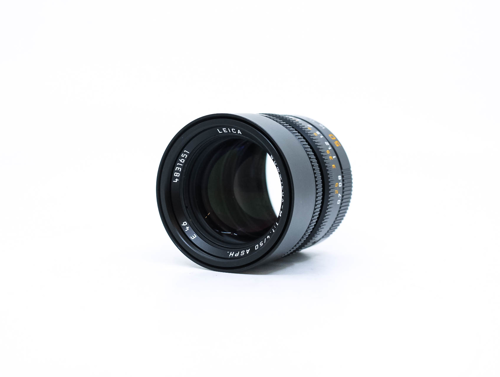
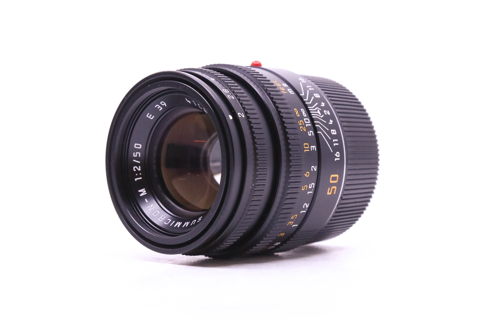
Leica 50mm F1.4 Asph Black 6bit - 11891
Sold by Ffordes Photographic
€1,343 ≈ $1,451
The Leica Summilux-M 50mm f/1.4 ASPH. I is Peter Karbe's M-mount fast fifty, the first to pair an aspherical surface with a floating element.
M mount
The Leica Summilux-M 50mm f/1.4 ASPH. I is a M-mount lens for Leica rangefinder cameras. As of October 2026, it sells from €1,343 used across 42 listings, with a 30-day median of €2,999. Leica price index →
Measured against the 76 other 50mm M-mount lenses in the catalogue.
This lens marked a turning point for Leica's fast standard optic, replacing the long-running non-aspherical 50mm Summilux with a design that combined an aspherical surface and a floating element in an M lens for the first time [1][3]. Credited to Leica designer Peter Karbe, it set out to deliver high resolution and contrast wide open and across the focusing range, a goal achieved partly through unusual glass choices; Karbe has described commissioning a German glassmaker to reinstate a discontinued glass type so rare that the single element made from it reportedly cost as much as all the other elements combined. The eight-element, five-group formula, 46mm filter thread, nine-bladed diaphragm and 0.7m close focus place it firmly among Leica's modern reference fifties rather than the classic pre-aspherical lenses [2].
The lens is a manual-focus, rangefinder-coupled M-bayonet optic with a click-stopped aperture offering half values, and it carries a built-in telescopic, lockable lens hood instead of a clip-on shade. Build quality is generally praised, with a solid barrel and deeply engraved, paint-filled focus and distance scales [4]. Because the design uses a floating group, focusing accuracy at close range matters; users note that the focus point is precise and that overshooting it is easy to see, while close-up performance stays consistent without the focus shift seen in some rivals[6]. Reviewers report copy-to-copy variation in helicoid feel, with some examples needing factory service to even out the focus action, so handling a specific copy before purchase is sensible.
The lens has been offered in black anodized aluminum and in heavier chrome-plated brass, the latter weighing considerably more, and Leica has issued limited variants over the years including a black chrome edition and an LHSA-style MP3 version with a different filter size and hood arrangement. It is the first of two aspherical 50mm Summilux generations: a later "ASPH II" or Close-Focus version, introduced afterward, shortens the minimum focus distance and improves flare control, which is why this earlier model is now commonly distinguished as the "ASPH I"[5]. It should not be confused with the much rarer 1990s Summilux-M 50mm ASPHERICAL with two aspherical surfaces, nor with the older non-aspherical Summilux that it succeeded [7].
Rendering Reviewers consistently describe a clean, high-contrast, high-resolution rendering with strong performance from maximum aperture, a character often called transparent or smooth rather than overtly vintage. The lens is regarded as a consistent, dependable performer across apertures rather than a strongly characterful one.
Sharpness The optic is noted for high resolution wide open, becoming very sharp on stopping down, with one reviewer pointing to a marked peak in the f/2.8 to f/8 range.
Bokeh and transitions Out-of-focus rendering is generally described as smooth and creamy, sometimes to the point of looking clinical; some users observe a tendency toward swirl at the frame edges wide open.
Flare resistance Owners cite good flare control as a reason for choosing this lens, with the later ASPH II said to control flare even better.
Distortion Reviewers report essentially no noticeable distortion.
Collector and user notes The lens is frequently called a near-perfect modern fifty, though some users feel its very polished rendering trades away a distinctive signature.
Development and Launch The aspherical Summilux-M 50mm was developed under Peter Karbe to modernize Leica's fast standard lens, introducing both an aspherical surface and a floating element to a 50mm M optic and aiming for reference-grade resolution and contrast at full aperture. It succeeded the earlier non-aspherical 50mm Summilux that had served in the lineup for decades. The lens is widely dated to a 2004 design and subsequent production, and it carries Leica order numbers 11891 in black and 11892 in silver.
Production Evolution Over its run the lens has appeared in black anodized aluminum and in chrome-plated brass, with the brass versions substantially heavier, and it has been produced with 6-bit coding support for digital M bodies in later examples. Documented serial-number records track large annual production from the mid-2000s onward.
Special editions Limited and special versions are documented, including a black chrome edition produced in a run of 500 and an LHSA-associated MP3 version finished in black paint and chrome that uses a 43mm filter thread and lacks the standard built-in hood.
Collector Notes Identification is straightforward from the front engraving, which reads as a Summilux-M ASPH 1:1.4/50 with E46 filter size. Buyers should be aware of the broader 50mm Summilux family, since the modern ASPH is easily confused with the older non-aspherical 50mm Summilux and with the very rare two-element-aspherical Summilux-M ASPHERICAL of the early 1990s. Copy variation in focus feel is a known issue, so checking the helicoid through its full travel is advisable; accessories worth confirming include the built-in hood's locking action, the E46 filter thread, and original caps. One note on sourcing: LeicaLensList records a 1994 to 2004 production span for this lens, whereas most public references, including the Leica Wiki and collector identification guides, associate the aspherical 50mm Summilux with a 2004 design and later production; the verified record is retained here and the discrepancy is flagged for users.
Good time to buy. The lowest listing is 55% below the 30-day average.
Lowest price Click a mark to open that listing · arrow keys to step, Enter to open
Price against condition for 42 listings of Leica Summilux-M 50mm f/1.4 ASPH. I, €1,343 to €18,085, median €3,256. New: 4 at €4,876, €4,936, €5,145, €6,017. Mint: 5 at €3,032, €3,378, €3,533, €4,198, €4,629. Excellent: 16 at €1,343, €2,218, €2,445, €2,690, €2,725, €2,799, €2,806, €3,113, €3,118, €3,233, €3,280, €3,482, €3,514, €5,093, €17,461, €18,085. Good: 8 at €2,439, €2,702, €3,078, €3,143, €3,825, €4,105, €4,157, €12,472. Fair: 2 at €1,871, €2,858. Unknown: 7 at €2,338, €2,545, €2,962, €3,066, €3,421, €3,741, €4,563. The full table follows.
| Condition | Lowest | Median |
|---|---|---|
| New | €4,876 | €5,040 |
| Mint | €3,032 | €3,533 |
| Excellent | €1,343 | €3,115 |
| Good | €2,439 | €3,484 |
| Fair | €1,871 | €2,365 |
| Other | €2,338 | €3,066 |
Over the last 18 weeks the median price for the Leica Summilux-M 50mm f/1.4 ASPH. I has fallen, ranging from €2,975 to €3,282 (now €2,999).
Weekly price (EUR). Median (Good or better) and lowest (Good or better) across 18 weeks. The full figures follow in the table below.
| Week | Median | Lowest |
|---|---|---|
| Jun 1, 2026 | €3,144 | €2,471 |
| Jun 8, 2026 | €3,138 | €2,161 |
| Jun 15, 2026 | €3,155 | €2,161 |
| Jun 22, 2026 | €3,160 | €2,161 |
| Jun 29, 2026 | €3,163 | €2,038 |
| Jul 6, 2026 | €3,229 | €2,038 |
| Jul 13, 2026 | €3,348 | €2,038 |
| Jul 20, 2026 | €3,453 | €1,359 |
| Jul 27, 2026 | €3,480 | €1,359 |
| Aug 3, 2026 | €3,305 | €2,084 |
| Aug 10, 2026 | €3,393 | €1,359 |
| Aug 17, 2026 | €3,393 | €1,359 |
| Aug 24, 2026 | €3,282 | €1,359 |
| Aug 31, 2026 | €3,161 | €1,359 |
| Sep 7, 2026 | €3,316 | €1,359 |
| Sep 14, 2026 | €3,241 | €1,359 |
| Sep 21, 2026 | €3,230 | €1,359 |
| Sep 28, 2026 | €3,143 | €1,343 |
Every shop grades differently. Leica Classic uses letters, Ffordes uses E++ and E+, German dealers write "Zustand B", Japanese dealers write A−. We map all of them onto the one ladder below. Where a shop states its own grade, we print it under ours.
As of October 2026, the Leica Summilux-M 50mm f/1.4 ASPH. I sells from €1,343 used, with a 30-day median of €2,999, across 42 active listings.
As of October 2026, the Leica Summilux-M 50mm f/1.4 ASPH. I is sold by 5 sources (42 listings), from €1,343 used: all compared cheapest-first on this page.
Similar lenses you might be interested in
Comments