Best price Used
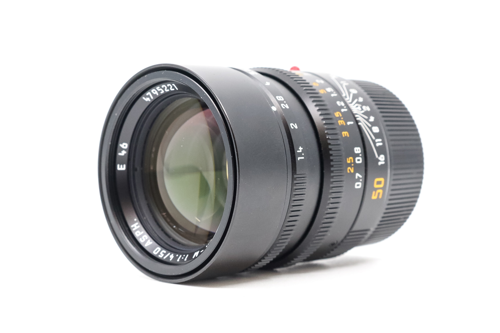
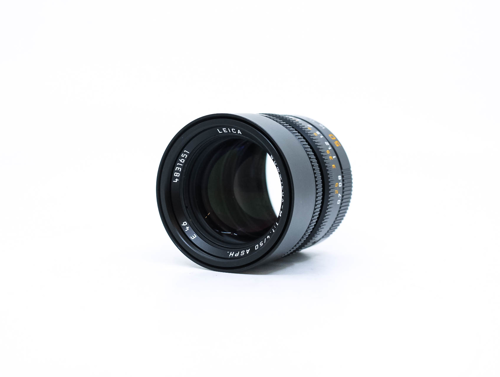
Leica Camera AG Leica SUMMILUX-M 50mm f/1.4 ASPH. [I], black anodized
Sold by Foto Ottica Cavour
€2,720 ≈ $2,937
The Leica Summilux-M 50mm f/1.4 ASPH. II is a refreshed M-mount fast standard prime with close focus to 0.45 m and 11 aperture blades.
![Summilux-M 50mm f/1.4 ASPH [11728]](https://assets.leicalenslist.com/images/lenses/347_medium.webp)
M mount
The Leica Summilux-M 50mm f/1.4 ASPH. II is a M-mount lens for Leica rangefinder cameras. As of October 2026, it sells from €2,720 used across 29 listings, with a 30-day median of €4,474. Leica price index →
Measured against the 76 other 50mm M-mount lenses in the catalogue.
Announced by Leica in April 2023, this lens is a refresh rather than a redesign of the long-running aspherical 50mm Summilux. Leica described it as a refined version of an existing M lens, keeping the compact, lightweight character of the original while adding modern conveniences [1]. The headline change is closer focusing: the minimum focus distance drops from the traditional 70 cm to 45 cm, which Leica achieved with a newly developed double cam gear that also lengthened the rotation angle of the focusing ring. The aperture was rebuilt with 11 blades in place of the previous nine, which Leica states produces a visibly rounder bokeh. It was introduced alongside, and as a companion to, the close-focus 35mm Summilux ASPH released in 2022 [2].
The optical core is the well-known aspherical, floating-element 50mm Summilux design that Leica had carried with essentially unchanged optics for around two decades, a configuration of eight elements in five groups [3]. Reviewers who compared the two versions found the formula effectively carried over, with only edge-of-element changes intended to improve definition from centre to edge and optimisation for newer high-resolution M sensors such as the M11. Up to 70 cm the lens couples to the rangefinder as usual; within the extended 70 to 45 cm range, Leica notes that focusing must be done using Live View, the Visoflex electronic finder, or the FOTOS app, and there is a detent at the point where the lens passes the rangefinder limit. The lens carries a 46 mm filter thread, weighs about 337 g, and ships in black anodised or silver chrome anodised finishes; in combination with the Leica M-Adapter L it can also be used on the SL bodies. The close-focus capability raises maximum magnification from roughly 1:11.3 to about 1:6.4.
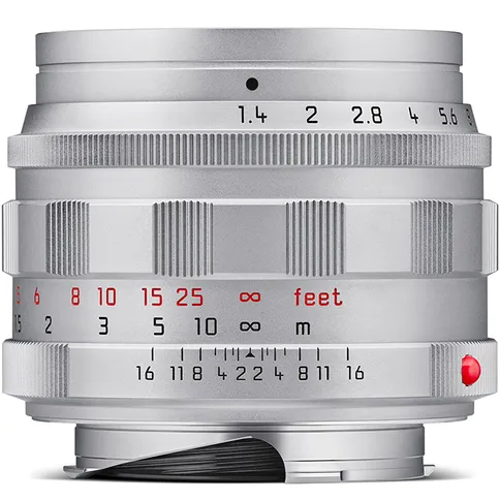
Externally the second version is a sibling of the close-focus 35mm Summilux, with a slightly fatter barrel and a recessed, twist-out round lens hood integrated into the lens. It is a little longer and thicker than the previous 50mm Summilux ASPH and marginally heavier, and the narrower hood relative to the barrel is a styling change some long-time users noticed. Black and silver versions share the same weight. The two finishes carry separate model numbers, 11728 and 11729.
Rendering Because the optics are carried over from the earlier aspherical design, the rendering character is broadly the same well-known look, with a small, mostly resolution-driven gain at the edges on high-megapixel sensors. One reviewer comparing the new lens against its predecessor and the 50mm APO-Summicron found a noticeable improvement in edge definition over the old version, while the APO-Summicron retained the advantage in outright detail and control of chromatic aberration from f/2 onward. The original design is widely regarded as a capable and much-loved lens despite not being a clinical performer.
Bokeh and transitions The move from nine to eleven aperture blades is intended to keep the out-of-focus highlights rounder as the lens is stopped down. Commentators noted that the extra blades make the most difference around f/2 and beyond, with little practical change at f/1.4 where the aperture is already wide open.
Aberrations The underlying design is not free of the issues seen in the earlier version. Critical testing of the optically equivalent predecessor has pointed to focus shift, lateral chromatic aberration, and magenta and green color fringing in out-of-focus areas wide open, traits that carry over since the formula is essentially unchanged.
Development and Launch The lens descends from the aspherical, floating-element 50mm Summilux that Leica introduced in the mid-2000s, a compact fast 50mm with an aspherical element that had few rivals when it appeared and remained in the catalogue with unchanged optics for about twenty years. The 2023 version was launched on 13 April 2023 and presented as a refined update that extends the close-focus range and rounds out the bokeh while preserving the lens's size and weight. It followed the same close-focus treatment Leica had already applied to the 35mm Summilux ASPH.
Production Evolution The main documented changes from the earlier ASPH are mechanical and detail-level rather than a new optical formula: a double cam gear for the 45 cm close focus, an expanded focusing rotation angle, an integrated twist-out round hood, eleven aperture blades, and minor edge-of-element refinements aimed at newer sensors. The barrel grew slightly in length and diameter compared with the previous model.
Special editions No major factory special editions of this version are widely documented. The lens is cataloged in black anodised and silver chrome anodised finishes under model numbers 11728 and 11729.
Collector Notes The most useful identification point is the close-focus behaviour and the eleven-blade aperture, which distinguish this version from the earlier nine-blade ASPH, along with the recessed twist-out hood shared with the close-focus 35mm Summilux. Buyers should note that focusing closer than 70 cm requires Live View, an electronic finder, or the FOTOS app, since the rangefinder does not couple in the extended range. Published figures for weight vary slightly between sources and between the original and revised versions, so verifying the exact variant by its features is more reliable than by quoted mass alone.
Good time to buy. The lowest listing is 39% below the 30-day average.
Lowest price Click a mark to open that listing · arrow keys to step, Enter to open
Price against condition for 29 listings of Leica Summilux-M 50mm f/1.4 ASPH. II, €2,720 to €5,463, median €4,854. New: 19 at €3,915, €3,978, €4,058, €4,069, €4,853, €4,875, €4,888, €4,999, €5,043, €5,082, €5,093, €5,119, €5,150, €5,197, €5,256, €5,301, €5,358, €5,370, €5,463. Mint: 1 at €4,444. Excellent: 4 at €4,180, €4,251, €4,365, €4,854. Used: 5 at €2,720, €2,877, €3,830, €4,360, €4,469. The full table follows.
| Condition | Lowest | Median |
|---|---|---|
| New | €3,915 | €5,082 |
| Mint | €4,444 | €4,444 |
| Excellent | €4,180 | €4,308 |
| Other | €2,720 | €3,830 |
Over the last 18 weeks the median price for the Leica Summilux-M 50mm f/1.4 ASPH. II has fallen, ranging from €4,474 to €5,052 (now €4,474).
Weekly price (EUR). Median (Good or better) and lowest (Good or better) across 18 weeks. The full figures follow in the table below.
| Week | Median | Lowest |
|---|---|---|
| Jun 1, 2026 | €5,046 | €4,128 |
| Jun 8, 2026 | €4,999 | €4,069 |
| Jun 15, 2026 | €4,999 | €4,069 |
| Jun 22, 2026 | €4,988 | €3,522 |
| Jun 29, 2026 | €4,977 | €3,522 |
| Jul 6, 2026 | €5,034 | €4,069 |
| Jul 13, 2026 | €5,052 | €4,069 |
| Jul 20, 2026 | €4,977 | €3,977 |
| Jul 27, 2026 | €4,941 | €3,957 |
| Aug 3, 2026 | €4,944 | €3,977 |
| Aug 10, 2026 | €4,898 | €3,916 |
| Aug 17, 2026 | €4,941 | €3,916 |
| Aug 24, 2026 | €4,898 | €3,916 |
| Aug 31, 2026 | €4,959 | €3,916 |
| Sep 7, 2026 | €4,941 | €3,916 |
| Sep 14, 2026 | €4,941 | €3,916 |
| Sep 21, 2026 | €4,919 | €3,917 |
| Sep 28, 2026 | €4,864 | €3,915 |
Every shop grades differently. Leica Classic uses letters, Ffordes uses E++ and E+, German dealers write "Zustand B", Japanese dealers write A−. We map all of them onto the one ladder below. Where a shop states its own grade, we print it under ours.
As of October 2026, the Leica Summilux-M 50mm f/1.4 ASPH. II sells from €2,720 used, with a 30-day median of €4,474, across 29 active listings.
As of October 2026, the Leica Summilux-M 50mm f/1.4 ASPH. II is sold by 5 sources (29 listings), from €2,720 used: all compared cheapest-first on this page.
Similar lenses you might be interested in
Comments