Best price Good
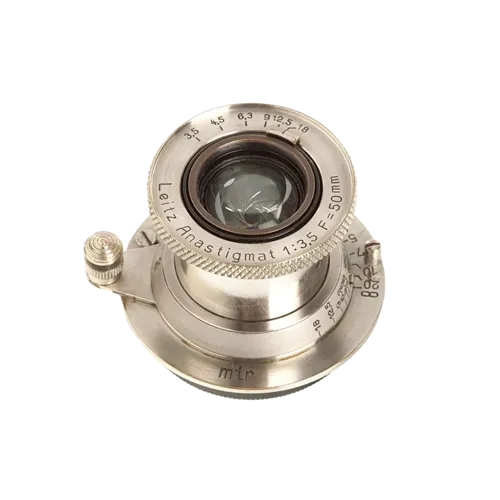
LEITZ Leica Elmar L39 50mm/F3.5 Lens Yr.1956 LTM Germany #10521
Sold by M&K Kamera
€340 ≈ $367
The Leica Elmar 50mm f/3.5 Red Scale is a late collapsible LTM standard lens, recognized by its revised optics and red depth-of-field markings.
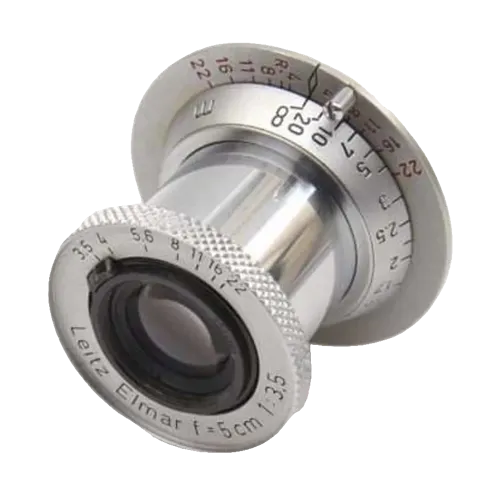
LTM / M39 mount
The Leica Elmar 50mm f/3.5 LTM Red Scale (1951) is a LTM / M39-mount lens for Leica rangefinder cameras. As of October 2026, it sells from €340 used across 18 listings, with a 30-day median of €443. Leica price index →
Measured against the 117 other 50mm lenses in the catalogue.
The Leica Elmar 50mm f/3.5 LTM Red Scale is a collapsible standard lens introduced in 1951 for Leica screw-mount rangefinder cameras. It represents the final major form of the classic f/3.5 Elmar in Leica Thread Mount and is distinguished by red-filled depth-of-field markings, revised scale placement and a late coated optical configuration. It remains historically important as the last major development of the compact Elmar design before the faster Elmar 50mm f/2.8 replaced it in Leica's normal-lens range .
The lens uses a four-element, three-group optical construction and a ten-blade diaphragm operating from f/3.5 to f/22. Its chrome-plated brass barrel collapses into compatible Leica screw-mount camera bodies for transport. The focusing mount is rangefinder coupled, locks at infinity and focuses down to 1 metre. Filters and accessories attach through the A36 clamp-on standard rather than a conventional 36mm threaded filter mount.
The Red Scale version should be separated from the earlier black-scale chrome Elmar. Collector references describe a recomputed design beginning around serial number 905000, accompanied by changes in optical glass and element curvature. The visible identification changes include red depth-of-field figures and the reversal of the focusing-distance and depth-of-field scale positions. However, black-scale and Red Scale production overlapped, so production year or serial number alone should not be used without inspecting the physical markings.
Rendering
The Red Scale Elmar retains the compact four-element, three-group architecture associated with the classic Elmar family. Leica describes the 50mm f/3.5 Elmar as producing good central definition at full aperture, with weaker outer zones that improve when the lens is stopped down.
Sharpness
The lens is strongest in the central image area at wider apertures. Stopping down improves the outer field and overall uniformity. Specialist historical references place peak general performance around f/8, although the condition and optical alignment of individual surviving examples can materially influence results.
Contrast and color
The Red Scale Elmar was produced as a coated lens. Its coating and limited number of air-to-glass surfaces support better contrast in difficult lighting than an early uncoated Elmar. Actual performance depends heavily on coating condition, internal haze, cleaning damage and previous servicing.
Flare resistance
The A36 FISON hood is the period accessory normally associated with this lens. Hood use is advisable because front-element cleaning marks, coating deterioration and internal haze can reduce contrast and increase veiling flare.
Digital use
The lens can be mounted on a Leica M camera with a correctly manufactured 50mm LTM-to-M adapter. Because it is collapsible, clearance should be checked before retracting the barrel into any digital or film M body. The lens should not be collapsed when compatibility is uncertain.
Development and Launch
The original 50mm f/3.5 Elmar design became Leica's principal standard lens during the screw-mount era. In 1951 Leitz introduced the form now commonly called the Red Scale Elmar, beginning around serial number 905000 according to specialist collector research.
The revised lens retained the established 50mm focal length, f/3.5 maximum aperture, collapsible construction and one-metre minimum focusing distance. The most visible changes were the red-filled depth-of-field figures and the reversed placement of the distance and depth-of-field scales.
Production Evolution
Early Red Scale lenses were produced in Leica Thread Mount with metric or foot distance scales. Some collector references distinguish early examples by a diamond-shaped focus index and later examples by a triangular index. These are identification variations within the Red Scale family rather than separate optical models.
Later production continued alongside the native Leica M-bayonet Elmar. Screw-mount examples must therefore be distinguished from M-mount lenses and from LTM lenses carrying a removable M adapter.
Special Editions/Variants
An Esercito Italiano version with Italian Army engraving is documented. Rare black-finished Elmars with white engravings were also made to accompany a limited group of black Leica IIIf cameras. No separate numerical model number is confirmed for either variation.
Older Elmars could be returned to Leitz for coating, repolishing, recalibration or mechanical updating. A lens with modified red markings or a replacement barrel may therefore not retain its original optical cell or original production appearance.
Collector Notes
A genuine production Red Scale Elmar normally displays red-filled depth-of-field markings and the reversed scale arrangement associated with the late version. The serial number is engraved in small figures near the front aperture-control area and should be inspected with magnification.
Collectors should not classify a lens solely by its year. Red Scale and black-scale examples overlap in documented serial-number blocks, and Leitz offered factory servicing that could alter coatings, engravings or mechanical components.
The lens should be inspected for front-element cleaning marks, coating damage, internal haze, fungus and separation in the cemented rear group. The collapsible tube should extend smoothly and lock firmly. The infinity lock, focusing helicoid, aperture tab and rangefinder cam should operate without excessive resistance.
Good time to buy. The lowest listing is 23% below the 30-day average.
Lowest price Click a mark to open that listing · arrow keys to step, Enter to open
Price against condition for 18 listings of Leica Elmar 50mm f/3.5 LTM Red Scale (1951), €340 to €803, median €444. Excellent: 8 at €369, €413, €435, €435, €458, €462, €505, €803. Good: 8 at €340, €352, €399, €413, €417, €452, €531, €736. Unknown: 2 at €497, €532. The full table follows.
| Condition | Lowest | Median |
|---|---|---|
| Excellent | €369 | €446 |
| Good | €340 | €415 |
| Other | €497 | €515 |
Over the last 21 weeks the median price for the Leica Elmar 50mm f/3.5 LTM Red Scale (1951) has risen, ranging from €306 to €443 (now €443).
Weekly price (EUR). Median (Good or better) and lowest (Good or better) across 21 weeks. The full figures follow in the table below.
| Week | Median | Lowest |
|---|---|---|
| Jun 1, 2026 | €463 | €463 |
| Jun 8, 2026 | €482 | €463 |
| Jun 15, 2026 | €463 | €463 |
| Jun 22, 2026 | €463 | €463 |
| Jun 29, 2026 | €463 | €463 |
| Jul 6, 2026 | €440 | €417 |
| Jul 13, 2026 | €440 | €417 |
| Jul 20, 2026 | €306 | €198 |
| Jul 27, 2026 | €417 | €340 |
| Aug 3, 2026 | €426 | €340 |
| Aug 10, 2026 | €434 | €340 |
| Aug 17, 2026 | €434 | €340 |
| Aug 24, 2026 | €434 | €340 |
| Aug 31, 2026 | €434 | €340 |
| Sep 7, 2026 | €434 | €340 |
| Sep 14, 2026 | €434 | €340 |
| Sep 21, 2026 | €434 | €340 |
| Sep 28, 2026 | €434 | €340 |
| Oct 5, 2026 | €434 | €340 |
| Oct 12, 2026 | €434 | €340 |
| Oct 19, 2026 | €435 | €340 |
Every shop grades differently. Leica Classic uses letters, Ffordes uses E++ and E+, German dealers write "Zustand B", Japanese dealers write A−. We map all of them onto the one ladder below. Where a shop states its own grade, we print it under ours.
As of October 2026, the Leica Elmar 50mm f/3.5 LTM Red Scale (1951) sells from €340 used, with a 30-day median of €443, across 18 active listings.
As of October 2026, the Leica Elmar 50mm f/3.5 LTM Red Scale (1951) is sold by 2 sources (18 listings), from €340 used: all compared cheapest-first on this page.
The Leica Elmar 50mm f/3.5 LTM Red Scale (1951) takes 36 mm screw-in filters (E36).
The Leica Elmar 50mm f/3.5 LTM Red Scale (1951) focuses down to 1 m, and the rangefinder stays coupled over the whole range.
The Leica Elmar 50mm f/3.5 LTM Red Scale (1951) weighs 125 g, lighter than 82% of the 67 other 50mm lenses in the catalogue.
The Leica Elmar 50mm f/3.5 LTM Red Scale (1951) is a Leica screw-mount (M39/LTM) lens. It fits Leica M bodies with a screw-to-M adapter, which keeps rangefinder coupling, and mirrorless cameras with an M39 adapter. It carries no 6-bit code, so select the lens profile by hand on a digital M.
The Leica Elmar 50mm f/3.5 LTM Red Scale (1951) was produced from 1951 to 1959.
Similar lenses you might be interested in
Comments