The Carl Zeiss Opton Sonnar 50mm f/2 is a coated postwar West German Contax rangefinder lens, a collectible six-element Bertele Sonnar design.</parameter> <parameter name="long_description">## Carl Zeiss Opton Sonnar 50mm f/2 The Opton Sonnar 50mm f/2 represents the West German continuation of one of the most influential rangefinder lens designs of the twentieth century. It is the slower, more affordable sibling of the famous f/1.5 Sonnar, built on the same optical principle conceived by Ludwig Bertele, who developed the fast Ernostar at Ernemann before that firm was absorbed into Zeiss [1]. The "Opton" marking on the barrel identifies it as a product of the Oberkochen branch of Carl Zeiss after the company was split between East and West Germany following the Second World War, when the western operation relaunched the lens as Zeiss-Opton around 1950. Optically the lens follows the classic Sonnar layout of six elements arranged in three groups, comprising one single element and two cemented groups. This compact three-group structure was central to Bertele's achievement, since reducing the number of air-to-glass surfaces lowered internal reflections and flare in an era before anti-reflective coatings, while still delivering high effective speed. The Opton-era lenses carried the red T anti-reflective coating, a meaningful improvement over the uncoated prewar Sonnars, and the body was built from chrome over brass. It is a compact, all-metal lens for the Contax rangefinder bayonet mount; on these cameras focus is driven through the camera body's helicoid rather than a coupling mechanism on the lens barrel itself, and the lens is finished in silver chrome with an eleven-blade iris. The Opton name is itself a useful identification marker. The branding existed because of the postwar dispute over the Carl Zeiss trademark, and the marking changed as the situation evolved. The final type of these lenses, built around 1953, was no longer marked Zeiss-Opton once Zeiss Ikon regained the rights to use the "Carl Zeiss" brand; that later type also dropped the aperture-ring grips and stopped down to f/16. Earlier in the run, a black filter ring was introduced from 1951, and around 1952 a version that stopped down to f/22 appeared. Because the f/2 Sonnar was produced in both prewar Carl Zeiss Jena form and postwar East and West German forms, the Opton marking together with the coating and chrome-over-brass construction is one of the clearest ways to place a given example in the West German postwar production. --- ## Optical qualities **Rendering** The postwar Opton Sonnar f/2 inherits the rendering reputation of the Sonnar family, which is rooted in its low-flare, high-contrast three-group design and, in this generation, the addition of T coating. Detailed, independently measured optical data for this specific f/2 variant is limited in the sources consulted, so claims about its sharpness, bokeh, and aberration behavior should be treated cautiously. What can be said with confidence is that the coating was a real advance over the uncoated prewar Sonnars in reducing reflections and light loss, which generally improves contrast. --- ## History **Development and Launch** The Sonnar name derives from the German word Sonne, meaning sun, and the modern Sonnar was introduced by Carl Zeiss Jena in 1932 for the Contax rangefinder system as a complete redesign that abandoned the earlier Tessar-derived lens of that name in favor of a layout based on the Ernostar. At its introduction the Contax Sonnar was the fastest lens available at f/1.5, and a slower f/2 budget version was offered alongside it. The f/2 Sonnar therefore existed from the line's earliest days as the more economical normal lens for Contax users. **Production Evolution** After the war Zeiss was divided between East and West Germany, and the western branch in Oberkochen relaunched the lens as Zeiss-Opton around 1950 with a new optical design and red T coating, in a chrome-over-brass body. A black filter ring followed from 1951, and around 1952 apertures extending to f/22 were introduced. The final lenses of 1953 abandoned the Zeiss-Opton marking in favor of "Carl Zeiss," dropped the aperture-ring grips, and stopped down to f/16. **Special editions** No major factory special editions of the postwar Opton f/2 Sonnar are widely documented in the sources consulted; the notable variation within the line concerns the marking, coating, minimum aperture, and filter-ring changes described above rather than distinct commemorative or military versions. **Collector Notes** For buyers, the most useful identification points are the "Zeiss-Opton" marking with the red T, which together signal a postwar West German example rather than a prewar Carl Zeiss Jena lens or an East German postwar build. The presence or absence of the aperture-ring grips and the marked minimum aperture (f/16 versus f/22) help narrow the production period. As with all coated Sonnars of this age, the soft early coatings and the cemented groups make haze and coating condition worth inspecting closely before purchase. Note also that the same f/2 Sonnar design lived on in Soviet form as the ZK and then the Jupiter-3 after the USSR moved Zeiss tooling to Kiev, so the design lineage is easily confused with later copies even though those are differently marked and constructed. --- ## Sources * [1] Camera-wiki.org. *Sonnar 50mm*. https://camera-wiki.org/wiki/Sonnar_50mm * [2] Kamerastore. *Carl Zeiss 50mm f2 Sonnar T* Opton - Lens*. https://kamerastore.com/en-us/products/carl-zeiss-50mm-f2-sonnar-t-opton-contax-kiev * [3] LENS-DB.COM. *Carl Zeiss / Zeiss-Opton Sonnar 50mm F/2*. https://lens-db.com/zeiss-opton-carl-zeiss-contax-sonnar-50mm-f2
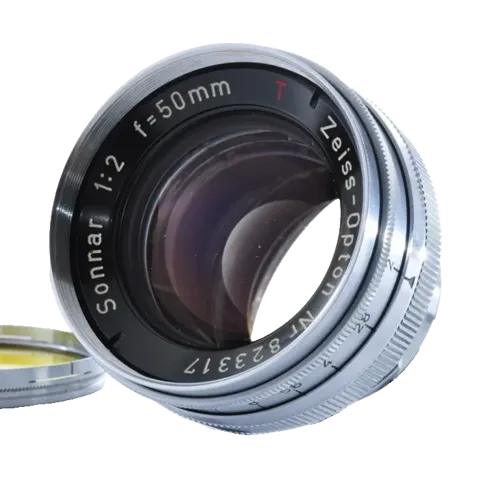
Carl Zeiss Opton Sonnar 50mm f/2
Contax RF mount
No listings tracked for this lens right now.
The Carl Zeiss Opton Sonnar 50mm f/2 is a Contax RF-mount lens for Leica rangefinder cameras. Leica price index →
How it compares
Measured against the 15 other 50mm Contax RF-mount lenses in the catalogue.
Specification
About this lens
Carl Zeiss Opton Sonnar 50mm f/2
The Opton Sonnar 50mm f/2 marks the postwar, West German chapter of one of the most influential rangefinder designs of the twentieth century. After the division of Germany split the Zeiss organization, the Oberkochen works relaunched the f/2 Sonnar around 1950 under the Zeiss-Opton name, supplying a coated normal lens for the Contax rangefinder system [1][2]. The optical concept traces back to Ludwig Bertele, whose six-element, three-group Sonnar derived from the fast Ernostar and deliberately limited the number of internal air-glass surfaces to preserve contrast, a major advantage in the era before anti-reflection coatings.
Mechanically the Opton version is a rigid lens with a chrome-over-brass barrel, distinct from the earlier prewar and collapsible Jena Sonnars. It keeps the classic six-element, three-group Sonnar arrangement of a single element paired with two cemented groups, focuses down to about 0.91 m, and weighs roughly 140 g in its compact silver mount. The lens uses the Contax rangefinder bayonet rather than a Leica mount, so on a Contax body the camera's helical drives focus; as a bare lens it is not independently rangefinder coupled in the Leica sense.
The postwar Oberkochen lenses were among the first in the line to be fully coated, and early examples carry the famous red "T" marking to indicate the coating; the "T" was later dropped once coating had become standard across the range. These lenses also adopted a double-diaphragm iris, and the blade count is variously described, with some sources citing the 22-blade double diaphragm and others an 11-blade arrangement[3]. Identification rests on the Zeiss-Opton name on the front ring: as West German Zeiss prevailed in the trademark disputes, later lenses dropped "Opton" and were engraved simply "Carl Zeiss," while the East German factory lost the right to use the Zeiss name on exports.
Optical qualities
Rendering Documented rendering character for the f/2 Sonnar centers on its coated, contrast-favoring layout. The three-group design with few air-glass surfaces was specifically intended to hold contrast, and the postwar T coating further reduced internal reflections and light loss compared with the uncoated prewar lenses. Detailed, standardized test data for the Opton variant specifically is limited, so claims about fine sharpness, bokeh, distortion, or vignetting beyond this general behavior are not well established in the consulted sources.
History
Development and Launch The Sonnar name comes from the German word for sun, and the 50mm Sonnar was introduced by Carl Zeiss Jena from 1932 as a lens for the Contax rangefinder, a complete redesign away from an earlier Tessar-type lens of the same name. Bertele's f/2 version used six elements in three groups; an even faster f/1.5 sibling shared the family. After the Second World War the Zeiss organization was split between East and West Germany, and the western branch at Oberkochen relaunched the lens as Zeiss-Opton around 1950 with a coated optical design and a chrome-over-brass body.
Production Evolution The f/2 Sonnar was reformulated repeatedly across its long life to exploit new optical glasses, passing through black-and-nickel, black-nickel-and-chrome, collapsible, and rigid chrome forms before the war. T coating began to appear on Jena lenses in the late 1930s and became widespread by the early 1940s. The Oberkochen Zeiss-Opton lenses were rigid, chrome-over-brass, initially carrying the red T and using a double-diaphragm iris; later the T marking was discontinued and, following the trademark rulings, the engraving changed from Zeiss-Opton to Carl Zeiss.
Special editions No major factory special editions specific to the Opton f/2 are widely documented in the consulted sources. Adjacent rarities belong to the wider Sonnar family rather than the Opton variant, including wartime alloy lenses with military markings and a very small ivory-finished batch made for an experimental Contax that never reached series production.
Collector Notes The clearest identification point is the front-ring engraving: "Zeiss-Opton" denotes the early West German Oberkochen lenses, while a plain "Carl Zeiss" engraving indicates the later post-trademark production. Buyers should confirm the Contax rangefinder mount and check the coating, as the red T denotes the early coated examples. Reported blade counts differ between sources, with the double-diaphragm iris variously described as 22 blades or 11 blades, so it is worth inspecting the actual lens rather than relying on a single published figure. As with any lens of this age, examine the glass for haze, cleaning marks, and coating wear before purchase.
Sources
Where to buy
Related lenses
Similar lenses you might be interested in
Comments