The Funky Lens List: 10 Weird and Wonderful Lenses You Can Put on a Leica
Discover 10 weird and wonderful Leica lenses, from body-cap oddities and organ transplants to Cold War glass and a 740g f/1 monster.
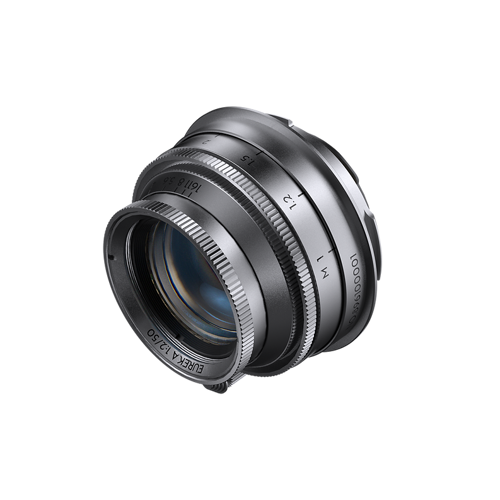
The Thypoch Eureka 50mm f/2 is a modern manual focus lens introduced in 2024, designed as a mechanical and aesthetic tribute to the classic collapsible lenses of the 1950s. Available in both lightweight aluminum and solid brass finishes, it incorporates a retractable barrel mechanism that reduces the lens profile for storage. Internally, it utilizes a modernized six-element optical formula with Extra-Low Dispersion glass, offering a balance between vintage rendering characteristics and modern contrast, while its 12-blade aperture ensures circular bokeh highlights at all settings.
M mount
The Thypoch Eureka 50mm f/2 is a M-mount lens for Leica rangefinder cameras. As of October 2026, it sells from €462 used across 4 listings, with a 30-day median of €793. Leica price index →
Measured against the 76 other 50mm M-mount lenses in the catalogue.
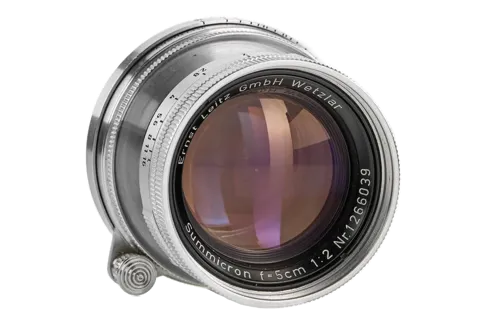
The Thypoch Eureka 50mm f/2 is a standard prime lens released in 2024. Manufacturers designed the optic as a direct tribute to the collapsible lenses of the 1950s, specifically referencing the first-generation Leica Summicron. Although the lens maintains a vintage external profile, Thypoch re-engineered the internal optical system with modern glass types to ensure performance remains consistent on high-resolution digital cameras. The lens is notable for its availability in two distinct material finishes and its retractable barrel mechanism.
Internally, the Eureka utilizes a six-element, four-group optical structure based on the classic double-Gauss configuration. While the layout mimics the 1953 design it emulates, the inclusion of High Refractive Index (HRI) and Extra-Low Dispersion (ED) elements marks a significant departure from vintage manufacturing. This modern glass helps suppress chromatic aberration and improves overall sharpness compared to the original thorium-based optics.
The resulting image quality serves as a hybrid between old and new standards. At the maximum aperture of f/2, the lens retains a degree of spherical aberration. This optical characteristic creates the soft rendering or "glow" often associated with vintage photography. However, modern multi-coatings ensure the lens delivers significantly higher contrast and flare resistance than actual vintage lenses. A distinctive feature of this model is the 12-blade aperture diaphragm, which maintains a circular shape at all settings to produce smooth, non-polygonal background blur.
Thypoch produces the Eureka in two variations that differ in weight and tactile handling:
The defining mechanical feature is the collapsible barrel, which allows the user to push the optical cell back into the camera body for compact storage. The design ensures the rear element generally clears the sensor stack of modern digital Leica M bodies, but users should still verify clearance to prevent accidental contact. The lens focuses down to a minimum distance of 0.9 meters, a slight improvement over the 1-meter standard of the original vintage inspiration.
The Eureka occupies a specific niche for photographers seeking vintage character without the maintenance issues of antique glass.
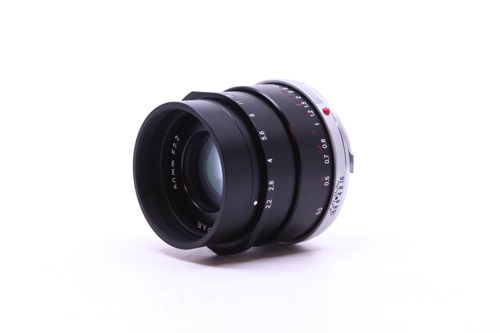
The Color-Skopar represents a strictly modern approach to compact lens design.
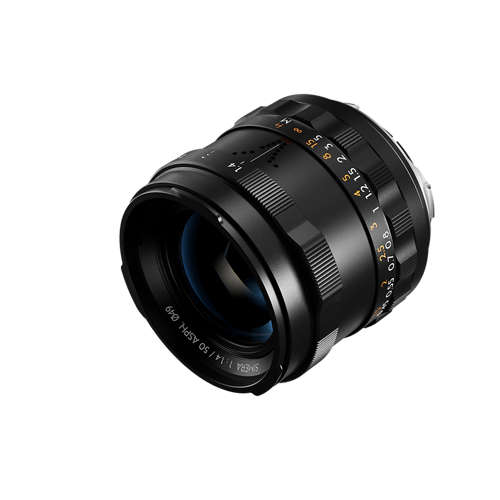
The Light Lens Lab Elcan is a replica of a rare military optic originally manufactured by Leitz Canada.
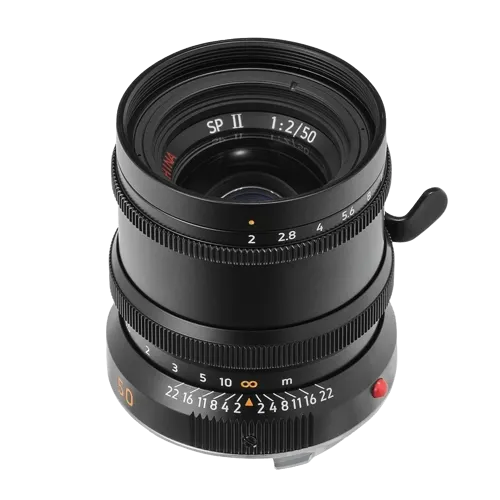
The Version 4 and Version 5 Summicrons are widely considered the modern benchmarks for the 50mm focal length.
The Elmar is the most common historical alternative for a collapsible lens.
Good time to buy. The lowest listing is 42% below the 30-day average.
Lowest price Official store Click a mark to open that listing · arrow keys to step, Enter to open
Price against condition for 4 listings of Thypoch Eureka 50mm f/2, €462 to €1,007, median €737. New: 3 at €462, €681, €1,007. Unknown: 1 at €793. The full table follows.
| Condition | Lowest | Median |
|---|---|---|
| New | €462 | €681 |
| Other | €793 | €793 |
Official-store listings are affiliate links: buying through them supports Leica Lens List at no extra cost to you.
Over the last 18 weeks the median price for the Thypoch Eureka 50mm f/2 has risen, ranging from €462 to €862 (now €793).
Weekly price (EUR). Median (Good or better) and lowest (Good or better) across 18 weeks. The full figures follow in the table below.
| Week | Median | Lowest |
|---|---|---|
| Jun 1, 2026 | €703 | €703 |
| Jun 8, 2026 | €703 | €703 |
| Jun 15, 2026 | €703 | €703 |
| Jun 22, 2026 | €703 | €703 |
| Jun 29, 2026 | €703 | €703 |
| Jul 6, 2026 | €703 | €703 |
| Jul 13, 2026 | €703 | €703 |
| Jul 20, 2026 | €703 | €703 |
| Jul 27, 2026 | €703 | €703 |
| Aug 3, 2026 | €703 | €703 |
| Aug 10, 2026 | €462 | €462 |
| Aug 17, 2026 | €710 | €462 |
| Aug 24, 2026 | €706 | €462 |
| Aug 31, 2026 | €705 | €462 |
| Sep 7, 2026 | €703 | €462 |
| Sep 14, 2026 | €695 | €462 |
| Sep 21, 2026 | €692 | €462 |
| Sep 28, 2026 | €681 | €462 |
Official store Official-store listings are affiliate links. Buying through one supports Leica Lens List at no extra cost to you, and never changes where a listing sits in this table.
Every shop grades differently. Leica Classic uses letters, Ffordes uses E++ and E+, German dealers write "Zustand B", Japanese dealers write A−. We map all of them onto the one ladder below. Where a shop states its own grade, we print it under ours.
As of October 2026, the Thypoch Eureka 50mm f/2 sells from €462 used, with a 30-day median of €793, across 4 active listings.
As of October 2026, the Thypoch Eureka 50mm f/2 is sold by 2 sources (4 listings), from €462 used: all compared cheapest-first on this page.
Similar lenses you might be interested in
Discover 10 weird and wonderful Leica lenses, from body-cap oddities and organ transplants to Cold War glass and a 740g f/1 monster.

Thypoch Summer Sale 2026 runs June 15 to July 31 with up to 20% off selected lenses, plus 5% extra with code LEICALENSLIST.

Black Friday is coming. Thypoch offers a nice discount on their offerings!
Comments