Best price Fair
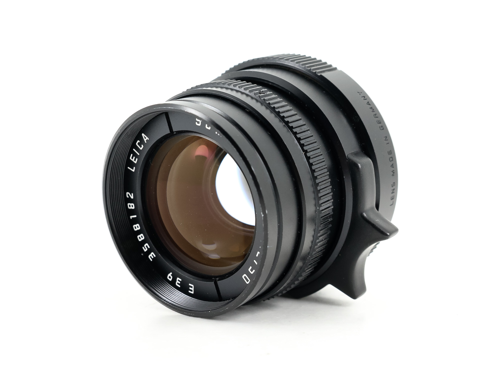
Leica M mount 50mm F2 Summicron V3 version 3 lens
Sold by Cardinal Camera Used
€740 ≈ $799
The Leica Summicron 50mm f/2 III is a six-element M-mount rangefinder lens from 1969, the lightweight black "black sheep" version collectors prize.
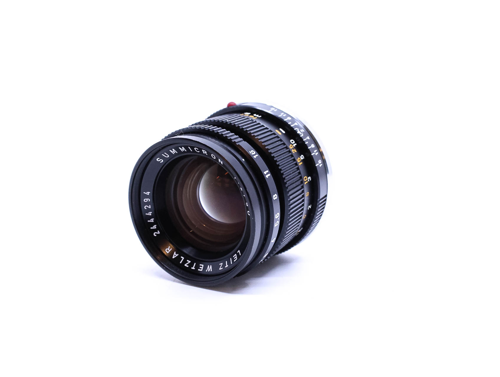
M mount
The Leica Summicron 50mm f/2 III is a M-mount lens for Leica rangefinder cameras. As of October 2026, it sells from €740 used across 38 listings, with a 30-day median of €1,098. Leica price index →
Measured against the 76 other 50mm M-mount lenses in the catalogue.
Introduced in 1969, the third version of the 50mm Summicron marked a clean break from the chrome, brass-and-glass Summicrons that came before it. Leitz abandoned the earlier seven-element optical scheme in favor of a simpler six-element design and housed it in a slim, modern barrel of black anodized aluminum, dropping the weight to roughly 240 grams [1][3]. Often called the Type III by Ken Rockwell's numbering, it is the lens that established the compact, focus-tab-free silhouette that Leica's 50mm rangefinder lenses still broadly resemble today, so much so that a casual glance can mistake the half-century-old design for a current one [2]. Among Leica enthusiasts it carries a contradictory reputation: long dismissed as the "black sheep" of the Summicron family, yet repeatedly defended by users who rate it among the finest normal lenses they have shot.
The lens is a rangefinder-coupled M-mount design with a maximum aperture of f/2 and a ten-blade diaphragm, focusing down to 0.7 m, closer than the one-meter limit of the rigid and Dual-Range Summicrons it replaced. It uses 39 mm filters and is compact at about 50 mm long and 51 mm in diameter. The simpler six-element formula was promoted as both lighter and higher in contrast than the earlier design, a reduction made possible by newer high-refractive-index glasses that allowed fewer elements and gentler curves without sacrificing performance. Production was associated with the era of Leitz designer Walter Mandler and split between Wetzlar in Germany and the Leitz plant in Canada, a point of much discussion among period buyers. The lens carries the factory order number 11817.
Identification is straightforward once the era is understood. The Type III is the black, non-collapsing 50mm Summicron with the 0.7 m close-focus barrel and the clip-on, reversible lens hood, succeeding the chrome rigid and Dual-Range lenses and preceding the longer-running 1979 Summicron-M with its "Tiger Paw" focus tab. Sources differ on how to count its groups: several published references describe the optical layout as six elements in four groups, though the configuration is also recorded as six elements in five groups. Build quality is the most common criticism, with some users noting that the lighter barrel and finish feel less substantial than the older Summicrons or contemporary Japanese lenses.
Rendering
Reviewers and long-term users broadly describe a lens that combines high sharpness with a gentle, understated tonal character rather than aggressive contrast.
Documented impressions emphasize smooth gradation between highlight and shadow, which is often credited for the three-dimensional, lifelike look associated with the Summicron name.
Sharpness Despite a reputation as the least sharp Summicron in side-by-side comparisons, the Type III is widely reported to deliver strong resolution that holds toward the edges of the frame across the aperture range, with little need to stop down for critical sharpness.
Contrast and color The six-element design was intended to raise contrast over the earlier formula. In practice users describe the increase as modest, leaving a relatively low-contrast, smoothly graded rendering that some photographers specifically prefer for black-and-white work.
Bokeh and transitions Although built on the double-Gauss form, the lens is praised for unexpectedly smooth out-of-focus rendering and graceful focus transitions rather than the busy backgrounds sometimes associated with that design.
Development and Launch The third 50mm Summicron arrived in 1969, during a difficult period for Leica as the rangefinder market gave way to Japanese SLRs and the company struggled with the Leicaflex program and the reception of the M5. Replacing the chrome rigid and Dual-Range Summicrons, it switched from the seven-element formula to a six-element design and adopted a lighter black barrel, changes presented as practical improvements in weight, contrast, and close-focus capability.
Production Evolution The Type III was made from 1969 to 1979, when it was superseded by the Mandler-designed Summicron-M that introduced the "Tiger Paw" focus tab and a revised barrel. Production took place at both Wetzlar and the Leitz facility in Canada, and lenses from either origin are encountered today.
Special editions No widely documented factory special editions, military variants, or unusual finishes are commonly associated with this version; it is generally encountered as the standard black M-mount lens carrying order number 11817.
Collector Notes Buyers should expect the black anodized barrel rather than chrome, the 0.7 m close-focus scale, and the clip-on reversible hood that distinguishes it from the built-in hood of later versions. Because it shares the Summicron name with both the costlier earlier lenses and the long-running 1979-onward Summicron-M, confirming the version by barrel style and close-focus distance avoids confusion. As with any lens of this age, checking the focusing helicoid for stiffness from old or excessive grease, and inspecting the glass and aperture blades for haze or oil, is advisable before purchase. Published references disagree on whether the optics are arranged in four or five groups, so spec sheets should be read with that discrepancy in mind.
Good time to buy. The lowest listing is 33% below the 30-day average.
Lowest price Click a mark to open that listing · arrow keys to step, Enter to open
Price against condition for 38 listings of Leica Summicron 50mm f/2 III, €740 to €8,055, median €1,097. Mint: 4 at €1,203, €1,203, €1,342, €1,860. Excellent: 7 at €920, €920, €1,038, €1,098, €1,099, €1,156, €1,321. Good: 12 at €920, €973, €1,040, €1,040, €1,040, €1,040, €1,098, €1,098, €1,455, €1,611, €6,756, €8,055. Fair: 9 at €740, €826, €901, €903, €906, €973, €1,251, €1,341, €2,086. Used: 6 at €1,025, €1,034, €1,151, €1,210, €1,292, €6,849. The full table follows.
| Condition | Lowest | Median |
|---|---|---|
| Mint | €1,203 | €1,272 |
| Excellent | €920 | €1,098 |
| Good | €920 | €1,069 |
| Fair | €740 | €906 |
| Other | €1,025 | €1,180 |
Over the last 18 weeks the median price for the Leica Summicron 50mm f/2 III has fallen, ranging from €1,097 to €1,204 (now €1,098).
Weekly price (EUR). Median (Good or better) and lowest (Good or better) across 18 weeks. The full figures follow in the table below.
| Week | Median | Lowest |
|---|---|---|
| Jun 1, 2026 | €1,238 | €1,045 |
| Jun 8, 2026 | €1,204 | €1,045 |
| Jun 15, 2026 | €1,238 | €1,045 |
| Jun 22, 2026 | €1,310 | €1,045 |
| Jun 29, 2026 | €1,349 | €1,045 |
| Jul 6, 2026 | €1,349 | €1,045 |
| Jul 13, 2026 | €1,349 | €1,045 |
| Jul 20, 2026 | €1,345 | €1,045 |
| Jul 27, 2026 | €1,345 | €993 |
| Aug 3, 2026 | €1,163 | €899 |
| Aug 10, 2026 | €1,217 | €921 |
| Aug 17, 2026 | €1,217 | €921 |
| Aug 24, 2026 | €1,217 | €921 |
| Aug 31, 2026 | €1,203 | €921 |
| Sep 7, 2026 | €1,203 | €921 |
| Sep 14, 2026 | €1,108 | €921 |
| Sep 21, 2026 | €1,102 | €921 |
| Sep 28, 2026 | €1,098 | €920 |
Every shop grades differently. Leica Classic uses letters, Ffordes uses E++ and E+, German dealers write "Zustand B", Japanese dealers write A−. We map all of them onto the one ladder below. Where a shop states its own grade, we print it under ours.
As of October 2026, the Leica Summicron 50mm f/2 III sells from €740 used, with a 30-day median of €1,098, across 38 active listings.
As of October 2026, the Leica Summicron 50mm f/2 III is sold by 7 sources (38 listings), from €740 used: all compared cheapest-first on this page.
Similar lenses you might be interested in
Comments