Best price Heavily Used
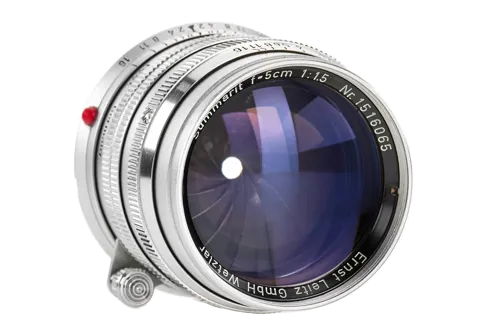
Leica 50mm f2 Summicron Dual Range 2032624
Sold by Camera West
€736 ≈ $795
The Leica Summicron 50mm f/2 II Dual Range is a chrome M-mount near-focusing lens (1956 to 1968), prized by collectors for its build and rendering.
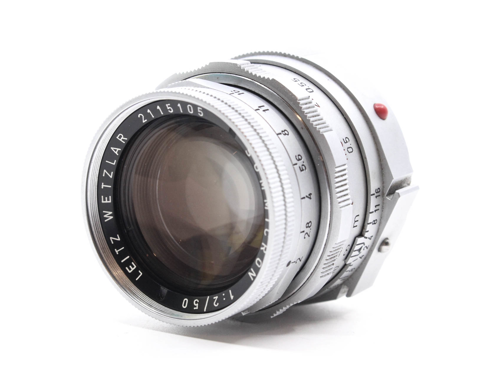
M mount
The Leica Summicron 50mm f/2 II Dual Range is a M-mount lens for Leica rangefinder cameras. As of October 2026, it sells from €736 used across 17 listings, with a 30-day median of €1,079. Leica price index →
Measured against the 76 other 50mm M-mount lenses in the catalogue.
The Dual Range Summicron is unusual among Leica M lenses for its close-focusing system: a removable parallax-correcting close-up attachment, often called the "eyes" or goggles, that lets the lens focus nearer than the standard one meter rangefinder limit. The removable eyes provide parallax corrected viewing in the close focus range, and the flat dovetail mounting base for the eyes gives the DR a unique appearance among Leica lenses. This made it, for many years, the most convenient way to shoot close-up subjects with a Leica M rangefinder [3]. The lens shares its optical heart with the rigid Summicron of the same period and is widely regarded by users as one of the finest standard lenses of its era [1].
Optically the lens uses a seven-element, six-group design with a ten-blade aperture diaphragm, the same configuration carried by the contemporary rigid and late collapsible Summicrons. All three of these early Summicrons share the optical configuration of seven elements in six groups with ten blade aperture diaphragms. Built only in chrome over its 1956 to 1968 production run, the lens is heavier than later Summicrons but exceptionally well finished [2]. Operating the close-focus range is a deliberate, mechanical procedure: the lens is mounted without the eyes, the focusing barrel is pulled outward and rotated to lock into the near range, and only then can the eyes be attached, since their base depresses a ball bearing in the barrel. Compatibility is the lens's main practical limitation. Leica has confirmed the DR will not mount on all M6 bodies due to internal changes of the film chamber, and it will not mount on the digital Leica M8, M8.2, M9 or M10 that were tried. On many digital M bodies that do accept it, the close-up attachment and infinity focus cannot both be used.
Two main variants are documented. Earlier examples have a single feet or meter focusing scale with clip-on eyes carrying the E. Leitz enlarger condenser logo and focus to about 19 inches, while later examples have a combined feet and meter scale, a simpler Leitz logo, and focus to about 20 inches. The optics in the two versions are generally believed to be identical. A practical identification and fitting point comes from the mounting hardware itself: the ball bearing mount on the earlier lenses is larger than on the later lenses, so the earlier condenser-logo eyes fit later lenses but not the reverse. The focusing head also unscrews for use on the Leica Visoflex system for bellows close-up work.
Rendering The Dual Range is consistently praised for sharpness, including wide open, paired with a smooth, classic out-of-focus rendering. Many photographers consider the DR their sharpest lens, and a DR had the honor of the highest resolution ever tested by Modern Photography magazine, at over 100 lines per mm. Users describe a distinctive look, noting sharpness at f/2 alongside an attractive treatment of out-of-focus areas. As an early-period lens with softer, less modern coatings, it is more prone to flare than recent Summicrons, an effect made worse by the front-element scratches that commonly afflict surviving examples.
Development and Launch The Dual Range was introduced in 1956 and sold alongside the contemporary rigid Summicron, both descending from the original collapsible Summicron of 1953. According to Dan Tamarkin, the first collapsible Summicrons of 1953 to 1960, the rigid Summicrons of 1956 to 1968 and the Dual Range Summicrons of 1956 to 1968 should all be grouped into the same Version 1 category. In the commonly used Ken Rockwell numbering, the rigid and Dual Range lenses are classified together as the second version, distinct from the earlier collapsible[4]. The defining purpose of the Dual Range was to extend the M system's usable focusing range closer than the rangefinder's normal limit, which it did through the dedicated close-up attachment.
Production Evolution Across the production run the most visible changes were to the focusing scale, the close-up eyes and their mounting. The Dual Range was made from 1956 to 1968, only in chrome. Earlier lenses carried the E. Leitz condenser logo on clip-on eyes and a single-unit focusing scale; later lenses adopted a simpler Leitz logo and a dual feet-and-meter scale, while the optics are believed to have remained the same. The change in ball-bearing size between earlier and later barrels affects which eyes will fit which lens.
Special editions No widely documented factory special editions, military variants or unusual finishes are recorded for the Dual Range; it was offered only in chrome throughout its production.
Collector Notes The most common issues are optical. The DR's soft lens coating scratches easily, and Leica glass of the period often develops haziness over the years; a lens that shows fog when a light is shone through it should be cleaned, and heavy front-element scratches are best avoided because recoating is expensive. Many lenses are sold without the close-up eyes, which can be hard to source, and buyers should confirm version compatibility because the first and second versions do not take the same eyes. Some Dual Range lenses have the lens-head serial number engraved inside the focusing helical, and where present this number should match the lens head. The lens uses standard 39mm filters; a commonly cited hood is the vented 12585, and the original chrome front cap is attractive but easily lost, so a modern plastic cap is suggested for field use.
Good time to buy. The lowest listing is 32% below the 30-day average.
Lowest price Click a mark to open that listing · arrow keys to step, Enter to open
Price against condition for 17 listings of Leica Summicron 50mm f/2 II Dual Range, €736 to €1,759, median €1,079. Excellent: 7 at €1,038, €1,099, €1,182, €1,246, €1,333, €1,384, €1,510. Good: 6 at €780, €829, €880, €921, €1,079, €1,455. Heavily Used: 1 at €736. Unknown: 3 at €987, €1,018, €1,759. The full table follows.
| Condition | Lowest | Median |
|---|---|---|
| Excellent | €1,038 | €1,246 |
| Good | €780 | €900 |
| Heavily Used | €736 | €736 |
| Other | €987 | €1,018 |
Over the last 18 weeks the median price for the Leica Summicron 50mm f/2 II Dual Range has fallen, ranging from €1,018 to €1,248 (now €1,079).
Weekly price (EUR). Median (Good or better) and lowest (Good or better) across 18 weeks. The full figures follow in the table below.
| Week | Median | Lowest |
|---|---|---|
| Jun 1, 2026 | €1,207 | €528 |
| Jun 8, 2026 | €1,215 | €528 |
| Jun 15, 2026 | €1,281 | €528 |
| Jun 22, 2026 | €1,281 | €625 |
| Jun 29, 2026 | €1,281 | €854 |
| Jul 6, 2026 | €1,281 | €555 |
| Jul 13, 2026 | €1,281 | €555 |
| Jul 20, 2026 | €1,248 | €477 |
| Jul 27, 2026 | €1,281 | €477 |
| Aug 3, 2026 | €1,248 | €477 |
| Aug 10, 2026 | €1,215 | €477 |
| Aug 17, 2026 | €1,281 | €477 |
| Aug 24, 2026 | €1,281 | €801 |
| Aug 31, 2026 | €1,175 | €801 |
| Sep 7, 2026 | €1,175 | €801 |
| Sep 14, 2026 | €1,095 | €796 |
| Sep 21, 2026 | €1,091 | €792 |
| Sep 28, 2026 | €1,099 | €780 |
Every shop grades differently. Leica Classic uses letters, Ffordes uses E++ and E+, German dealers write "Zustand B", Japanese dealers write A−. We map all of them onto the one ladder below. Where a shop states its own grade, we print it under ours.
As of October 2026, the Leica Summicron 50mm f/2 II Dual Range sells from €736 used, with a 30-day median of €1,079, across 17 active listings.
As of October 2026, the Leica Summicron 50mm f/2 II Dual Range is sold by 4 sources (17 listings), from €736 used: all compared cheapest-first on this page.
Similar lenses you might be interested in
Comments