Best price
Leica Summicron-M 50mm 2.0 - 11819
Sold by Fotohandel.de
€830 ≈ $896
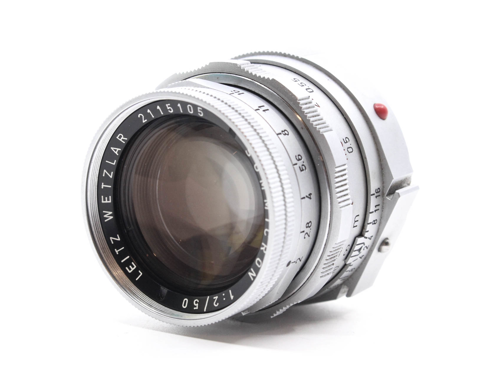
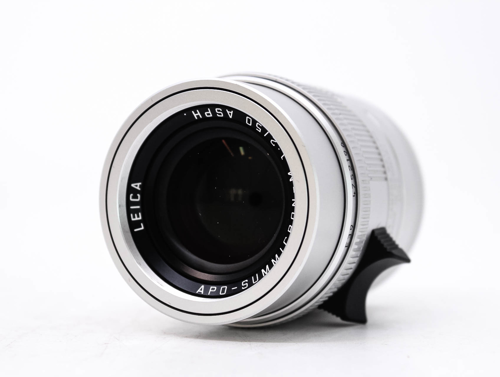
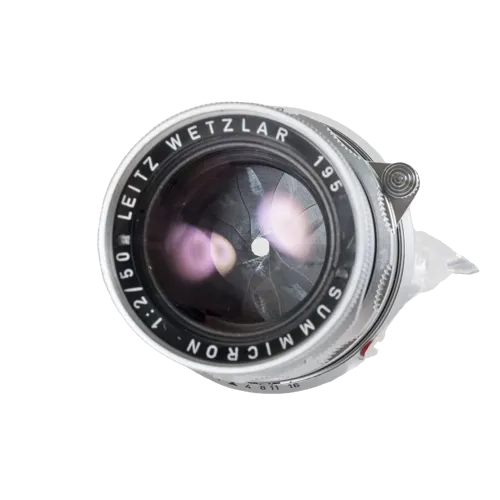
The Leica Summicron 50mm f/2 IV is a six-element M-mount standard lens designed by Walter Mandler's team, prized by collectors for its compact form and rendering.
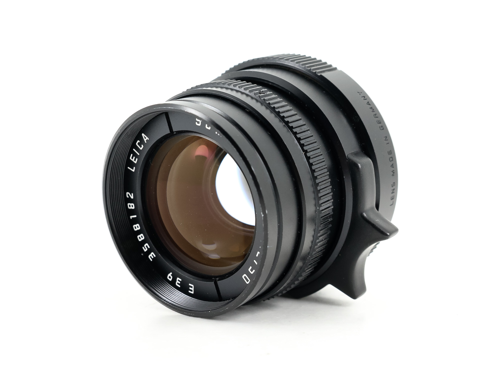
M mount
The Leica Summicron-M 50mm f/2 IV is a M-mount lens for Leica rangefinder cameras. As of October 2026, it sells from €830 used across 29 listings, with a 30-day median of €2,039. Leica price index →
Measured against the 76 other 50mm M-mount lenses in the catalogue.
The fourth-generation Summicron-M is the most enduring of all Leica 50mm f/2 designs, having entered production in 1979 and remained in the catalogue, in evolved form, for decades [1]. Where earlier Summicrons relied on collapsible barrels, goggles, or close-focus mechanisms, this version distilled the standard lens to a compact, modern, all-metal package that established the look most photographers now associate with a Leica normal lens [2]. Its optical layout was credited to a team led by Walter Mandler with Erich Wagner and Garry Edwards, with the design dated to 1977.
The lens uses a six-element, four-group formula and focuses to 0.7 m, with an aperture range from f/2 to f/16 set by a click-stopped diaphragm offering half-stop detents. It is built for the Leica M bayonet with full rangefinder coupling, takes E39 screw-in filters, and accepts a built-in telescopic hood as well as separate clip-on hoods such as the 12585 and 12538. The black anodised barrel is light and short, contributing to a handling character that reviewers describe as refined and balanced on M bodies. The aperture is recorded here with eight blades, though Leica technical data for the family also lists ten-blade examples across the long production run.
Version designation is a frequent source of confusion. Ken Rockwell classifies the 1979 to 1994 lens as the Type 4 and the 1994 to 2003 barrel as the Type 5, noting that both share the same optical formula and differ mainly in barrel construction [3]. Early production carried a distinctive focusing tab nicknamed the "Tiger Paw" or "Tiger Claw," which later gave way to a more conventional concave tab, and the tab was eventually dropped from the standard finish entirely. Reported finishes across the lineage include black, chrome, and a small run of titanium, with collectors using the focus-tab style and serial ranges to separate earlier from later examples.
Rendering The version IV is widely regarded among Leica's normal lenses for its combination of resolution and pleasing rendering, and it retains a strong following for both film and digital use. Reviewers consistently treat it as a high-performing, characterful standard lens rather than a clinical one, though detailed laboratory measurements are not the focus of the collector-oriented sources surveyed here. Because the Type 4 and later Type 5 share an optical formula, observations on image character generally apply to both barrels.
Development and Launch The design was finalised in the late 1970s by a Leitz team under Walter Mandler, with Erich Wagner and Garry Edwards also credited, and the lens reached the market in 1979. It replaced the previous 1969 to 1979 Summicron, itself a six-element-in-four-groups design, and carried the simplified, compact philosophy further into a modern fixed barrel.
Production Evolution Over its long life the lens saw barrel rather than optical changes. The focusing tab evolved from the early "Tiger Paw" style to a conventional concave tab and was later removed, while finishes spanned black, chrome, and titanium. Later production examples were offered with six-bit coding for digital M bodies, and the lens has been sold under multiple Leica order numbers across its variants.
Special editions Several commemorative and regional variants are documented, including a Royal Photographic Society Centenary lens, a Dutch Flag edition, a Colombo '92 release, and a 50 Jahre Summicron anniversary edition, alongside a small titanium run. A limited screw-mount edition was also produced near the end of the 1990s.
Collector Notes Because the standard modern barrel closely resembles current production, an older Type 4 can be mistaken for a recent lens at a glance, so buyers should verify serial number, finish, and tab style against the variant they intend to buy. Order numbers recorded for the family include the black 11819 and the silver 11816, among others tied to specific finishes and editions. When shopping, it is worth confirming the presence and condition of period-correct hoods such as the 12538, which trade as desirable accessories in their own right.
Good time to buy. The lowest listing is 59% below the 30-day average.
Lowest price Click a mark to open that listing · arrow keys to step, Enter to open
Price against condition for 29 listings of Leica Summicron-M 50mm f/2 IV, €830 to €2,807, median €1,443. Mint: 2 at €2,548, €2,807. Excellent: 8 at €1,204, €1,274, €1,443, €1,510, €1,661, €1,982, €2,336, €2,712. Good: 11 at €1,159, €1,364, €1,400, €1,402, €1,478, €1,506, €1,547, €1,555, €1,555, €2,005, €2,039. Fair: 1 at €1,113. Unknown: 7 at €830, €1,038, €1,122, €1,133, €1,143, €1,195, €1,340. The full table follows.
| Condition | Lowest | Median |
|---|---|---|
| Mint | €2,548 | €2,678 |
| Excellent | €1,204 | €1,586 |
| Good | €1,159 | €1,506 |
| Fair | €1,113 | €1,113 |
| Other | €830 | €1,133 |
Over the last 21 weeks the median price for the Leica Summicron-M 50mm f/2 IV has risen, ranging from €1,364 to €2,074 (now €2,039).
Weekly price (EUR). Median (Good or better) and lowest (Good or better) across 21 weeks. The full figures follow in the table below.
| Week | Median | Lowest |
|---|---|---|
| Jun 1, 2026 | €1,503 | €1,111 |
| Jun 8, 2026 | €1,538 | €1,111 |
| Jun 15, 2026 | €1,538 | €1,111 |
| Jun 22, 2026 | €1,538 | €1,111 |
| Jun 29, 2026 | €1,429 | €1,111 |
| Jul 6, 2026 | €1,429 | €1,111 |
| Jul 13, 2026 | €1,471 | €1,111 |
| Jul 20, 2026 | €1,471 | €1,052 |
| Jul 27, 2026 | €1,429 | €1,052 |
| Aug 3, 2026 | €1,399 | €1,111 |
| Aug 10, 2026 | €1,511 | €1,111 |
| Aug 17, 2026 | €1,470 | €1,111 |
| Aug 24, 2026 | €1,530 | €1,111 |
| Aug 31, 2026 | €1,470 | €1,111 |
| Sep 7, 2026 | €1,530 | €1,111 |
| Sep 14, 2026 | €1,528 | €1,111 |
| Sep 21, 2026 | €1,528 | €1,111 |
| Sep 28, 2026 | €1,480 | €1,111 |
| Oct 5, 2026 | €1,520 | €1,111 |
| Oct 12, 2026 | €1,510 | €1,160 |
| Oct 19, 2026 | €1,506 | €1,159 |
Every shop grades differently. Leica Classic uses letters, Ffordes uses E++ and E+, German dealers write "Zustand B", Japanese dealers write A−. We map all of them onto the one ladder below. Where a shop states its own grade, we print it under ours.
As of October 2026, the Leica Summicron-M 50mm f/2 IV sells from €830 used, with a 30-day median of €2,039, across 29 active listings.
As of October 2026, the Leica Summicron-M 50mm f/2 IV is sold by 5 sources (29 listings), from €830 used: all compared cheapest-first on this page.
The Leica Summicron-M 50mm f/2 IV takes 39 mm screw-in filters (E39).
The Leica Summicron-M 50mm f/2 IV focuses down to 0.7 m, and the rangefinder stays coupled over the whole range.
The Leica Summicron-M 50mm f/2 IV weighs 195 g, lighter than 74% of the 72 other 50mm M-mount lenses in the catalogue.
The Leica Summicron-M 50mm f/2 IV has a Leica M mount, so it fits every Leica M body natively and mirrorless cameras with an M adapter. It carries no 6-bit code, so select the lens profile by hand on a digital M.
The Leica Summicron-M 50mm f/2 IV was produced from 1980.
Similar lenses you might be interested in
Comments