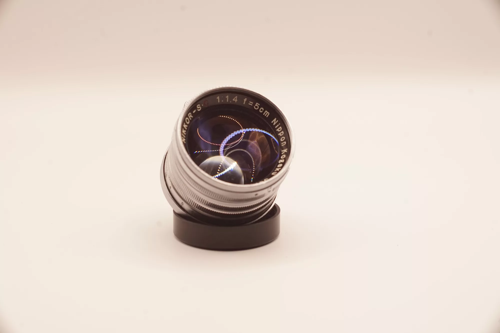
The Nippon-Kogaku Nikkor-HC 5cm f/2 Collapsible is a rare LTM Sonnar-derived 50mm rangefinder lens prized by Nikon and Leica-mount collectors.
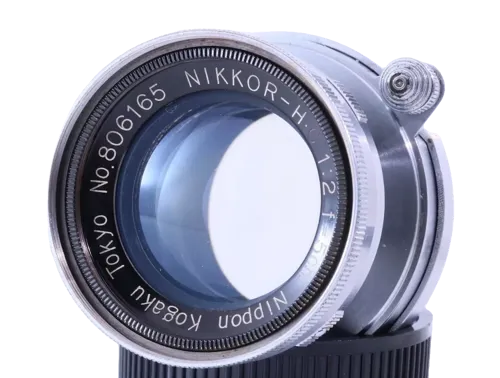
Nippon-Kogaku Nikkor-HC 5cm f/2 Collapsible
LTM mount
No listings tracked for this lens right now.
The Nippon-Kogaku Nikkor-HC 5cm f/2 Collapsible is a LTM-mount lens for Leica rangefinder cameras. Leica price index →
How it compares
Measured against the 108 other 50mm LTM-mount lenses in the catalogue.
Specification
About this lens
Nippon-Kogaku Nikkor-HC 5cm f/2 Collapsible
The collapsible Nikkor-HC 5cm f/2 is the earliest form of what became Nippon Kogaku's most prolific rangefinder normal lens, and the one most likely to be mistaken for a Leitz optic at a glance. Its six-element, three-group formula descends from the prewar Zeiss Sonnar 5cm f/2, a design Nippon Kogaku adapted after Zeiss patents passed to Japan in the aftermath of the Second World War [1]. The "H" in the name denotes the six-element construction and the "C" marks the lens as coated. Both the S-mount and the Leica Thread Mount collapsible versions were produced in a brief, parallel run, and both are now considered rare and expensive among collectors [2].
The barrel collapses by roughly a centimeter, a modest but real reduction in carrying length that sets it apart from the later rigid LTM Nikkor 5cm f/2. The machining quality is high, with closely fitted parts that recall an era of small-batch, hand-finished production, and the lens carries a noticeable heft for its size. Focusing uses a long throw suited to precise rangefinder work, and earlier examples have an infinity-lock button that doubles as a focusing finger grip and helps when unscrewing the lens from the body. The aperture ring is clickless, predating the click-stop convention, and the barrel seats into its collapsed and extended positions with a faint but positive detent. With ten blades the iris stays close to round. The lens couples to the rangefinder on Leica Thread Mount cameras and on the many postwar Japanese screw-mount bodies such as Nicca, Tower and Leotax that were frequently sold bundled with Nikkors.
Identification rests on details that distinguish this collapsible model from its successors. It precedes both the rigid LTM Nikkor-HC 5cm f/2 and the later black-banded "Blackbelt" version, the latter using more aluminum internals and dropping the red "C" once coating had become universal [3]. Early collapsible examples carry thinner, lighter engraving than later, bolder typefaces, and late examples were supplied with a collar to prevent collapse, a configuration collectors call the "hybrid" version. Because production spanned a period of glass-supply transition, the optics went through small recalculations as German glass gave way to Japanese equivalents, so minor running changes exist within the type.
Optical qualities
Rendering Documented impressions describe a classic Sonnar character: smooth, slightly swirly background blur with gentle, "polite" focus transitions rather than abrupt ones, and good central sharpness even wide open. Out-of-focus highlights show some outlining and a mild soap-bubble tendency at f/2, becoming cleaner and rounder by about f/2.8. The optics are shared with the S-mount sibling, which exhibits noticeable vignetting wide open that improves by f/2.8, and modest, visible geometric distortion on straight lines [4].
Flare resistance Flare resistance is weak by modern standards, as is typical of an uncoated-era optical layout carried over with early coatings; strong light sources in the frame reduce contrast.
History
Development and Launch Nippon Kogaku entered the Leica Thread Mount market in the desperate postwar years when Japan needed export currency and when many domestic makers produced Leica-copy bodies without the capacity to build their own lenses. Supplying LTM Nikkors let those cameras be sold complete, and the lenses gained wider attention after favorable press exposure. The S-mount and LTM collapsible 5cm f/2 lenses date from the early years of Nikon's consumer camera business, with serial-number evidence placing some examples around 1948. The broader Nikkor-HC 5cm f/2 family remained in production until roughly 1962.
Production Evolution The collapsible LTM version was followed by a rigid LTM model that added its own helicoid allowing very close focusing while uncoupled from the rangefinder, and later by the black-banded variant with simplified, lighter aluminum internals. Within the collapsible run itself, small optical recalculations accompanied the shift from German to locally sourced glass, and late units gained an anti-collapse collar.
Collector Notes The collapsible LTM Nikkor commands a premium for its rarity, with one repairer reporting the batch numbered fewer than about two thousand examples; the S-mount equivalent can fetch even higher prices. Buyers should check for haze and early balsam separation between cemented elements, both reported on surviving examples, as well as the usual oil migration onto the aperture blades[5]. Confirming whether a lens is an early collapsible, a late "hybrid" with collar, or one of the later rigid or black-banded versions helps establish what is actually in hand, since the names are easily conflated.
Sources
- Casual Photophile. Nikon Nikkor H C 50mm F/2 LTM Lens Review: A Leica Alternative That's More Than Just a Copycasualphotophile.com →
- Richard Haw's Classic Nikon Repair and Review. Repair: Nikkor-H•C 5cm f/2 LTM (collapsible)richardhaw.com →
- Richard Haw's Classic Nikon Repair and Review. Nikkor-H•C 5cm f/2 (Leica Thread Mount)richardhaw.com →
- Richard Haw's Classic Nikon Repair and Review. Repair: Nikkor-H•C 5cm f/2 (S-Mount)richardhaw.com →
- Victory Camera. Nikon Nikkor H.C 5cm 50mm f2 LTM Rare Collapsible Screw Mount Lensvictorycamera.com →
Where to buy
Related lenses
Similar lenses you might be interested in
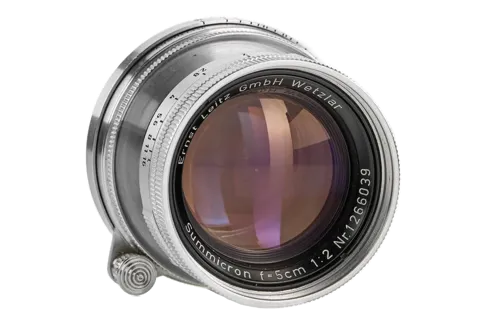
Summicron 50mm f/2 I (Collapsible)
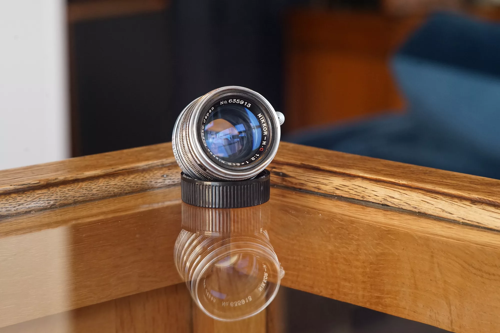
Nikkor-HC 5cm f/2 Rigid
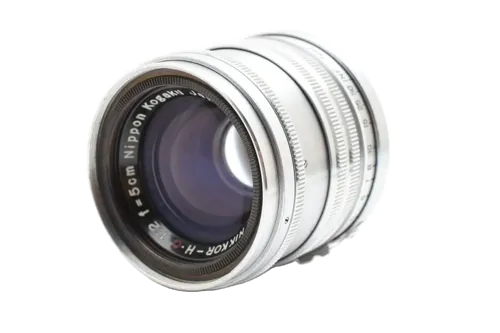
Nikkor-H.C 5cm f/2

Nikkor-S.C 50mm f/1.5
Nikkor-SC 50mm f1/1.4

Comments