Best price Good
Nikon (ニコン) NIKKOR-S.C 5cm/1.4 黒 (S)
Sold by Nisshin Camera
€233 ≈ $251
A Sonnar-derived Nippon-Kogaku Nikkor-SC 50mm f/1.4 in Leica screw mount (LTM), a single-coated fast fifty prized by rangefinder collectors for classic rendering.
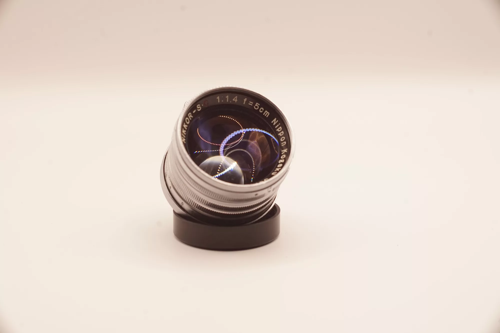
LTM mount
The Nippon-Kogaku Nikkor-SC 50mm f1/1.4 is a LTM-mount lens for Leica rangefinder cameras. As of October 2026, it sells from €233 used across 3 listings, with a 30-day median of €634. Leica price index →
Measured against the 108 other 50mm LTM-mount lenses in the catalogue.
Few fast fifties carry as much rangefinder folklore as the Nikkor 50mm f/1.4, the lens whose reputation among Korean War photojournalists helped establish Nippon-Kogaku's optical credentials in the West [1]. This Leica screw mount (LTM, M39) example belongs to that lineage, a single-coated f/1.4 standard lens whose suffix tells its story: the "S" denotes the seven-element design and the "C" denotes coated optics, with "C" specifically indicating single coating rather than the later multicoating used on Nikon's reflex lenses[2]. The lens uses a 50mm focal length, an f/1.4 maximum aperture, seven elements in five groups, and a twelve-blade diaphragm, in a silver barrel of roughly 70mm length and 57mm diameter that takes 52mm filters and weighs about 325g.
The optical formula is a Sonnar derivative, a layout that uses fewer separated air-to-glass surfaces than the Gauss-type lenses favoured by competitors such as the contemporaneous Canon 50mm f/1.4. According to a collector summary of the two schools, the Sonnar approach was popular before coatings became widespread because cementing elements into groups reduced internal reflections and helped contrast, which tended to give the Nikkors strong central sharpness and contrast wide open while the Gauss designs offered more even performance across the field. In its LTM form the lens mounts on Leica screw bodies and, via a screw-to-bayonet adapter, on Leica M cameras; it is not six-bit coded. The barrel focuses down to 0.6m. Handling of the Nikkor rangefinder 50mm is frequently praised, with one reviewer describing the build quality as among the nicest he had handled.
A note on naming and identification: this lens shares its optical heritage and the S.C designation with the earlier Nikon rangefinder Nikkor produced for both the Nikon S bayonet (internal Contax-type) mount and the Leica screw mount. Published descriptions of the original vintage version cite different barrel dimensions, a different blade count, and an alternative element-grouping count, so buyers should rely on the markings and the verified specifications for this particular screw-mount example rather than assuming all Nikkor 50mm f/1.4 lenses are identical. Reviewers also note that consistency of assembly was historically a selling point for these Nikkors, with a lower chance of a poor sample than was sometimes reported for Leica or Zeiss lenses of the period.
Rendering The Nikkor 50mm f/1.4 rangefinder lens is widely treated as a character lens rather than a clinical performer. On film at full aperture one user found sharpness better than expected, while preferring f/2 for portraits. Adapted to digital, a detailed review reported noticeably reduced contrast across the frame at f/1.4 with acceptable centre resolution, clear improvement by f/2, and best mid-frame results only on stopping well down, with corners that never fully sharpen.
Bokeh and transitions Out-of-focus rendering wide open is described as busy, with visible outlining of highlights, and as becoming better behaved at f/2; the overall verdict is character rather than smoothness.
Flare resistance Flare control is a clear weakness on the single-coated design. One reviewer rated its behaviour against bright light as among the worst he had encountered, with prominent ghosting from point light sources and visible internal reflections. This is consistent with the era and the single-coating implied by the "C" suffix.
Distortion and vignetting The lens shows only minor pincushion distortion, light enough that the reviewer left it uncorrected in samples. Vignetting is heavy wide open, measured at roughly three stops at f/1.4 and improving gradually on stopping down, still around a stop at f/8.
Collector and user notes Owners value the lens for a classic, slightly glowing look that suits portraiture, while acknowledging it is not a lens chosen for across-frame resolution.
Development and Launch Nippon-Kogaku's fast 50mm Nikkor built the company's postwar reputation, gaining attention in the 1950s when combat photographers covering the Korean War praised the new Nikkors against established European optics. The Sonnar-type f/1.4 was offered in both the Nikon S rangefinder mount and the Leica screw mount, allowing Leica and Contax-type users to fit a Japanese fast standard lens.
Collector Notes The defining identification point is the S.C marking, where the "C" indicates single coating, distinguishing these from later multicoated Nikkors. Because the same general design circulated in both Nikon S and Leica screw mounts, and because the original and later versions differ in detail, buyers should confirm the actual mount, filter thread, and barrel before purchase rather than relying on the family name alone. As with any single-coated lens of this age, internal haze and coating condition are worth checking given the design's already limited flare resistance. On the open market the rangefinder Nikkor 50mm f/1.4 is uncommon, and prices reflect its collector standing.
Good time to buy. The lowest listing is 63% below the 30-day average.
Lowest price Click a mark to open that listing · arrow keys to step, Enter to open
Price against condition for 3 listings of Nippon-Kogaku Nikkor-SC 50mm f1/1.4, €233 to €879, median €634. Mint: 1 at €879. Good: 2 at €233, €634. The full table follows.
| Condition | Lowest | Median |
|---|---|---|
| Mint | €879 | €879 |
| Good | €233 | €433 |
Over the last 18 weeks the median price for the Nippon-Kogaku Nikkor-SC 50mm f1/1.4 has fallen, ranging from €634 to €879 (now €634).
Weekly price (EUR). Median (Good or better) and lowest (Good or better) across 18 weeks. The full figures follow in the table below.
| Week | Median | Lowest |
|---|---|---|
| Jun 1, 2026 | €794 | €648 |
| Jun 8, 2026 | €794 | €648 |
| Jun 15, 2026 | €794 | €648 |
| Jun 22, 2026 | €794 | €648 |
| Jun 29, 2026 | €794 | €648 |
| Jul 6, 2026 | €794 | €648 |
| Jul 13, 2026 | €792 | €648 |
| Jul 20, 2026 | €834 | €648 |
| Jul 27, 2026 | €838 | €648 |
| Aug 3, 2026 | €840 | €648 |
| Aug 10, 2026 | €841 | €648 |
| Aug 17, 2026 | €846 | €648 |
| Aug 24, 2026 | €844 | €648 |
| Aug 31, 2026 | €843 | €648 |
| Sep 7, 2026 | €879 | €648 |
| Sep 14, 2026 | €879 | €648 |
| Sep 21, 2026 | €756 | €634 |
| Sep 28, 2026 | €634 | €233 |
Every shop grades differently. Leica Classic uses letters, Ffordes uses E++ and E+, German dealers write "Zustand B", Japanese dealers write A−. We map all of them onto the one ladder below. Where a shop states its own grade, we print it under ours.
As of October 2026, the Nippon-Kogaku Nikkor-SC 50mm f1/1.4 sells from €233 used, with a 30-day median of €634, across 3 active listings.
As of October 2026, the Nippon-Kogaku Nikkor-SC 50mm f1/1.4 is sold by 2 sources (3 listings), from €233 used: all compared cheapest-first on this page.
Similar lenses you might be interested in



Comments