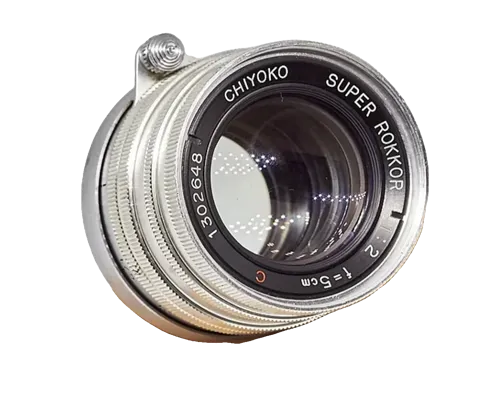
The Chiyoda Kogaku Super Rokkor 50mm f/2 [C], a coated LTM normal lens from Minolta's Minolta 35 rangefinder system, prized by Leica-mount collectors.
![Chiyoda Kogaku Super Rokkor 50mm f/2 [C]](https://assets.leicalenslist.com/images/2063_medium.webp)
Chiyoda Kogaku Super Rokkor 50mm f/2 [C]
LTM mount
No listings tracked for this lens right now.
The Chiyoda Kogaku Super Rokkor 50mm f/2 [C] is a LTM-mount lens for Leica rangefinder cameras. Leica price index →
How it compares
Measured against the 108 other 50mm LTM-mount lenses in the catalogue.
Specification
About this lens
Chiyoda Kogaku Super Rokkor 50mm f/2 [C]
This faster normal lens belongs to the Super Rokkor family that Chiyoda Kogaku Seiko built for its Minolta 35, the Leica-style 35mm rangefinder the company began making in 1947 after years of specializing in medium-format folders and TLRs [1]. Where the earliest Minolta 35 cameras shipped with a 45mm f/2.8 Super Rokkor, the f/2 marked a step up in speed within the same screw-mount system, and it sits among the lenses introduced as the camera line matured in the mid-1950s. Rokkor itself was the brand Chiyoda Kogaku, later Minolta, used for its lenses, a name taken from Mount Rokko near the company's optics works in the Osaka area and chosen to signal optical quality [2].
The lens uses a seven-element optical design and a coated standard formula, fitting on the Leica thread mount (LTM / M39) and coupling to the rangefinder, with a 10-blade diaphragm, a 43mm filter thread, and focusing down to one meter. As with the rest of the Minolta 35 normal lenses of the period, handling follows the conventions of the screw-mount Leica copies it was built to complement, and the silver barrel matches the chrome finish of the cameras of the era. Because it is an LTM lens, it can also be mounted on other Leica thread-mount bodies and, by way of an LTM-to-M adapter, on later Leica M cameras.
A useful identification point is the maker's engraving. Minolta 35 LTM lenses carried the "Chiyoko" logo until roughly 1956 to 1958, after which the marking changed to "Chiyoda Kogaku," so a barrel reading "Chiyoda Kogaku Super Rokkor" indicates the later naming convention rather than the earliest examples. Collector references describe the f/2 Super Rokkor as a seven-element design; the element-and-group split reported in some sources differs from the configuration recorded here, so buyers should treat group counts in secondary listings with caution.
Optical qualities
Rendering Independent published testing of this specific lens is scarce, so its rendering is not documented in the same depth as the better-known Leica and Canon normals of the period. As a coated mid-1950s double-Gauss-type normal lens, it would be expected to deliver moderate contrast and a classic rendering consistent with its era and coating, but detailed claims about sharpness, bokeh, or flare are not supported by a reliable dedicated review and are therefore not made here.
History
Development and Launch The Minolta 35 was Chiyoda Kogaku's Leica-like 35mm rangefinder, produced from 1947 to 1958 and shipped widely, including to Allied occupation-force stores in Japan; it shared the Leica thread mount and went through roughly nine significant variations over its life. The standard-lens lineup evolved alongside the camera: early bodies used a 45mm f/2.8 Super Rokkor, and as the line developed, additional coupled lenses were introduced, including 5cm normal lenses that brought the focal length to a true 50mm marking. The Super Rokkor name itself sits within Chiyoda Kogaku's broader Rokkor branding that ran from 1940 to 1980.
Production Evolution Across the Minolta 35 generations the standard lenses progressed from the five-element 45mm and 5cm f/2.8 designs toward faster optics, with the more complex f/2 normal appearing as the system matured; later models such as the Model IIB introduced a 5cm f/1.8 Super Rokkor as well. The most visible production change relevant to identification is the logo transition from "Chiyoko" to "Chiyoda Kogaku" on LTM lenses around 1956 to 1958.
Collector Notes A documented third-party accessory for this lens is the Auto-Up close-up attachment made by Pleasant, listed specifically for the 5cm f/2 Super Rokkor. As with most chrome-era LTM normals, prospective buyers should check for haze, cleaning marks, and coating wear on the elements, confirm smooth focus and aperture action, and verify the maker's engraving to place the lens within the Chiyoko or Chiyoda Kogaku production window. Because secondary listings sometimes disagree on the internal element-and-group arrangement, the optical configuration is best confirmed against authoritative records rather than seller descriptions.
Sources
Where to buy
Related lenses
Similar lenses you might be interested in
![Chiyoda Kogaku Super Rokkor 50mm f/2.8 [C]](https://assets.leicalenslist.com/images/2065_medium.webp)
Comments