Chiyoda Kogaku Super Rokkor 50mm f/2: a Leica thread mount standard prime for the Minolta-35 rangefinder, prized by collectors for its swirly rendering.
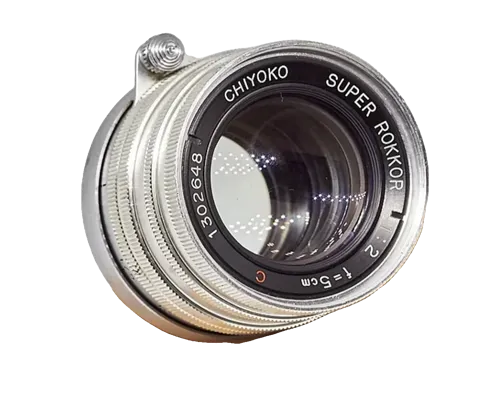
Chiyoda Kogaku Super Rokkor 50mm f/2
LTM mount
No listings tracked for this lens right now.
The Chiyoda Kogaku Super Rokkor 50mm f/2 is a LTM-mount lens for Leica rangefinder cameras. Leica price index →
How it compares
Measured against the 108 other 50mm LTM-mount lenses in the catalogue.
Specification
About this lens
Chiyoda Kogaku Super Rokkor 50mm f/2
The Super Rokkor 50mm f/2 belongs to the small family of interchangeable Leica thread mount lenses that Chiyoda Kogaku built for its Minolta-35 rangefinder cameras, the company's Leica-derived 35mm system [1][2]. Rokkor was the brand name Chiyoda Kogaku Seiko used for its optics, taken from Mount Rokko near the company's Mukogawa factory. Within the rangefinder lineup the f/2 sat between the slower Super Rokkor 50mm f/2.8 and the faster, much rarer 50mm f/1.8, giving Minolta-35 owners a moderately fast normal lens that remains uncommon today because the interchangeable rangefinder system was produced in modest numbers.
Optically the lens uses a symmetrical Planar-type design of seven elements in six groups with a purple-toned coating, and the aperture is built from ten blades that keep the opening close to circular through the stop-down range. Construction is all metal with a silver chrome finish, and the lens couples to the rangefinder for focusing down to about one meter. Because it carries the standard 39mm Leica thread, it mounts not only on the Minolta-35 but also on Leica, Canon and later Cosina Voigtlander thread mount bodies, and on M-mount cameras through a thread-to-bayonet adapter. A closely related Super A bayonet version of the same optic exists without its own focusing helicoid, relying on the camera body for focus, so collectors should confirm whether a given example is the native screw mount lens or the Super A type.
Optical qualities
Rendering Documentation for this lens is limited and comes mainly from collector use rather than formal testing. Users describe a higher-contrast, saturated look with a distinct rotational, swirly out-of-focus background and cat-eye shaped highlights toward the frame edges, along with noticeable corner darkening. The lens is reported to perform well even wide open at f/2.
Collector and user notes The rear group is prone to fogging or oil migration, which when severe reduces contrast and sharpness, so the rear element condition is worth checking before purchase.
History
Development and Launch Chiyoda Kogaku built the Minolta-35, a Leica-type screw mount rangefinder, and supplied a set of interchangeable Super Rokkor lenses for it. The 50mm f/2 was introduced as a standard lens for that system toward the end of the 1950s decade, joining the existing slower normal optics in the line. Production of the interchangeable rangefinder lenses was never large, which is one reason these Super Rokkors are scarce relative to the company's later SLR lenses.
Collector Notes Examples are marked Chiyoda Kogaku, and the rear cover may still carry the Chiyoda optical marking, helping confirm the maker. Beyond the screw mount and Super A distinction noted above, the main originality concerns are internal haze and oil on the rear group; the simple barrel construction means cleaning is sometimes possible, but heavily affected glass should lower expectations on price and image quality. There is a minor discrepancy in published descriptions of the optical layout: at least one collector account refers to a four-group arrangement, but the configuration recorded here is seven elements in six groups.
Sources
Where to buy
Related lenses
Similar lenses you might be interested in
![Chiyoda Kogaku Super Rokkor 50mm f/2 [C]](https://assets.leicalenslist.com/images/2063_medium.webp)
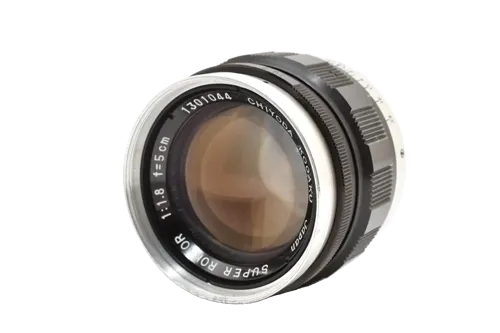
![Chiyoda Kogaku Super Rokkor 50mm f/2.8 [C]](https://assets.leicalenslist.com/images/2065_medium.webp)
Comments