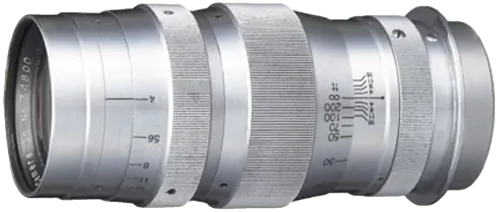
An early coupled 135mm f/4 LTM telephoto for the Minolta-35, with four elements, ten blades and three documented chrome focusing-barrel generations.
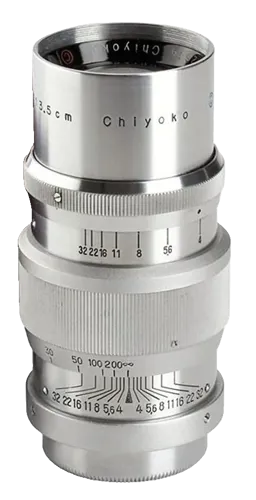
Chiyoda Kogaku Tele Rokkor 135mm f/4
LTM mount
No listings tracked for this lens right now.
The Chiyoda Kogaku Tele Rokkor 135mm f/4 is a LTM-mount lens for Leica rangefinder cameras. Leica price index →
How it compares
Measured against the 23 other 135mm LTM-mount lenses in the catalogue.
Specification
About this lens
Chiyoda Kogaku Tele Rokkor 135mm f/4
The Chiyoda Kogaku Tele Rokkor 135mm f/4 is an early telephoto lens for the Minolta-35 rangefinder system. Period documentation writes the focal length as 13.5cm, while modern cataloguing commonly uses 135mm. It is a native Leica-standard screw-mount lens with its own focusing helicoid and mechanical rangefinder coupling, intended for Minolta-35 cameras and compatible LTM rangefinder bodies.
The optical system is documented as four elements in three groups. Aperture settings run from f/4 to f/32 and are controlled manually on the lens. A ten-blade diaphragm forms the iris. The metal barrel was produced in more than one mechanical form, and the close-focus specification changed with production. The earliest described version reaches approximately 2 metres, while the more commonly documented later forms focus to about 2.5 metres.
Period and specialist sources disagree on a single universal size and weight because they describe different generations or use rounded brochure figures. A 40mm filter thread is consistently reported, but length and mass should be assigned only when the exact barrel generation is known. Coated examples may carry a red C mark. That mark identifies coating and does not by itself create a separate optical profile.
The 135mm field of view requires an appropriate external finder on most screw-mount cameras. On Leica M bodies the lens can be mounted with a correctly coded 135mm LTM-to-M adapter, but the accuracy of any vintage rangefinder body and lens cam should be checked before relying on critical focus.
Optical qualities
Rendering
A modern full-frame test of one later-generation example reports a distinctly period telephoto character rather than modern uniform correction. The test found usable portrait rendering with visible residual aberrations and a long minimum-focus distance. Because this evidence comes from a single tested lens and not a factory performance standard, it should be treated as descriptive evidence for the optical type, not as a guarantee for every surviving copy.
Sharpness
The same test found resolution modest by modern standards, with no aperture producing completely uniform performance across the frame. Age, centring, haze and focus calibration can materially change the result of an individual lens, so this finding should not be converted into an absolute rating. Stopping down is expected to improve practical definition, but no dependable period chart has been located for this exact rangefinder lens.
Bokeh and transitions
The ten-blade diaphragm maintains a comparatively rounded opening through much of the aperture range. Sample photographs in the modern test show that out-of-focus rendering can be useful for portrait work, while also reflecting the lens's residual aberrations. Background structure, focus distance and individual optical condition remain important variables.
Distortion and vignetting
The available modern test reports visible pincushion distortion. It does not provide a basis for a universal numerical distortion or vignetting value, so no percentage should be assigned. These characteristics should be evaluated from the exact lens if measurement is required.
History
Development and Launch
Chiyoda Kogaku introduced the Tele Rokkor as part of the first accessory-lens generation for the Minolta-35 system around 1949. The contemporary range included normal and short-telephoto lenses as well as the 13.5cm model. Its native coupled Leica thread mount allowed Chiyoda Kogaku to serve Minolta-35 users while retaining compatibility with the wider screw-mount rangefinder market.
The four-element, three-group layout, f/4 maximum aperture and 17-degree angle of view are recorded in period-derived specifications. The lens was a substantial all-metal accessory rather than a compact standard lens, and it was normally used with a separate 135mm finder.
Production Evolution
Specialist research describes three mechanical generations. The earliest has a dull-finished ring near the mount and focuses to about 2 metres. A second form uses a brighter chrome treatment and generally focuses to 2.5 metres. A later version, appearing in the first half of the 1950s, has a revised barrel, changed markings and a larger aperture-control ring. The core four-element, three-group specification and ten-blade diaphragm remain associated with the profile.
Published dimensional and weight figures vary between these forms. Some brochures round the length to 10cm and give a higher mass than later measurements, while specialist measurements differ by version. For that reason, one combined dimension or weight should not be presented as if it describes every Tele Rokkor 135mm f/4.
Special Editions/Variants
Coated lenses marked with a red C and the documented mechanical generations belong to this profile unless further evidence establishes an optical recalculation. No separate commemorative or special-order factory edition has been reliably documented. A different close-focus scale or mount-ring treatment should be recorded as a production variant, not automatically split into a new lens identity.
Collector Notes
The correct rangefinder lens is engraved Tele Rokkor and 13.5cm or its equivalent, has a native Leica-standard screw mount and includes a rangefinder cam. It should not be confused with later Minolta SLR telephotos of the same nominal focal length and aperture. Those lenses have different mounts, registers and mechanical construction.
For practical use, confirm which close-focus generation is present, inspect the heavy focusing barrel for smooth travel and test coupling on the intended body. A 135mm finder is normally required on classic LTM cameras. The red C is a coating mark, not a model code or serial designation.
Sources
Where to buy
Related lenses
Similar lenses you might be interested in
Comments