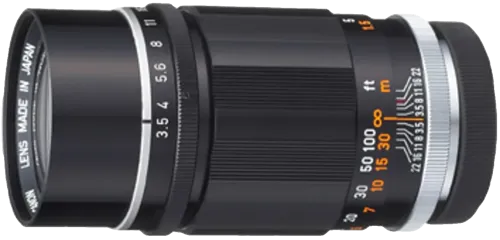
A June 1948 Canon Serenar 135mm f/4 telephoto with four elements in three groups, a 40mm filter fitting and original coupled LTM focusing.
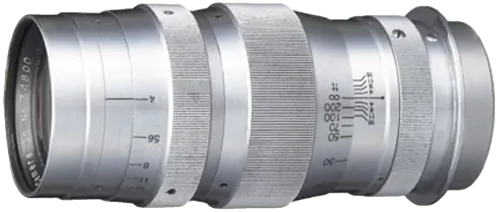
Canon Serenar 135mm f/4 II
LTM mount
No listings tracked for this lens right now.
The Canon Serenar 135mm f/4 II is a LTM-mount lens for Leica rangefinder cameras. Leica price index →
How it compares
Measured against the 23 other 135mm LTM-mount lenses in the catalogue.
Specification
About this lens
Canon Serenar 135mm f/4 II
The Canon Serenar 135mm f/4 II is an early postwar Japanese telephoto marketed in June 1948. It places a four-element, three-group optical system in a chrome Leica screw-mount barrel with rangefinder coupling. Canon records a 40mm filter diameter and an f/16 minimum aperture, but does not provide a minimum focusing distance, dimensions, weight or diaphragm blade count for this exact version.
This profile is defined by the coupled Type II construction. It is separate from the uncoupled Serenar 135mm f/4 I marketed three months earlier and from the faster 135mm f/3.5 introduced in 1952. The coupling mechanism is a material functional difference, not a minor cosmetic revision.
Optical qualities
Rendering
Canon documents four elements in three groups, the same count listed for the preceding uncoupled Type I. No controlled test or factory modulation data for this exact coupled 1948 barrel has been located. Descriptions of later f/3.5 Canon lenses should not be imported because maximum aperture, coating period and mechanical construction differ.
The 135mm focal length provides a narrow field on 35mm film. It is suited to portraits, distant details and subjects that can be framed with a dedicated finder. The f/4 aperture offers moderate subject separation, but the visible result from a surviving lens can be changed substantially by internal haze, coating wear, separation or inaccurate optical spacing.
At f/4
Maximum aperture places a greater demand on rangefinder calibration than a shorter standard lens. The coupled cam should be checked at infinity and at several measured distances. No reliable near-focus figure is available from Canon, so the engraved scale of an original example should be read rather than replaced with the 1.52m value from Type I.
The diaphragm blade count is also undocumented in Canon's specification. Background highlight shape and aperture geometry are therefore left undescribed. A hood may reduce oblique flare, while haze or damaged coatings require condition assessment rather than stylistic interpretation.
Stopped down
Closing the aperture increases depth of field and usually improves field consistency. Canon specifies a smallest setting of f/16. Middle settings are practical when more of the scene must remain in focus, while the smallest aperture trades depth for increasing diffraction.
Handling and compatibility
The key operational advance over Type I is rangefinder coupling. The lens should focus through the camera's normal coincidence mechanism rather than relying solely on the distance scale. A 135mm accessory finder is still required on bodies without an appropriate frame because focusing and framing are separate functions.
The 40mm front fitting should not be confused with the 48mm thread of the later f/3.5. An LTM-to-M adapter permits use on many Leica M bodies but cannot correct a worn cam or inaccurate infinity setting. Mirrorless adaptation provides direct sensor focus. Dimensions and weight remain unknown rather than being copied from Type I.
History
Development and Launch
Canon traces the original 135mm f/4 to development work that began during the early 1940s. The uncoupled lens was advertised in 1947 and marketed in March 1948 after its original bayonet arrangement had been changed to Canon's S screw mount. It was Canon's first interchangeable lens programme in this focal length.
The rangefinder-coupled Type II followed in June 1948. Canon's museum describes it as an overseas-only product. The rapid revision made the long lens more practical on compatible rangefinder bodies while retaining the recorded four-element, three-group optical count.
Production Evolution
The addition of a coupling cam is the principal documented change from Type I. The filter fitting remained 40mm and the minimum aperture f/16. Canon does not publish the Type II's close-focus distance, dimensions or weight, so those specifications are kept unknown rather than averaged with adjacent models.
In December 1952 Canon replaced the f/4 class with a 135mm f/3.5 Serenar using a different specification and 48mm front thread. That successor is a separate profile. Small engraving and scale changes within the f/4 II require evidence before being treated as production stages.
Special Editions/Variants
No factory special edition of Type II has been confirmed. Export engravings and small exterior differences can occur on early Canon lenses, but they do not establish a separate optical identity. The uncoupled Type I is not a variant within this entry because its focusing method differs materially.
Collector Notes
Confirm Serenar 1:4 f=135mm engraving, the chrome barrel, 40mm front fitting, Leica-standard S thread and a working rangefinder cam. A lens that looks like Type II but does not move the rangefinder may be Type I, incomplete or incorrectly assembled. Test infinity register and cam movement before assigning the profile.
Inspect the optics for haze, fungus, separation, coating wear and cleaning damage. Check helicoid play and diaphragm movement through f/16. Individual serial numbers, export history, included finders, cases, condition grades and prices do not belong to the generic description.
Sources
Where to buy
Related lenses
Similar lenses you might be interested in
Comments