A postwar German 135mm f/4 triplet in a documented coupled LTM barrel, with three elements in three groups, 15 blades and 1.5m close focus.
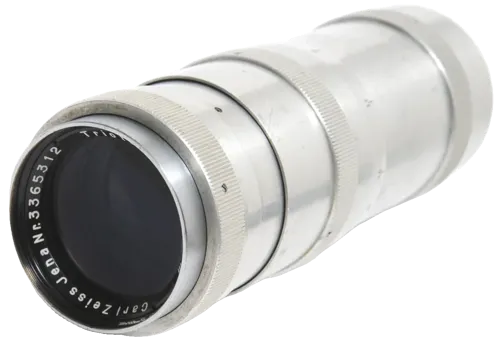
Carl Zeiss Jena Triotar 135mm f/4
LTM mount
No listings tracked for this lens right now.
The Carl Zeiss Jena Triotar 135mm f/4 is a LTM-mount lens for Leica rangefinder cameras. Leica price index →
How it compares
Measured against the 23 other 135mm LTM-mount lenses in the catalogue.
Specification
About this lens
Carl Zeiss Jena Triotar 135mm f/4
The Carl Zeiss Jena Triotar 135mm f/4 is a German telephoto built around a three-element, three-group triplet. This profile concerns the unusual coated version documented in a rangefinder-coupled Leica screw-mount barrel. The database records a fifteen-blade diaphragm and a minimum focusing distance of approximately 1.5 metres.
The coupled LTM configuration is much less commonly documented than the Triotar versions made for Exakta, M42, Praktina and other SLR systems. Because surviving online evidence is largely based on specialist dealer records rather than a complete Carl Zeiss Jena mount catalogue, physical originality should be checked carefully on each example.
Optical qualities
Rendering
The Triotar uses three separate elements, the classic triplet principle in its simplest form. A well-corrected triplet can provide strong central definition with a low element count, but it has fewer degrees of freedom for correcting the outer field than more complex Sonnar or double-Gauss designs. Stopping down is therefore particularly relevant when even performance across the frame matters.
At 135mm, the lens gives a narrow field of view and comfortable working distance for portraits, landscape details and distant subjects. The f/4 maximum aperture allows subject separation without the size of a faster telephoto. Background transition depends on subject distance and outer-field aberrations rather than on the triplet label alone.
At f/4
Full aperture is the natural setting for the strongest separation and shortest shutter speed. Central focus can appear crisp while the edges show lower contrast or a different focus surface. Coating condition has a material effect on flare resistance. The red T marking seen on documented examples indicates a coated lens, but haze or cleaning damage can still produce veiling flare.
The fifteen-blade diaphragm keeps the opening comparatively rounded through much of the aperture range. It does not ensure that every out-of-focus highlight will be smooth, because the optical design, clipping at the barrel and background geometry also contribute.
Stopped down
Closing the aperture increases depth of field and normally improves field consistency. The middle settings suit landscapes or architectural details that extend beyond the central subject. At very small apertures, diffraction reduces fine resolution. No repeatable laboratory measurements have been located for the coupled M39 version, so distortion and resolution figures are not asserted.
Handling and compatibility
The original coupling claim should be verified by checking the cam, register and rangefinder agreement rather than by the M39 thread alone. Many detached Triotar lens heads and SLR lenses have been adapted to mirrorless or screw fittings. A genuine coupled rangefinder barrel should focus correctly from infinity to its near limit. A 135mm accessory finder may be required on early Leica-thread bodies.
History
Development and Launch
JAPB's historical data sheet places the introduction of the 135mm f/4 Triotar in 1938 for SLR cameras. Within that market it served as a simpler alternative to the more complex Sonnar. Postwar Carl Zeiss Jena production continued the lens and added coated examples marked with the red T.
The Leica-thread configuration represented here is documented by specialist seller records as a coupled M39 lens. The database currently places it from 1946, consistent with the postwar coated period, but an exact factory launch date for the LTM execution has not been confirmed from a primary catalogue.
Production Evolution
Early Triotars appeared in chrome barrels with manual aperture control. Later SLR versions adopted revised barrels and preset mechanisms while retaining the basic three-element formula. Mount, focusing distance, diaphragm and exterior dimensions can differ, so SLR specifications must not be transferred automatically to the coupled LTM lens.
JAPB notes that the Triotar became less central after Carl Zeiss Jena established the 135mm Sonnar for SLR systems during the 1950s. This broader family history does not establish how many Leica-thread examples were made.
Special Editions/Variants
The coupled M39 configuration is treated separately because it serves a rangefinder system and requires a different focusing cam. Exakta, M42 and Praktina lenses remain separate mount variants. The red T identifies coating, not a commemorative edition. No special-edition production run is established.
Collector Notes
Identification requires the Carl Zeiss Jena and Triotar engravings, 13.5cm or 135mm f/4 specification, coated red-T presentation and a functioning coupled Leica-thread mount. Compare the barrel, cam and scale with documented examples. A simple adapter or replacement thread does not prove factory origin.
Inspect the three elements for haze, fungus, coating wear and separation at any cemented accessory component, while checking the fifteen-blade iris and long helicoid mechanically. Dealer condition claims and prices are specific to individual examples and are not model data.
Sources
Where to buy
Related lenses
Similar lenses you might be interested in
Comments