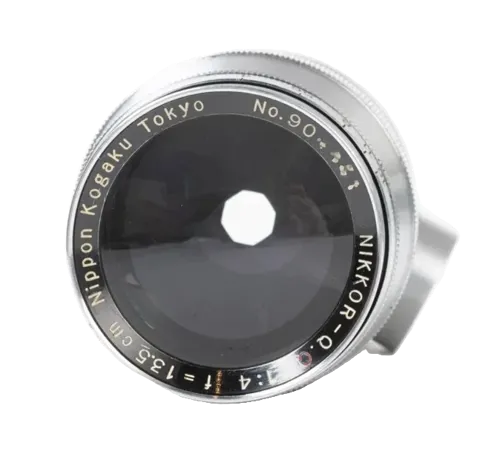
An early postwar Japanese 135mm f/4 telephoto with a four-element, three-group Tele-Sonnar design, coupled LTM focus and 1.5m close focus.
Nippon-Kogaku Nikkor-Q.C 135mm f/4
LTM mount
No listings tracked for this lens right now.
The Nippon-Kogaku Nikkor-Q.C 135mm f/4 is a LTM-mount lens for Leica rangefinder cameras. Leica price index →
How it compares
Measured against the 23 other 135mm LTM-mount lenses in the catalogue.
Specification
About this lens
Nippon-Kogaku Nikkor-Q.C 135mm f/4
The Nippon-Kogaku Nikkor-Q.C 135mm f/4 is an early postwar Japanese telephoto made for Leica screw-mount rangefinder cameras. Its four-element, three-group optical system is identified by Nikon as a Tele-Sonnar type. The original LTM barrel is rangefinder coupled and focuses to approximately 1.5 metres. A relatively small front optical unit and a physical length shorter than the stated focal length are characteristic of its telephoto construction.
This profile covers the factory Leica-thread lens, historically engraved as 13.5cm f/4 as well as described in modern notation as 135mm f/4. It is separate from the later Nikkor-Q.C 13.5cm f/3.5 and from Nikon S-mount versions of the f/4 lens.
Optical qualities
Rendering
Nikon's published optical account describes a four-element, three-group arrangement with a positive front element, a cemented pair in the centre and a positive rear element. The asymmetrical layout shortens the assembly compared with a conventional long-focus design. Nikon also records some pincushion distortion and lateral chromatic aberration as design tendencies, while measuring distortion at about 0.6 percent in the evaluated lens.
At full aperture, the central image is described as high in resolution with reasonably good contrast. Field curvature shifts best focus toward the front as image height increases, so detail becomes less even near the edges. That behaviour should not be confused with simple overall softness. The centre and outer field respond differently, and film flatness, adapter alignment and optical decentring can change how the transition appears in practice.
At f/4
The 135mm focal length allows a narrow field of view and comfortable working distance for portraits, distant details and compressed landscape compositions. At f/4, subject separation is possible without the bulk of a faster telephoto. Nikon's evaluation associates the open aperture with natural gradation and a gradual background transition. Results still depend on focus accuracy, subject distance and the condition of the individual lens.
The coating and internal cleanliness are important to contrast. Haze, cleaning damage or separation can create flare that is not representative of the original design. A properly sized hood is useful in oblique light, although the earliest filter fitting is not generalized because Nikon records a later change to 48mm.
Stopped down
Nikon reports that f/5.6 enlarges the area of useful sharpness, while f/8 to f/11 extends high resolution farther across the frame. At f/16, diffraction reduces overall sharpness. Those findings provide a practical guide, but they come from Nikon's evaluated example and should not be treated as a guarantee for every surviving copy.
Handling and compatibility
The focusing barrel is self-contained and communicates distance to a compatible LTM rangefinder. Many screw-mount bodies do not provide a 135mm viewing field, so an accessory finder may be needed for accurate framing. A mirrorless adapter provides through-the-sensor focusing but does not test the original coupling cam. Infinity focus and rangefinder agreement should therefore be checked independently.
History
Development and Launch
Nikon attributes the design to Saburo Murakami of Nippon Kogaku's optical research organisation. A completion report was issued in autumn 1946, and mass production began in October of that year. Nikon says the company first produced the lens in L mount, then added Nikon S-mount production after the Nikon I camera appeared in 1948. The exact retail launch date is not recorded, although advertisements are documented by October 1949.
The lens belongs to Nippon Kogaku's earliest postwar 35mm rangefinder programme. Nikon's Camera Chronicle confirms that the 135mm f/4 was produced for both Nikon S and Leica screw mount by 1949. This native LTM version should therefore not be described as a later workshop conversion.
Production Evolution
Nikon records an early, unusual filter size followed by a 48mm fitting. The company subsequently developed a faster 135mm f/3.5 and a lighter barrel, creating a successor rather than merely a cosmetic revision of the f/4. The f/4 profile remains separate because its aperture, mechanical presentation and historical role are distinct.
Some early exported lenses carry Made in Occupied Japan markings. That inscription is consistent with the export period from 1947 to 1952, but its presence or absence does not alone establish the complete production sequence. A documented Leitz Auction example is described as a second version from about 1949.
Special Editions/Variants
Factory LTM and Nikon S-mount versions are documented. They share the 13.5cm f/4 identity but use different camera interfaces and coupling systems. This entry is limited to the Leica-thread version. No commemorative edition is established by the consulted sources.
Collector Notes
Identification should combine the Nikkor-Q.C engraving, 13.5cm f/4 specification, original LTM thread and functioning rangefinder cam. Inspect the long focusing helicoid, aperture movement and mount registration. The narrow optical unit should be checked for haze, coating damage, fungus and separation. Filter accessories must match the particular barrel because Nikon records a production change in the fitting.
Occupied Japan engraving is historically informative, but auction language, price and the condition of one lot are not model specifications. A collector description should record markings and barrel details without importing an individual serial number into the general profile.
Sources
Where to buy
Related lenses
Similar lenses you might be interested in
Comments