Best price Used
Canon 135mm f4 Serenar 36074
Sold by Camera West
€69 ≈ $75
A March 1948 Canon Serenar 135mm f/4 scale-focus telephoto with four elements in three groups, uncoupled LTM mounting and 1.52m focus.
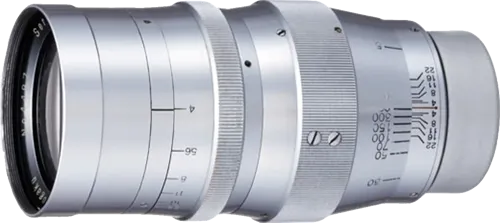
LTM mount
The Canon Serenar 135mm f/4 I is a LTM-mount lens for Leica rangefinder cameras. As of October 2026, it sells from €69 used across 1 listing, with a 30-day median of €69. Leica price index →
Measured against the 23 other 135mm LTM-mount lenses in the catalogue.
The Canon Serenar 135mm f/4 I is an early Japanese telephoto and Canon's first interchangeable lens in this focal-length programme. It uses four elements in three groups and was marketed in March 1948 in Canon's S screw mount. The focusing system is not coupled to the camera rangefinder, so distance must be set from the engraved scale or with an independent focusing aid.
Canon specifies a 1.52-metre minimum focusing distance, a 40mm filter fitting, an f/16 minimum aperture and a weight of 580g. Dimensions and diaphragm blade count are not provided. This profile remains separate from the coupled Type II introduced in June 1948 because focusing operation is central to the lens's identity.
Rendering
Canon publishes a four-element, three-group block diagram for the Type I. No controlled period test of the exact uncoupled version has been located, so the entry avoids fixed claims about sharpness, contrast, distortion or bokeh. Its optical count should not be used to transfer the performance of the later f/3.5 line.
At 135mm, the field of view is narrow and suitable for portraits and distant details. Camera position determines perspective, while the long focal length permits selective framing from farther away. Coating condition, haze, element separation and previous disassembly can have a large effect on surviving examples.
At f/4
The lack of rangefinder coupling is most important at full aperture and near the 1.52m limit, where depth of field is limited. Estimating distance by eye may be adequate for distant subjects or when stopped down, but close work benefits from an accessory rangefinder, measured distance or direct sensor focus on an adapted digital camera.
The diaphragm blade count is unknown, so no particular highlight shape is claimed. A hood can reduce veiling light, but condition problems such as internal haze cannot be corrected by accessories. Focus accuracy should be evaluated independently of optical contrast.
Stopped down
Closing the aperture increases depth of field and makes scale focusing more forgiving. Canon provides settings to f/16. Hyperfocal or depth-of-field markings can assist with distant work if the scale and infinity position remain accurate, but they do not replace calibration at close distance.
Handling and compatibility
The 580g barrel should be supported when fitted to an early screw-mount body. A 135mm finder is needed for framing on cameras without a matching field. The 40mm filter fitting differs from the later f/3.5 family's 48mm thread.
The native S thread is Leica-standard LTM in the marketed version, but the rear has no coupling cam. An LTM-to-M adapter provides mechanical mounting only and cannot create rangefinder coupling. Mirrorless adaptation is especially useful because magnified live view supplies direct focus. The uncoupled operation is an original feature, not automatically a fault.
Development and Launch
Canon states that trial production began in 1941, before the company had adopted its later corporate identity. The lens was advertised in the May 1947 issue of the Japanese magazine Kouga. Canon records it as the first interchangeable lens for Seiki Kogaku and dates market introduction to March 1948.
The original trial arrangement used a standard bayonet that Canon changed to its S screw mount before commercial release. Canon also explains that Serenar was chosen through an internal naming contest, drawing on “serene” and the Sea of Serenity. These facts place the lens at the start of Canon's postwar interchangeable-lens range.
Production Evolution
The marketed Type I retained scale focusing without a camera rangefinder connection. Canon followed it in June 1948 with the Type II, adding rangefinder coupling while keeping the four-element, three-group count and 40mm filter size. The operational change justifies separate profiles.
The later f/3.5 line began in December 1952 and used a 48mm front thread. It should not be treated as a faster aperture variant inside this entry. A complete end date for Type I has not been established, and the existence of a 1947 documented example does not define total production.
Special Editions/Variants
The pre-market bayonet construction belongs to development history and is not included in this LTM profile. No commemorative or separately named factory edition has been confirmed. Early Seiki Kogaku engraving differences should be documented without assuming an optical revision.
Collector Notes
Confirm Serenar 1:4 f=135mm engraving, the chrome barrel, 40mm fitting, Leica-standard S thread and absence of a coupling cam. A correctly functioning Type I will not move the camera's rangefinder. Confusing that design choice with mechanical failure can lead to incorrect classification or modification.
Check the distance scale, infinity position, helicoid, aperture and 1.52m near travel. Inspect for haze, fungus, separation, coating wear and signs of optical reassembly. Serial numbers, individual auction condition, accessories, provenance and prices are not generic specifications.
About the usual price. The lowest listing is around the 30-day average.
Over the last 8 weeks the median price for the Canon Serenar 135mm f/4 I has held steady, ranging from €69 to €69 (now €69).
Weekly price (EUR). Median (Good or better) and lowest (Good or better) across 8 weeks. The full figures follow in the table below.
| Week | Median | Lowest |
|---|---|---|
| Aug 17, 2026 | €69 | Unknown |
| Aug 24, 2026 | €69 | Unknown |
| Aug 31, 2026 | €69 | Unknown |
| Sep 7, 2026 | €69 | Unknown |
| Sep 14, 2026 | €69 | Unknown |
| Sep 21, 2026 | €69 | Unknown |
| Sep 28, 2026 | €69 | Unknown |
| Oct 5, 2026 | €69 | Unknown |
Every shop grades differently. Leica Classic uses letters, Ffordes uses E++ and E+, German dealers write "Zustand B", Japanese dealers write A−. We map all of them onto the one ladder below. Where a shop states its own grade, we print it under ours.
As of October 2026, the Canon Serenar 135mm f/4 I sells from €69 used, with a 30-day median of €69, across 1 active listing.
As of October 2026, the Canon Serenar 135mm f/4 I is sold by 1 source (1 listing), from €69 used: all compared cheapest-first on this page.
Similar lenses you might be interested in
Comments