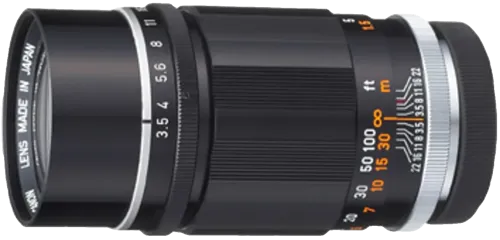
A 1961 Canon 135mm f/3.5 telephoto with four elements in three groups, coupled LTM focusing, 1.5m close focus and a light black barrel.
Canon 135mm f/3.5 III
LTM mount
No listings tracked for this lens right now.
The Canon 135mm f/3.5 III is a LTM-mount lens for Leica rangefinder cameras. Leica price index →
How it compares
Measured against the 23 other 135mm LTM-mount lenses in the catalogue.
Specification
About this lens
Canon 135mm f/3.5 III
The Canon 135mm f/3.5 III is a late Japanese rangefinder telephoto introduced in January 1961. It combines a four-element, three-group optical system with a black, rangefinder-coupled Leica screw-mount barrel. Canon specifies a 1.5-metre minimum focusing distance, a 48mm filter thread and an f/22 minimum aperture. At 424g, it is substantially lighter than the first chrome 135mm f/3.5.
This profile covers Canon's factory-designated Type III direct-mount rangefinder lens. It remains separate from the 1952 Serenar Type I, the black Type II introduced in 1958, the faster 135mm f/2.5 made for Canon's mirror-box system and later SLR lenses. Similar focal lengths do not make those products mechanically interchangeable.
Optical qualities
Rendering
Canon records four elements in three groups, the same element and group count listed for the preceding f/3.5 versions. Specialist research has found no evidence of a changed optical formula across the three factory designations, while documenting substantial changes in materials and barrel details. The Type III should nevertheless be assessed as its own mechanical version rather than treated as a generic Canon 135mm.
The 135mm focal length gives a narrow field of view on 35mm film, suited to portraits, stage work and distant details. Perspective is determined by camera position, while the narrow field makes distant planes appear visually compressed when compared from the same framing. Sample condition remains important because haze, coating wear, separation or disturbed optical spacing can reduce contrast and fine detail.
At f/3.5
Maximum aperture provides moderate subject separation and requires accurate rangefinder calibration, especially near the 1.5m limit. A modern review of a late black Canon 135mm reports mild halation at long distance at f/3.5 and stronger contrast by f/5.6, while finding good near-focus performance. That test is useful evidence from one lens, not a guarantee for every surviving example.
The exact diaphragm blade count is not stated by Canon's museum record and remains unknown here. Background shape should therefore not be inferred from repeated online specification tables. A hood can be useful with oblique light, but it cannot compensate for internal haze or coating damage.
Stopped down
Closing the aperture increases depth of field and generally improves consistency across the frame. Canon specifies settings through f/22. Middle apertures are appropriate when more of a portrait or distant scene must remain defined, while diffraction increasingly limits the finest detail at the smallest settings.
Handling and compatibility
Canon lists dimensions of 54 by 97mm and a weight of 424g. The 48mm front thread accepts filters and appropriate hoods. On the late barrel, focusing rotates the front assembly and aperture ring, so a polarising filter must be readjusted after focus changes. Setting the aperture before final focusing can also be more convenient.
The original LTM cam should couple on a calibrated screw-mount rangefinder. Many bodies need a dedicated 135mm finder or appropriate built-in frame. An LTM-to-M adapter provides mounting on Leica M bodies but cannot correct an inaccurate cam. Live view on an adapted digital camera permits direct focus evaluation.
History
Development and Launch
Canon's 135mm f/3.5 rangefinder line began with the heavy chrome Serenar introduced in December 1952. The company followed it with a black Type II in April 1958 and marketed the Type III in January 1961. The final designation belongs to Canon's mature screw-mount rangefinder period, alongside the Canon 7 generation of cameras.
Canon's Camera Museum gives the Type III's original construction, dimensions, weight and launch month. Those specifications establish a direct-mount 135mm telephoto rather than the separate M135 reflex lens intended for a mirror box.
Production Evolution
The recorded optical count remained four elements in three groups, while the barrel became progressively lighter. The first f/3.5 weighs 565g, compared with 424g for the Type III. Specialist references describe the later versions as changes in materials, finish and structure rather than a documented optical recalculation.
Collector literature identifies two minor production forms within the Type III and additional forms across the wider f/3.5 family. Those subtypes concern engraving and construction details. They do not require separate LeicaLensList optical profiles, and individual serial ranges are deliberately omitted.
Special Editions/Variants
No commemorative edition of the Type III has been documented. Minor engraving differences within the factory designation are production variants rather than special editions. The earlier Types I and II remain separate profiles because Canon marketed them as distinct versions with materially different barrels and weight.
Collector Notes
Identification should combine the Canon 135mm 1:3.5 engraving, late black barrel, 48mm thread, 54 by 97mm dimensions and original coupled LTM mount. Confirm that it is the direct rangefinder lens rather than an optical head or reflex-mount product. The front assembly should rotate smoothly without looseness.
Test cam agreement at infinity, intermediate distance and near 1.5m. Inspect for haze, fungus, separation, coating wear and signs of incorrect reassembly. The aperture should move evenly to f/22. Serial numbers, included finders, cases, auction condition and sale prices are not generic model data.
Sources
Where to buy
Related lenses
Similar lenses you might be interested in
Comments