Best price Fair
Canon 135mm f/3.5 L39 LTM Leica Thread Mount Lens
Sold by Five Star Camera
€86 ≈ $93
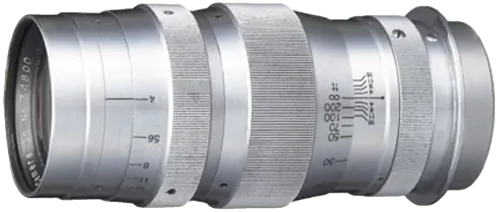
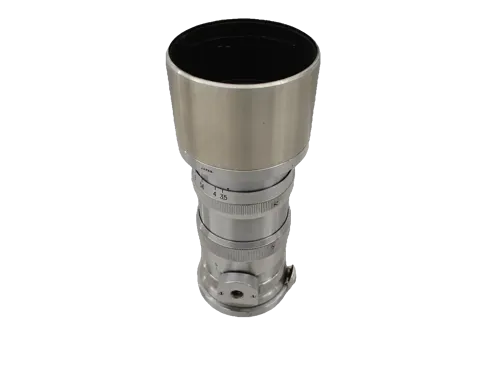
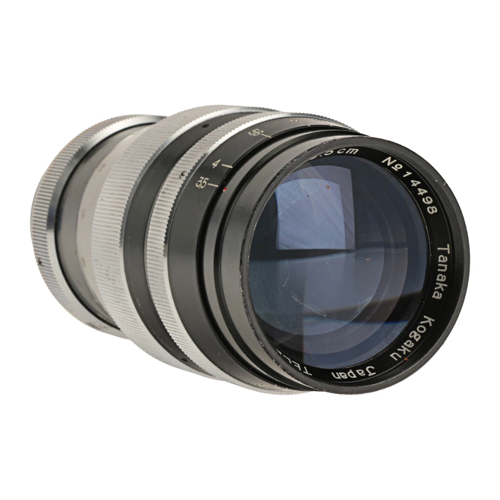
The Canon 135mm f/3.5 II is an all-black LTM screw-mount telephoto from 1958, a light, sharp and affordable rangefinder lens collectors still favor.
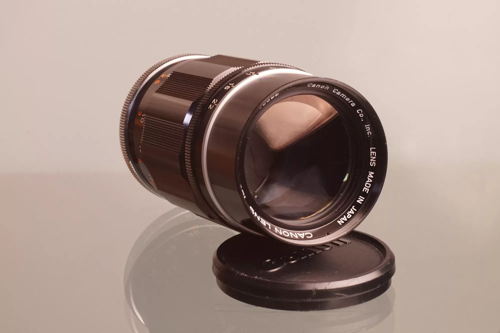
LTM mount
The Canon 135mm f/3.5 II is a LTM-mount lens for Leica rangefinder cameras. As of October 2026, it sells from €86 used across 1 listing, with a 30-day median of €86. Leica price index →
Measured against the 23 other 135mm LTM-mount lenses in the catalogue.
The "II" is the all-black evolution of Canon's long-running 135mm f/3.5 rangefinder telephoto, a lens whose simple four-element optical layout stayed essentially unchanged across the many cosmetic variants Canon issued over its production life [1][2]. Canon's own museum lists this version as marketed in April 1958 at 27,000 yen, built in four elements across three groups, and weighing 438 g, figures that mark it as one of the later, weight-conscious black-finish iterations rather than the earlier heavy chrome examples [4]. The optical formula is credited to Canon lens designer Jirou Mukai and was carried forward through the series with only visual changes, so the various 135mm f/3.5 lenses are regarded as optically identical. Because telephoto lenses sit at the edge of what a rangefinder can comfortably handle, the 135mm length is something of a specialist tool, useful for picking architectural details and distant subjects out of a wider scene.
Construction is all metal, with a black lacquer finish and matte silver accents, and the barrel is solid with smooth focus and a firmly clicking aperture ring. The diaphragm uses ten blades, which gives rounded out-of-focus highlights, and the click stops are firm enough that one source recommends holding the focus collar when changing apertures so the focus does not shift [3]. The lens predates double-helicoid barrels, so the front element and aperture ring rotate as the lens is focused, which makes polarizers awkward and encourages setting the aperture before focusing. The focus throw is very long, close to a full turn, apparently a deliberate choice to aid precise rangefinder alignment at this focal length. As an LTM screw-mount lens it is rangefinder coupled and mounts on a Leica M body through a standard M39-to-M adapter, focusing through the optical rangefinder like any native lens; accurate focusing of a 135mm is helped by a higher-magnification finder, an auxiliary magnifier, or live view on later digital bodies. Some examples are also canted slightly toward the viewfinder so the distance scale can be read while shooting.
Across the series Canon is reported to have made around eight versions over roughly two decades, with differences limited to the change from silver to black barrels, reductions in weight, engraving on the front ring, and distance-scale markings rather than to the optics. The black "II" sits among these later variants. Peter Kitchingman's reference work on Canon's M39 rangefinder lenses is the standard source for distinguishing the individual versions and their production details.
Rendering Reviewers describe a neutral, predictable rendering without a strong signature character, which suits photographers wanting an honest performer rather than a stylized one. Contrast is moderate and true to life, lower than a modern lens but capable of deep blacks and clean highlights in contrasty scenes.
Sharpness The lens is reported as sharp across the frame, a little soft wide open at f/3.5 but reaching its best from about f/5.6, where one reviewer rated it competitive with Leica's own 135mm Tele-Elmar-M and Telyt-M designs. Near-focus performance is described as excellent even wide open, while at long distances it shows mild halation at f/3.5 that clears as the lens is stopped down.
Flare resistance Users report that the lens holds contrast well and does not flare badly when bright light strikes from the side.
Development and Launch The 135mm f/3.5 line began in the early 1950s as part of Canon's screw-mount Serenar and Canon rangefinder system, with the optical design attributed to Jirou Mukai. The black "II" version recorded by Canon's museum was marketed in April 1958, positioned as a long telephoto within the company's 100mm-and-up rangefinder lens range.
Production Evolution Through a production run of roughly two decades Canon issued about eight variants, all sharing the same four-element, three-group optics; the visible changes were the move from silver to black barrels, lighter construction, revised front-ring wording, and altered distance scales. The "II" represents one of these later, lighter all-black iterations.
Collector Notes The 135mm f/3.5 remains an affordable entry point into Canon LTM glass, with examples trading at modest prices and sometimes appearing with an accessory finder and case worth checking for. Buyers should inspect the glass for haze, fungus and cleaning scratches as with any lens of this age, and confirm that focus and aperture move smoothly. Because the front element rotates during focusing, anyone planning to use filters should account for that, and the heavier chrome f/4 and earlier chrome f/3.5 examples are easily confused with the lighter black versions when shopping. One published account notes the early production date sometimes given as 1952 for the line as a whole; Canon's museum records the black "II" specifically as an April 1958 product.
About the usual price. The lowest listing is around the 30-day average.
Over the last 14 weeks the median price for the Canon 135mm f/3.5 II has fallen, ranging from €86 to €108 (now €86).
Weekly price (EUR). Median (Good or better) and lowest (Good or better) across 14 weeks. The full figures follow in the table below.
| Week | Median | Lowest |
|---|---|---|
| Jun 1, 2026 | €96 | €85 |
| Jun 8, 2026 | €96 | €85 |
| Jun 15, 2026 | €96 | €85 |
| Jun 22, 2026 | €108 | €108 |
| Jun 29, 2026 | €108 | €108 |
| Jul 6, 2026 | €149 | €108 |
| Jul 13, 2026 | €149 | €108 |
| Jul 20, 2026 | €149 | €108 |
| Jul 27, 2026 | €149 | €108 |
| Aug 3, 2026 | €149 | €108 |
| Aug 10, 2026 | €149 | €108 |
| Aug 17, 2026 | €149 | €108 |
| Aug 24, 2026 | €189 | €189 |
| Sep 28, 2026 | €86 | Unknown |
Every shop grades differently. Leica Classic uses letters, Ffordes uses E++ and E+, German dealers write "Zustand B", Japanese dealers write A−. We map all of them onto the one ladder below. Where a shop states its own grade, we print it under ours.
As of October 2026, the Canon 135mm f/3.5 II sells from €86 used, with a 30-day median of €86, across 1 active listing.
As of October 2026, the Canon 135mm f/3.5 II is sold by 1 source (1 listing), from €86 used: all compared cheapest-first on this page.
Similar lenses you might be interested in
Comments