Best price
Leica 13.5cm f4.5 11750
Sold by One Of Many Cameras
€153 ≈ $165
The Leica Elmar 135mm f/4 is an LTM rangefinder telephoto from the 1960s, a Mandler design valued by collectors for its modular Visoflex-compatible head.
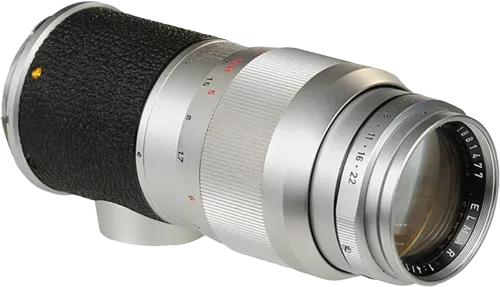
M / LTM mount
The Leica Elmar 135mm f/4 LTM is a M / LTM-mount lens for Leica rangefinder cameras. As of October 2026, it sells from €153 used across 8 listings, with a 30-day median of €187. Leica price index →
Measured against the 31 other 135mm lenses in the catalogue.
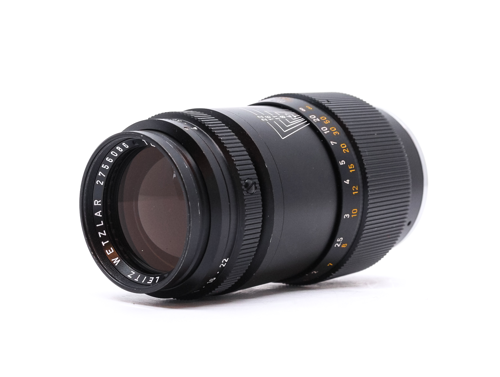
The Elmar 135mm f/4 represents the longest focal length Leitz built to work with a coupled rangefinder, and it marked a clear step forward from the older Hektor 135mm f/4.5 it replaced [1][2]. Designed by Walter Mandler, it used a simple but effective layout of four elements in four groups, and it became the standard Leica long telephoto of the 1960s before later Tele-Elmar designs took over[3]. Production ran from 1960 to 1968, with the lens carrying the inscription ELMAR 1:4/135 LEITZ WETZLAR.
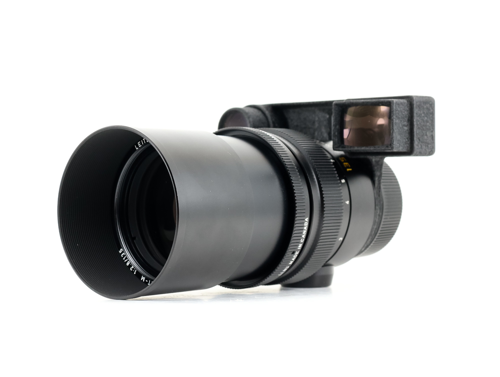
The lens is a substantial all-metal barrel measuring about 123 mm long and 53 mm in diameter, weighing roughly 440 g, built from anodized aluminium with a leatherette focusing grip. It focuses from 1.5 m to infinity, takes E39 filters, and uses a twelve-blade diaphragm running from f/4 to f/22. A distinctive feature is its modular construction: the optical cell unscrews from the focusing mount so the head can be used on the Visoflex reflex housing with a focusing adapter, giving the lens a second life as a short telephoto for close and macro work. The narrow 18-degree angle of view makes accurate framing on a rangefinder demanding, and the matching IUFOO clamp-on hood and an auxiliary finder were offered to help. On the camera the lens is rangefinder coupled, and the chrome two-tone finish is typical of the period.
Sources record the lens in both Leica screw mount and M-bayonet forms, with screw-mount examples far less common than the bayonet version. Collector references differ on the production span and order numbers: the manufacturer-derived data note an end around the mid-1960s and list several order numbers across the M and screw variants, while LeicaLensList records the screw-mount lens under 11750 with production through 1968. The verified figures take precedence here, and buyers should confirm mount and order number against the specific example.
Rendering Documented impressions of the Elmar 135 come mainly from user reports rather than formal test data. Reviewers describe it as a sharp performer wide open, with resolution improving only marginally on stopping down, and good results achievable even at f/4. Its rendering is often praised for portraiture, where it treats skin tones gently and separates a head from a blurred background, a character several users attribute to the Mandler-era design rather than to clinical modern sharpness. Because the maximum aperture is f/4, the lens is comparatively slow, but in landscape, detail and aviation work that is rarely a limitation, and a tripod is commonly used to extract the best results.
Development and Launch The Elmar 135mm f/4 arrived in 1960 as Leitz's improved replacement for the Hektor 135mm f/4.5, offering a more modern optical formula while remaining the longest lens that could still be focused with the rangefinder. It was offered in both Leica screw and M-bayonet mounts and slotted in as the standard long telephoto in the M-system lineup, later giving way to the Tele-Elmar 135mm f/4.
Production Evolution The lens was produced through the 1960s with its distinctive removable optical head, allowing the same cell to serve on the Visoflex via a focusing adapter. Surviving serial-number records show production concentrated in the early 1960s and split between M-bayonet and screw-mount examples, with bayonet versions far outnumbering screw ones.
Collector Notes The lens is widely regarded as an affordable entry into vintage Leica telephotos, with usable examples often selling well below the cost of later 135 mm Leica optics. Buyers should confirm that the unscrewing front cell is present and undamaged, since the Visoflex-compatible head is integral to the design, and should check focus smoothness and the diaphragm action. Original accessories such as the IUFOO hood, the front cap and the clear plastic dome keeper add to a clean example, and the chrome two-tone finish should be checked for wear consistent with the lens's age.
Good time to buy. The lowest listing is 18% below the 30-day average.
Lowest price Click a mark to open that listing · arrow keys to step, Enter to open
Price against condition for 8 listings of Leica Elmar 135mm f/4 LTM, €153 to €398, median €187. Mint: 1 at €213. Good: 2 at €156, €187. Fair: 1 at €187. Unknown: 4 at €153, €156, €259, €398. The full table follows.
| Condition | Lowest | Median |
|---|---|---|
| Mint | €213 | €213 |
| Good | €156 | €171 |
| Fair | €187 | €187 |
| Other | €153 | €207 |
Over the last 18 weeks the median price for the Leica Elmar 135mm f/4 LTM has risen, ranging from €158 to €191 (now €187).
Weekly price (EUR). Median (Good or better) and lowest (Good or better) across 18 weeks. The full figures follow in the table below.
| Week | Median | Lowest |
|---|---|---|
| Jun 1, 2026 | €158 | €158 |
| Jun 8, 2026 | €158 | €158 |
| Jun 15, 2026 | €158 | €158 |
| Jun 22, 2026 | €158 | €158 |
| Jun 29, 2026 | €158 | €158 |
| Jul 6, 2026 | €189 | €159 |
| Jul 13, 2026 | €159 | €159 |
| Jul 20, 2026 | €175 | €159 |
| Jul 27, 2026 | €175 | €159 |
| Aug 3, 2026 | €163 | €159 |
| Aug 10, 2026 | €177 | €159 |
| Aug 17, 2026 | €177 | €159 |
| Aug 24, 2026 | €177 | €159 |
| Aug 31, 2026 | €177 | €159 |
| Sep 7, 2026 | €177 | €159 |
| Sep 14, 2026 | €191 | €159 |
| Sep 21, 2026 | €191 | €159 |
| Sep 28, 2026 | €187 | €156 |
Every shop grades differently. Leica Classic uses letters, Ffordes uses E++ and E+, German dealers write "Zustand B", Japanese dealers write A−. We map all of them onto the one ladder below. Where a shop states its own grade, we print it under ours.
As of October 2026, the Leica Elmar 135mm f/4 LTM sells from €153 used, with a 30-day median of €187, across 8 active listings.
As of October 2026, the Leica Elmar 135mm f/4 LTM is sold by 4 sources (8 listings), from €153 used: all compared cheapest-first on this page.
Similar lenses you might be interested in
Comments