Best price Fair
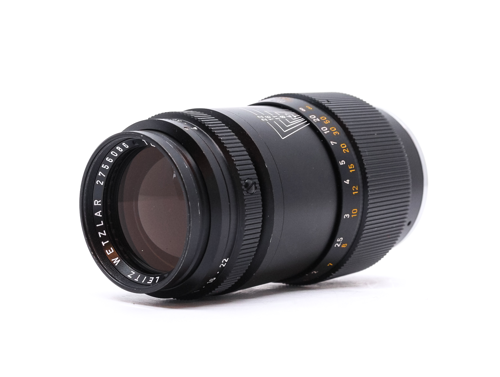
Leica 135mm f4 Elmar (11850)
Sold by Kamerastore
€101 ≈ $109
The Leica Elmar 135mm f/4 is a Walter Mandler four-element telephoto for the M mount, prized by collectors as an affordable, sharp rangefinder long lens.
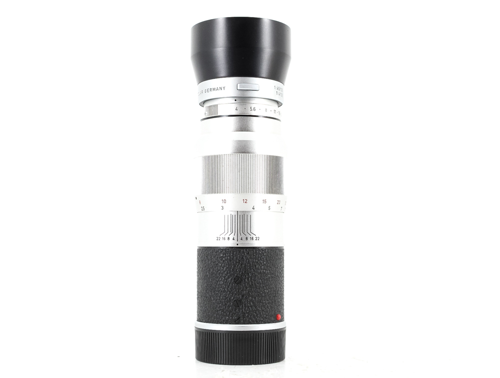
M mount
The Leica Elmar 135mm f/4 M is a M-mount lens for Leica rangefinder cameras. As of October 2026, it sells from €101 used across 7 listings, with a 30-day median of €1,458. Leica price index →
Measured against the 8 other 135mm M-mount lenses in the catalogue.
Among Leica's longest rangefinder-coupled focal lengths, the Elmar 135mm f/4 holds an unusual place: it is one of the most capable yet least expensive M lenses on the used market, frequently described by reviewers as a sleeper bargain [1][2]. Designed by Walter Mandler and introduced in 1960, it replaced the older Hektor 135mm f/4.5 with an improved four-element optical formula and represented the longest focal length that could still be used with the coupled rangefinder before the system reached the limits of accurate focusing[3]. The lens carries the classic Elmar engraving, ELMAR 1:4/135 LEITZ WETZLAR, and was built in clear-anodized aluminium with a leatherette grip.
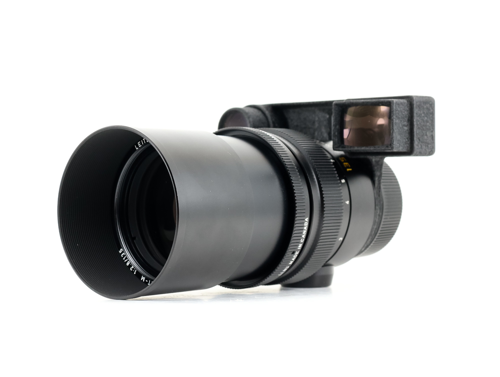
Optically the lens uses a simple four-element, four-group arrangement with a twelve-blade diaphragm, an unusually high blade count that gives a near-circular aperture. A defining feature is its detachable optical cell: the lens head unscrews from the focusing mount so it can be fitted, via a focusing adapter, to the Visoflex reflex housing and bellows for close-up and near macro work. As a standard rangefinder lens it focuses to 1.5 m, takes 39mm (E39) filters, and accepts the dedicated clamp-on hood. The barrel is long and grows longer still toward infinity, and at roughly 405 g it is substantial but manageable. Because the 135mm frame is the smallest and narrowest in the M finder, with a diagonal angle of view of about 18 degrees, accurate framing and focusing on a rangefinder body is demanding; users widely note that the lens is far easier to focus on live-view digital bodies or mirrorless cameras with magnification or an EVF.
The lens was produced in both Leica screw mount (LTM/M39) and M bayonet, with the M bayonet version far more common; the screw-mount copies can be adapted to M bodies and also used on screw-thread Leicas. Catalogued model numbers include 11850, 11950 and 11951, the latter sometimes cited as a lens-head-only configuration. The serial number is engraved on both the focusing mount and the optical head, which matters because the detachable design occasionally led to mis-matched head-and-mount pairings after third-party servicing; on a film rangefinder this can affect focus calibration, though it is far less of a concern on live-view digital cameras where focus is confirmed visually. The lens predates Leica's 6-bit coding system and is not factory coded [4].
Rendering Reviewers consistently report that the Elmar is sharp at its maximum aperture of f/4 and improves in micro-detail and contrast when stopped down, with f/8 noticeably crisper than wide open[5]. Wide open it can show a gentle "vintage glow" and lower contrast that some photographers value for portrait and cinematic looks, while stopping down tightens definition for more critical work. The lens renders a shallow depth of field at its 1.5 m close-focus distance for an f/4 telephoto. Glare and flare can appear in strong or off-axis light, contributing to the older, lower-contrast character noted by users. Overall the optical reputation is strong for the era and price, though it does not match the contrast and corrections of Leica's later 135mm designs.
Development and Launch The Elmar 135mm f/4 arrived in 1960 as the successor to the Hektor 135mm f/4.5, offering a cleaner four-element design and better definition than the older lens. It was conceived as the longest practical focal length for the coupled rangefinder and was designed by Walter Mandler, the optical engineer responsible for many of Leitz Canada's and Wetzlar's lenses. In the M system the 135mm sits one step beyond the 90mm, with longer focal lengths requiring the Visoflex reflex housing.
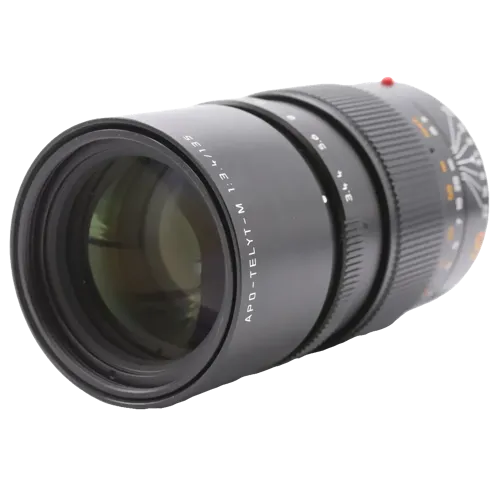
Production Evolution Leica Wiki records production beginning in 1960, split between a small number of screw-mount examples and a much larger quantity of M-bayonet lenses, with serial-number runs spanning the early 1960s. The optical formula remained the four-element, four-group design throughout. The lens was eventually succeeded by the optically different Tele-Elmar 135mm f/4, a five-element telephoto design that should not be confused with this earlier non-tele Elmar; the two share the same name length and aperture but differ in construction, blade count and weight.
Special editions No widely documented factory special editions, military variants or unusual finishes are associated with this lens; it was offered in a standard chrome/silver finish in screw and bayonet mounts. The lens-head-only configuration intended for Visoflex use is the principal variation beyond the mount difference.
Collector Notes Buyers should verify that the serial numbers on the focusing mount and the optical head match, since the detachable head occasionally led to mis-paired units during servicing, which can affect rangefinder focus accuracy. As with most older Leitz lenses, inspect the glass for haze, fungus and cleaning marks, and check the twelve aperture blades for oil. The dedicated hood and the original dome-style hard keeper with cap add to collector value when present. The lens cannot be 6-bit coded, so digital M users who want lens recognition rely on manual selection or aftermarket coding. Used prices remain low relative to most Leica M glass, which is the main reason the lens is regarded as a value entry point into the M telephoto range. Note that some collector references list the production end and weight slightly differently from one another; the figures recorded by LeicaLensList are authoritative for this entry.
Good time to buy. The lowest listing is 93% below the 30-day average.
Lowest price Click a mark to open that listing · arrow keys to step, Enter to open
Price against condition for 7 listings of Leica Elmar 135mm f/4 M, €101 to €1,449, median €208. Excellent: 2 at €208, €394. Good: 1 at €1,449. Fair: 1 at €101. Unknown: 3 at €130, €177, €259. The full table follows.
| Condition | Lowest | Median |
|---|---|---|
| Excellent | €208 | €301 |
| Good | €1,449 | €1,449 |
| Fair | €101 | €101 |
| Other | €130 | €177 |
Over the last 18 weeks the median price for the Leica Elmar 135mm f/4 M has risen, ranging from €159 to €1,486 (now €1,458).
Weekly price (EUR). Median (Good or better) and lowest (Good or better) across 18 weeks. The full figures follow in the table below.
| Week | Median | Lowest |
|---|---|---|
| Jun 1, 2026 | €193 | €161 |
| Jun 8, 2026 | €193 | €161 |
| Jun 15, 2026 | €161 | €127 |
| Jun 22, 2026 | €193 | €161 |
| Jun 29, 2026 | €193 | €161 |
| Jul 6, 2026 | €212 | €139 |
| Jul 13, 2026 | €161 | €139 |
| Jul 20, 2026 | €187 | €127 |
| Jul 27, 2026 | €161 | €139 |
| Aug 3, 2026 | €159 | €139 |
| Aug 10, 2026 | €161 | €127 |
| Aug 17, 2026 | €161 | €127 |
| Aug 24, 2026 | €216 | €129 |
| Aug 31, 2026 | €304 | €139 |
| Sep 7, 2026 | €304 | €139 |
| Sep 14, 2026 | €394 | €212 |
| Sep 21, 2026 | €394 | €211 |
| Sep 28, 2026 | €394 | €208 |
Every shop grades differently. Leica Classic uses letters, Ffordes uses E++ and E+, German dealers write "Zustand B", Japanese dealers write A−. We map all of them onto the one ladder below. Where a shop states its own grade, we print it under ours.
As of October 2026, the Leica Elmar 135mm f/4 M sells from €101 used, with a 30-day median of €1,458, across 7 active listings.
As of October 2026, the Leica Elmar 135mm f/4 M is sold by 4 sources (7 listings), from €101 used: all compared cheapest-first on this page.
Similar lenses you might be interested in
Comments