Best price Used
Leica Camera AG Leica APO-TELYT-M 135mm f/3.4
Sold by Foto Ottica Cavour
€1,988 ≈ $2,147
The Leica APO-Telyt-M 135mm f/3.4 is the longest M-mount rangefinder lens, an apochromatic telephoto prized by collectors for its compact size and resolution.
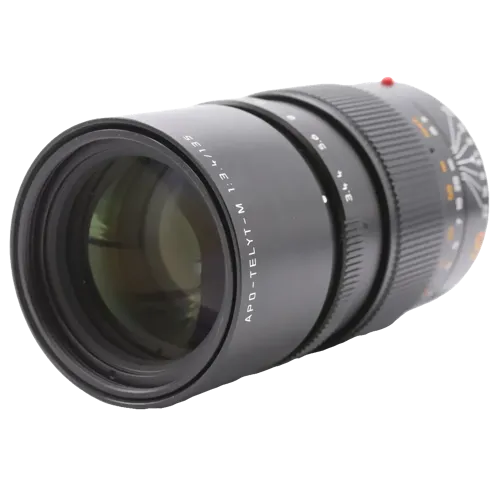
M mount
The Leica APO-Telyt-M 135mm f/3.4 is a M-mount lens for Leica rangefinder cameras. As of October 2026, it sells from €1,988 used across 8 listings, with a 30-day median of €2,747. Leica price index →
Measured against the 8 other 135mm M-mount lenses in the catalogue.
This lens occupies a singular spot in the Leica M catalogue: it is the longest focal length offered for the rangefinder system, yet at the same time the shortest member of the APO-Telyt family, and the only one of that family still in production [1][3]. Introduced in 1998, it replaced the earlier 135mm Elmarit-M f/2.8 and Tele-Elmar-M f/4 as the premium long option for the M, trading outright aperture speed for apochromatic correction and a notably compact, well-balanced barrel. With an aperture of f/3.4 it is not fast, but it was designed to deliver high contrast, resolution and color fidelity through extensive correction of chromatic aberration.
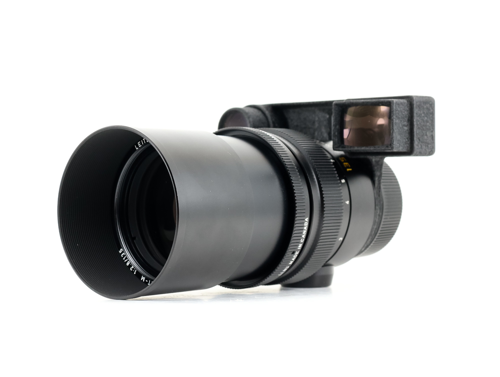
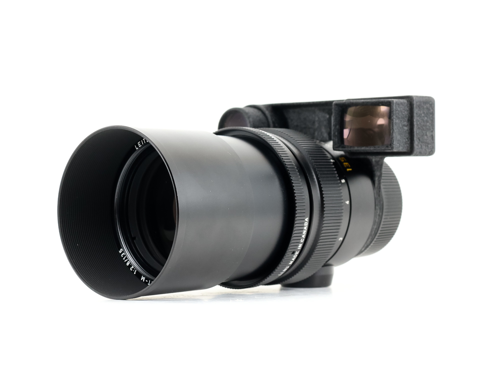
The optical formula uses five elements in four groups, and the lens carries a built-in telescopic hood and an internal E49 filter thread [2]. The aperture runs from f/3.4 to f/22 with click stops and intermediate half values, controlled by a preset manual diaphragm, and the barrel is made of anodized aluminum. Focusing extends from a minimum distance of 1.5 m to infinity, typical of 135mm rangefinder lenses, and the focus ring throw is relatively short at roughly 120 degrees, which speeds focusing at the cost of fine precision [4]. The lens is rangefinder coupled and the barrel does not block the 135mm frame line area in the M finder, although accurate composition at this focal length is inherently demanding and is helped considerably by an electronic finder or live view on newer digital M and SL bodies. The inscription reads APO-TELYT-M 1:3.4/135, and it carries Leica order number 11889.
Leica did not initially fit the lens with six-bit coding. After the question was raised at Photokina 2012, the company began manufacturing it with the code and offered to retrofit coding to lenses bought after September 2012, treating the omission as an oversight to be corrected[5]. As a result, both uncoded earlier examples and later coded examples exist, which is a point worth confirming when buying. Production has been comparatively limited; collector serial-number records compiled from known lenses and Erwin Puts's data point to roughly 4,500 units made across the first several years, in modest annual batches.
Rendering Reviewers consistently rate this as one of the highest-resolving lenses in the M system. One long-term user described its ability to resolve detail as among the best of any Leica M lens owned, with well-balanced contrast that is neither overly harsh nor washed out, and color rendering regarded as a strength of the apochromatic design. The character is precise and clinical rather than soft.
Sharpness It shows good across-frame resolution already at f/3.4, with contrast improving slightly by f/4 and corners and overall performance becoming really good by f/5.6.
Bokeh and transitions The background blur is regarded as only average. The moderate f/3.4 aperture limits the quantity of blur, so backgrounds can appear somewhat restless outside of close-up subjects, although the telephoto framing helps keep harsh double-line effects in check.
Flare resistance Like many telephoto designs, including its predecessors, the lens is vulnerable to strong flare and lowered contrast when the sun sits just outside the frame, and the retractable hood offers limited help in those cases. Ghosting with the sun inside the frame is not a significant problem.
Distortion and vignetting Distortion is a very small amount of pincushion with little practical relevance.
Aberrations Independent testing found the apochromatic correction of longitudinal chromatic aberration good but not perfect, with one reviewer noting it was not as flawless as some later apochromatic telephotos he had tested, while another reported chromatic aberration in the plane of focus as essentially non-existent.
Digital use The lens works well on full-frame digital M and SL bodies, but framing at 135mm is difficult on cameras that lack a 135mm frame line. Leica omitted the 135mm frame line on the M8 and M8.2 and discouraged use of the lens on those bodies; an electronic viewfinder or live view greatly improves consistent focusing and composition.
Development and Launch The APO-Telyt-M was launched in 1998 as a relatively compact lens that balances well on M cameras, intended for frame-filling portraits at a working distance and for compressed telephoto landscape work. It was positioned as the apochromatic successor to the long 135mm M lenses, the Elmarit-M f/2.8 and Tele-Elmar-M f/4, and as the long end of the M lens range.
Production Evolution The most significant production change was the addition of six-bit coding. Following discussion at Photokina 2012, Leica began producing coded examples and offered retrofitting of the code to lenses purchased after September 2012, so later barrels carry the coding while earlier ones do not.
Special editions No major factory special editions, military or regional variants of this lens are widely documented.
Collector Notes The lens is identified by the inscription APO-TELYT-M 1:3.4/135 and order number 11889. Key points to verify before buying are whether the example is six-bit coded or uncoded, given the retrofit history, and the condition of the built-in telescopic hood and the E49 filter thread. As a limited-production lens of around 4,500 units, serial numbers can be cross-checked against published collector ranges.
Good time to buy. The lowest listing is 28% below the 30-day average.
Lowest price Click a mark to open that listing · arrow keys to step, Enter to open
Price against condition for 8 listings of Leica APO-Telyt-M 135mm f/3.4, €1,988 to €4,584, median €2,773. New: 2 at €4,440, €4,584. Excellent: 5 at €2,005, €2,159, €2,218, €3,329, €3,426. Used: 1 at €1,988. The full table follows.
| Condition | Lowest | Median |
|---|---|---|
| New | €4,440 | €4,512 |
| Excellent | €2,005 | €2,218 |
| Other | €1,988 | €1,988 |
Over the last 18 weeks the median price for the Leica APO-Telyt-M 135mm f/3.4 has fallen, ranging from €2,042 to €3,918 (now €2,747).
Weekly price (EUR). Median (Good or better) and lowest (Good or better) across 18 weeks. The full figures follow in the table below.
| Week | Median | Lowest |
|---|---|---|
| Jun 1, 2026 | €3,918 | €3,426 |
| Jun 8, 2026 | €3,918 | €3,426 |
| Jun 15, 2026 | €3,426 | €2,224 |
| Jun 22, 2026 | €3,918 | €3,426 |
| Jun 29, 2026 | €3,918 | €3,426 |
| Jul 6, 2026 | €3,426 | €3,426 |
| Jul 13, 2026 | €3,426 | €3,426 |
| Jul 20, 2026 | €3,426 | €3,426 |
| Jul 27, 2026 | €3,426 | €3,426 |
| Aug 3, 2026 | €2,225 | €1,983 |
| Aug 10, 2026 | €1,982 | €1,982 |
| Aug 17, 2026 | €3,329 | €1,984 |
| Aug 24, 2026 | €3,329 | €1,984 |
| Aug 31, 2026 | €3,377 | €2,048 |
| Sep 7, 2026 | €3,041 | €1,747 |
| Sep 14, 2026 | €3,236 | €1,747 |
| Sep 21, 2026 | €3,377 | €2,001 |
| Sep 28, 2026 | €3,329 | €2,005 |
Every shop grades differently. Leica Classic uses letters, Ffordes uses E++ and E+, German dealers write "Zustand B", Japanese dealers write A−. We map all of them onto the one ladder below. Where a shop states its own grade, we print it under ours.
As of October 2026, the Leica APO-Telyt-M 135mm f/3.4 sells from €1,988 used, with a 30-day median of €2,747, across 8 active listings.
As of October 2026, the Leica APO-Telyt-M 135mm f/3.4 is sold by 4 sources (8 listings), from €1,988 used: all compared cheapest-first on this page.
Similar lenses you might be interested in
Comments