Best price Fair
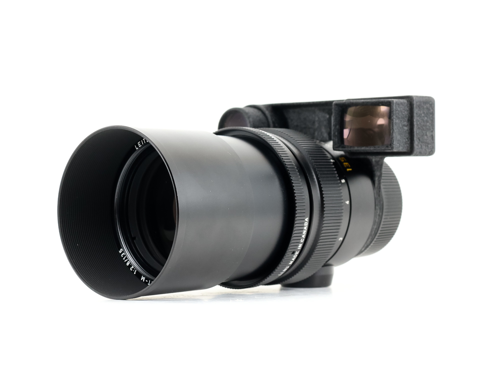
Leica Leitz Tele-Elmar 135mm F/4 M-mount, worn + 12575 lenshood
Sold by Fotohandel Delfshaven
€187 ≈ $202
The Leica Tele-Elmar-M 135mm f/4 Type 1 is an M-mount telephoto valued by collectors as a sharp, affordable Walter Mandler design with a long production run.
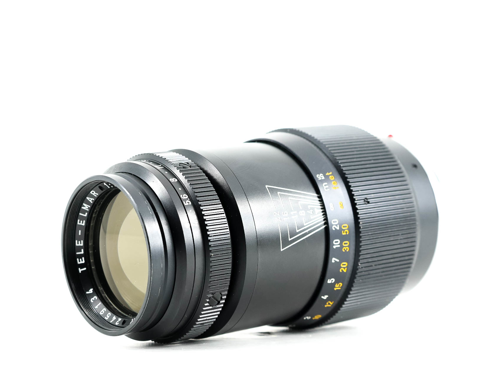
M mount
The Leica Tele-Elmar-M 135mm f/4 Type 1 is a M-mount lens for Leica rangefinder cameras. As of October 2026, it sells from €187 used across 16 listings, with a 30-day median of €395. Leica price index →
Measured against the 8 other 135mm M-mount lenses in the catalogue.
Often described as a sleeper among Leica rangefinder optics, the Tele-Elmar 135mm f/4 was designed by Walter Mandler, one of the most respected lens designers of the twentieth century and the man behind classics such as the Summilux 35mm f/1.4 and the Noctilux 50mm f/1 [2]. Introduced in 1965, the lens used five elements in three groups and replaced the earlier four-element Elmar 135mm f/4, delivering a marked improvement in correction and contrast for the long end of the M lineup [1][3]. Reviewers have noted that the optical formula is essentially a telephoto adaptation of the Sonnar layout, a design tradition with a long following, though this lineage is rarely spelled out in print.
The lens is built from black anodized aluminium and weighs 550 g, with a 39 mm filter thread, a ten-blade diaphragm running from f/4 to f/22, and a minimum focusing distance of 1.5 m. It is rangefinder coupled on the Leica M bayonet, covering a diagonal angle of view of about 18 degrees. A distinctive feature of the earliest examples is that the optical cell unscrews as a separate lens head, allowing the unit to be used on a Visoflex housing with the appropriate focusing mount and extension tubes for reflex and close-range work. The barrel is comparatively long and front-heavy, a handling trait reviewers consistently mention given the lens's telephoto reach on a compact rangefinder body.
The Type 1 carries the Leitz Wetzlar engraving and the order numbers 11851 and 11852, the latter denoting the removable lens head supplied for Visoflex use. Within the long production span Leica made several cosmetic and detail changes rather than optical ones: a red distance scale on the very first 1965 examples, soon replaced by yellow markings, and a shift from a scalloped focusing knurl to an unscalloped style during the 1970s. The optics remained unchanged across the whole run and into the later Tele-Elmar-M (order number 11861), so the various versions share the same imaging cell while differing only in their barrels and finishes. The design proved so durable that no optical revision was deemed necessary across its 33-year production life, until it was superseded by the APO-Telyt-M 135mm f/3.4 ASPH in 1998.
Rendering The Tele-Elmar has a strong reputation for sharpness and clean, neutral rendering that belies its modest price. Despite an unhurried design history, it is widely regarded as one of the better-performing lenses Leica produced at this focal length, with later lab and field comparisons showing its successor offers only marginal gains.
Sharpness Testing on high-resolution digital sensors found the lens already usable across the frame wide open at f/4, improving further by f/5.6. Lateral chromatic aberration and distortion are well controlled.
Bokeh and transitions The out-of-focus rendering is generally described as average rather than exceptional, and longitudinal chromatic aberration is only moderately corrected.
Flare resistance As with many telephoto designs, a light source just outside the frame can produce pronounced flare and reduced contrast, so a hood is helpful; ghosting with the sun within the frame is reported as less of a problem.
Distortion and vignetting Both distortion and vignetting are minimal, which reviewers count among the lens's strengths.
Development and Launch The Tele-Elmar arrived in 1965 as the replacement for the four-element Elmar 135mm f/4, offering a true telephoto construction of five elements in three groups credited to Walter Mandler. It occupied the slow-but-sharp position in the M telephoto range and was praised for matching the rangefinder system's compact ethos better than faster, bulkier rivals.
Production Evolution Leica recorded roughly 28,300 lenses across the combined Tele-Elmar and Tele-Elmar-M production from the mid-1960s through the 1990s. Documented changes were cosmetic and mechanical: red-scale to yellow-scale distance markings in 1965, scalloped to unscalloped focusing knurls in the 1970s, and a later telescoping-hood Tele-Elmar-M barrel, all sharing the original optical cell. The line was discontinued after the 1998 introduction of the APO-Telyt-M 135mm f/3.4 ASPH.
Collector Notes Early Type 1 examples are engraved Leitz Wetzlar and may have removable lens heads intended for Visoflex use, a useful identification point alongside the 11851 and 11852 order numbers. The red-scale first-year examples are the scarcer variant, with only a few thousand made, and command collector interest accordingly. As with any older lens, prospective buyers should check the optics for haze or cleaning marks and confirm that the removable head, when present, seats correctly; an original hood (Leica reference 12585) is a worthwhile accessory given the lens's susceptibility to flare from off-axis light. Note that LeicaLensList records the verified weight as 550 g and length as 105 mm; some collector sources quote slightly different figures for the tapered early barrel, which should be treated as variant-specific rather than contradictory.
Good time to buy. The lowest listing is 53% below the 30-day average.
Lowest price Click a mark to open that listing · arrow keys to step, Enter to open
Price against condition for 16 listings of Leica Tele-Elmar-M 135mm f/4 Type 1, €187 to €552, median €394. Excellent: 7 at €304, €444, €458, €458, €462, €531, €552. Good: 3 at €260, €312, €552. Fair: 3 at €187, €208, €273. Used: 3 at €301, €392, €398. The full table follows.
| Condition | Lowest | Median |
|---|---|---|
| Excellent | €304 | €458 |
| Good | €260 | €312 |
| Fair | €187 | €208 |
| Other | €301 | €392 |
Over the last 18 weeks the median price for the Leica Tele-Elmar-M 135mm f/4 Type 1 has fallen, ranging from €351 to €458 (now €395).
Weekly price (EUR). Median (Good or better) and lowest (Good or better) across 18 weeks. The full figures follow in the table below.
| Week | Median | Lowest |
|---|---|---|
| Jun 1, 2026 | €490 | €444 |
| Jun 8, 2026 | €414 | €290 |
| Jun 15, 2026 | €391 | €290 |
| Jun 22, 2026 | €391 | €290 |
| Jun 29, 2026 | €351 | €264 |
| Jul 6, 2026 | €437 | €264 |
| Jul 13, 2026 | €366 | €264 |
| Jul 20, 2026 | €394 | €264 |
| Jul 27, 2026 | €351 | €264 |
| Aug 3, 2026 | €458 | €259 |
| Aug 10, 2026 | €437 | €259 |
| Aug 17, 2026 | €417 | €264 |
| Aug 24, 2026 | €458 | €264 |
| Aug 31, 2026 | €458 | €264 |
| Sep 7, 2026 | €458 | €264 |
| Sep 14, 2026 | €458 | €264 |
| Sep 21, 2026 | €458 | €264 |
| Sep 28, 2026 | €458 | €260 |
Every shop grades differently. Leica Classic uses letters, Ffordes uses E++ and E+, German dealers write "Zustand B", Japanese dealers write A−. We map all of them onto the one ladder below. Where a shop states its own grade, we print it under ours.
As of October 2026, the Leica Tele-Elmar-M 135mm f/4 Type 1 sells from €187 used, with a 30-day median of €395, across 16 active listings.
As of October 2026, the Leica Tele-Elmar-M 135mm f/4 Type 1 is sold by 3 sources (16 listings), from €187 used: all compared cheapest-first on this page.
Similar lenses you might be interested in
Comments