KMZ Jupiter-11 135mm f/4 LTM is a Soviet Sonnar-type Leica screw-mount telephoto lens for Zorki and LTM collectors.
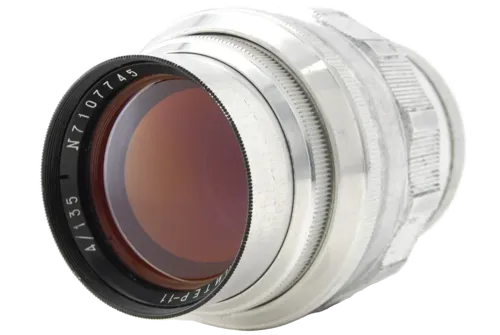
KMZ Jupiter-11 135mm f/4
LTM mount
No listings tracked for this lens right now.
The KMZ Jupiter-11 135mm f/4 is a LTM-mount lens for Leica rangefinder cameras. Leica price index →
How it compares
Measured against the 23 other 135mm LTM-mount lenses in the catalogue.
Specification
About this lens
KMZ Jupiter-11 135mm f/4 LTM
The KMZ Jupiter-11 135mm f/4 LTM is a Soviet long-focus rangefinder lens for Leica screw-mount and Zorki M39 cameras. It uses a four-element, three-group optical formula derived from the Carl Zeiss Sonnar 135mm f/4 design, placing it among the classic Soviet Jupiter lenses connected to postwar Zeiss optical influence [1]. The LTM version is built for the Leica screw-mount register and should not be confused with the M39 Zenit SLR version, which uses the same thread diameter but a different register.
The lens has a slim aluminium alloy barrel, manual focusing, stepless manual aperture control, single-coated optics, and a 40.5 mm front filter thread. FotoUSSR lists the KMZ M39 rangefinder version with a 135 mm focal length, f/4 maximum aperture, 12 aperture blades, 4 elements in 3 groups, 2.5 m minimum focusing distance, M39×1 camera connection, M40.5×0.5 filter thread, and 263 g weight. The physical length changes with focusing, so the 95 mm database value should be read as the shorter lens length, while collector sources also document longer measured lengths depending on focus position, caps, and measurement method[3].
For collectors, the Jupiter-11 is important because it links the Leica-compatible Soviet rangefinder system with the Zeiss Sonnar telephoto tradition. It is capable of good central sharpness and smooth rounded blur, helped by its many aperture blades, but performance depends strongly on sample condition. Haze, cleaning marks, coating wear, internal reflections, stiff helicoids, and poor flare resistance are common points to inspect[4]. For LeicaLensList, this KMZ LTM entry should be kept separate from Contax/Kiev RF, Zenit M39 SLR, M42, Jupiter-11A, Start, Kiev-10, and Kiev-15 versions.
History
Development and Launch
The Jupiter-11 family traces back to the ZK-135, also written as ZK 4/135, with ZK generally understood by collector sources as a Krasnogorsk Sonnar designation. Sovietcams documents very early KMZ ZK-135 examples from 1948 to 1949, followed by ZK Zorki examples from 1949 to 1951, with some early lenses described as using German Zeiss optical glass [2]. The regular KMZ Jupiter-11 name followed around 1950, marking the transition from the ZK naming period to the standardized Jupiter designation.
Production Evolution
Sovietcams lists the KMZ Jupiter-11 LTM / Zorki version under collector reference PT8215, produced from 1950 to 1959. It followed the ZK-135 and ZK Zorki versions and used the Jupiter-11 name on the front ring. Later related production expanded beyond KMZ to KOMZ and other Soviet factories, with versions for Zorki M39, Contax/Kiev RF, M39 SLR, M42, Start, and Kiev automatic bayonet systems.
Special Variants
Important related variants include the ZK-135, ZK Zorki, KMZ Jupiter-11 LTM, KOMZ rangefinder versions, Contax/Kiev RF versions, M39 Zenit SLR versions, M42 versions, Jupiter-11A interchangeable-mount versions, Start bayonet versions, and Kiev-10 / Kiev-15 automatic versions. These variants should not be merged into a single database record, because mount, register, barrel dimensions, focusing behavior, aperture mechanism, and collector value differ.
Collector Notes
Collectors should verify that an M39 example is the rangefinder version rather than the Zenit SLR version. The correct LTM / Zorki rangefinder lens has the Leica screw-mount register, rangefinder coupling, and 2.5 m minimum focusing distance. The M39 Zenit SLR version has a different register and will not focus correctly as a normal Leica screw-mount rangefinder lens. Check the KMZ logo, serial number, red П coating mark, aperture blade count, mount type, focusing action, internal haze, coating marks, oil on blades, and signs of incorrect conversion or mixed parts.
Sources
Where to buy
KMZ Jupiter-11 135mm f/4: frequently asked
What filter size does the KMZ Jupiter-11 135mm f/4 take?
The KMZ Jupiter-11 135mm f/4 takes 40.5 mm screw-in filters (E40.5).
How close does the KMZ Jupiter-11 135mm f/4 focus?
The KMZ Jupiter-11 135mm f/4 focuses down to 2.5 m, and the rangefinder stays coupled over the whole range.
How heavy is the KMZ Jupiter-11 135mm f/4?
The KMZ Jupiter-11 135mm f/4 weighs 263 g, lighter than 73% of the 11 other 135mm LTM-mount lenses in the catalogue.
Which cameras does the KMZ Jupiter-11 135mm f/4 fit?
The KMZ Jupiter-11 135mm f/4 is a Leica screw-mount (M39/LTM) lens. It fits Leica M bodies with a screw-to-M adapter, which keeps rangefinder coupling, and mirrorless cameras with an M39 adapter. It carries no 6-bit code, so select the lens profile by hand on a digital M.
When was the KMZ Jupiter-11 135mm f/4 made?
The KMZ Jupiter-11 135mm f/4 was produced from 1950 to 1959.
Reviews
No reviews yet. Own this lens? Be the first.
Write a review of the KMZ Jupiter-11 135mm f/4Related lenses
Similar lenses you might be interested in
Comments