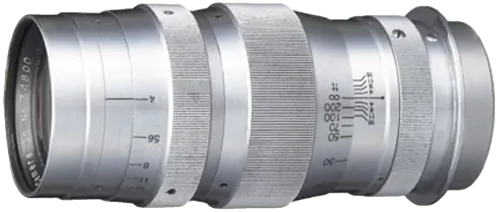
A 1952 chrome Canon Serenar 135mm f/3.5 telephoto with four elements in three groups, original coupled LTM focusing and a 1.5m near limit.
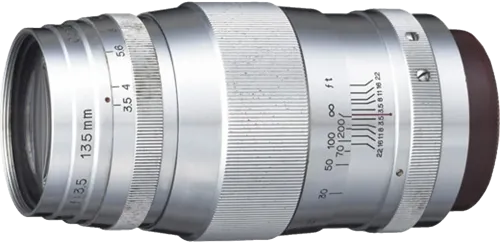
Canon Serenar 135mm f/3.5 I
LTM mount
No listings tracked for this lens right now.
The Canon Serenar 135mm f/3.5 I is a LTM-mount lens for Leica rangefinder cameras. Leica price index →
How it compares
Measured against the 23 other 135mm LTM-mount lenses in the catalogue.
Specification
About this lens
Canon Serenar 135mm f/3.5 I
The Canon Serenar 135mm f/3.5 I is a Japanese rangefinder telephoto marketed in December 1952. It uses four elements in three groups in a substantial chrome, rangefinder-coupled Leica screw-mount barrel. Canon specifies a 1.5-metre minimum focusing distance, a 48mm filter thread, settings through f/22 and dimensions of 56 by 97mm. Its listed weight is 565g.
This entry covers the first factory-designated 135mm f/3.5, carrying the Serenar name during Canon's transition to corporate lens branding. It is distinct from the earlier 135mm f/4 models and from the lighter black Types II and III. Their related optical count does not erase their different marketed identities and barrel constructions.
Optical qualities
Rendering
Canon documents a four-element, three-group construction. Specialist records indicate that this count continued through the later f/3.5 versions and that the main revisions concerned materials and mechanics. No controlled period test for the exact heavy chrome Serenar has been located, so performance claims from a late black lens should not be transferred without qualification.
At 135mm, the field of view is narrow and well suited to portraits, stage subjects and isolated landscape details. The f/3.5 aperture is two-thirds of a stop faster than the preceding f/4 Serenar. Its visible contrast and definition today depend not only on design but also on coating condition, internal cleanliness, optical alignment and correct focusing.
At f/3.5
Depth of field is limited near the 1.5m minimum, making accurate rangefinder coupling important. Calibration should be checked at several distances rather than only at infinity. Camera-body adjustment, cam wear or previous helicoid work can each produce an apparent focus error.
Canon does not state the diaphragm blade count in its surviving online specification. Claims about a particular highlight shape are therefore omitted. A clean, correctly assembled lens should be compared at full aperture and at f/5.6 before residual softness or flare is assigned to the optical design. Haze and cleaning wear can dominate the result in an older lens.
Stopped down
Closing the aperture increases depth of field and ordinarily improves contrast and field consistency. Canon provides settings to f/22. The middle range offers a practical balance between depth and fine detail, while diffraction becomes more visible at the smallest setting.
Handling and compatibility
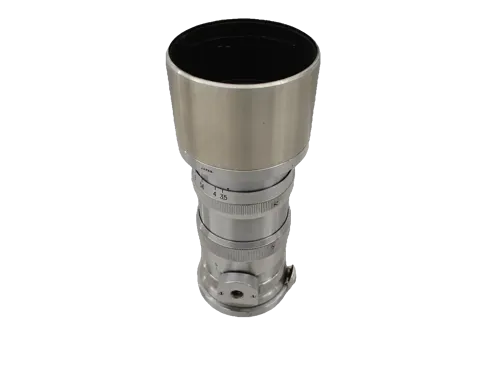
At 565g, the first f/3.5 is heavy for a direct-mount rangefinder lens and benefits from support during mounting and focusing. The 48mm filter thread also accepts the period adapter used with Canon's Series VII hood system. A separate 135mm finder was commonly associated with long Canon rangefinder lenses because many camera bodies lacked a matching frame.
The native coupling cam should work on a calibrated LTM camera. An LTM-to-M adapter can provide the bayonet interface and an appropriate frame where supported, but it cannot repair coupling error. Mirrorless adaptation permits direct sensor focusing and helps separate optical condition from rangefinder adjustment.
History
Development and Launch
Canon introduced its first 135mm lens as an f/4 design during its early postwar interchangeable-lens programme. By December 1952, the company marketed this brighter f/3.5 successor. Canon's Camera Museum records the new aperture, four-element construction, dimensions, weight and close-focus limit.
The lens appeared near the end of Serenar branding. Specialist historical research places the change from Serenar to “Canon Lens” in December 1952, which explains why the Serenar-marked f/3.5 belongs to a brief transition. The existence of later Canon-branded examples does not make the original Serenar engraving an alias without collector significance.
Production Evolution
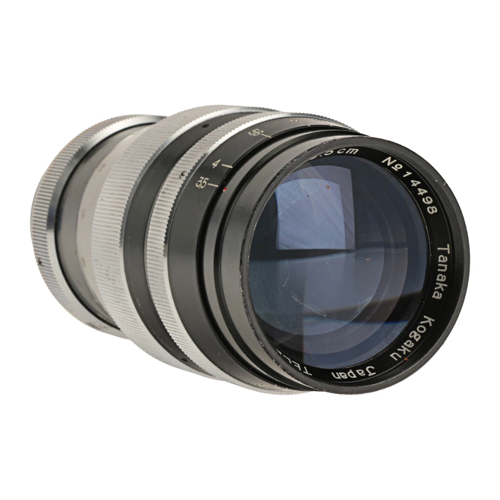
The first version uses a chrome-on-brass construction and is markedly heavier than the later black models. Type II followed in April 1958 with a lighter black barrel, and Type III arrived in January 1961. Canon continued to list four elements in three groups, while dimensions, finish, engraving and structural details changed.
Specialist literature divides the first version into several minor forms. These distinctions can help date and authenticate examples, but no verified optical recalculation accompanies them. Exact production totals and serial ranges are omitted because they are unnecessary for the generic profile.
Special Editions/Variants
No commemorative edition has been documented. Serenar and early Canon-name engraving changes belong to the branding transition. They should be recorded, but a small front-ring change alone does not establish a new optical product. The factory-designated Types II and III remain separate entries because their barrels and weights differ materially.
Collector Notes
Confirm the Serenar 1:3.5 f=135mm engraving, substantial chrome barrel, 48mm thread, original Leica-standard thread and functioning coupling cam. The listed 56mm diameter, 97mm length and 565g weight help separate it from the later black versions. Check that a converted optical head has not been substituted.
Test focus agreement from infinity to the 1.5m near limit and inspect the helicoid for play. Look for haze, fungus, separation, coating wear and cleaning damage. Period hood, finder and case can complete an outfit but are accessories, not defining specifications. Individual serial numbers and current prices are excluded.
Sources
Where to buy
Related lenses
Similar lenses you might be interested in
Comments